
Why Homeowners Need an Independent Cost Estimate
Yes, you should get an independent cost estimate before approving any renovation budget or new-build contract. For most projects with significant scope or involving multiple trades, the answer is not a close call. An independent estimate gives you a “should-cost” baseline built entirely for your benefit, with no contractor incentive attached. It reduces budget overruns, creates an apples-to-apples foundation for comparing bids, and gives lenders and insurers the third-party validation they increasingly require.
Here is when you definitely need one:
- Your project has significant scope or involves more than one trade (plumbing, electrical, HVAC, framing)
- A lender or insurer requires third-party cost validation
- You have received bids that vary widely and cannot tell why
- You are planning a phased renovation and need a defensible total-project budget
For a small cosmetic job, a single contractor’s itemized bid may be enough. Once scope grows, complexity multiplies, and so does your financial exposure.
Pro Tip: Before you contact a single contractor, write down what you want done in plain language. A one-page scope description, even a rough one, gives an independent estimator something concrete to price and prevents you from comparing bids that cover different work.
Table of Contents
- Why homeowners need an independent cost estimate: what it is and the types you’ll encounter
- How an independent estimate is actually prepared
- What you actually gain from commissioning an independent estimate
- What an independent estimate will not do, and how to reduce those risks
- When to commission one and what it typically costs in North America
- How homeowners actually use an independent estimate during a project
- Choosing an independent cost estimator: what to look for and what to avoid
- A practical WBS checklist you can send to any estimator
- Is an independent estimate worth it for homeowners?
- Key Takeaways
- The advisor’s perspective: what homeowners consistently get wrong
- Sources and further reading
Why homeowners need an independent cost estimate: what it is and the types you’ll encounter
An independent cost estimate is an owner-commissioned, third-party assessment that produces a “should-cost” number based on current market data, not on what a contractor needs to make a margin. The estimator works solely for you, which means the output reflects your risk exposure, not theirs.
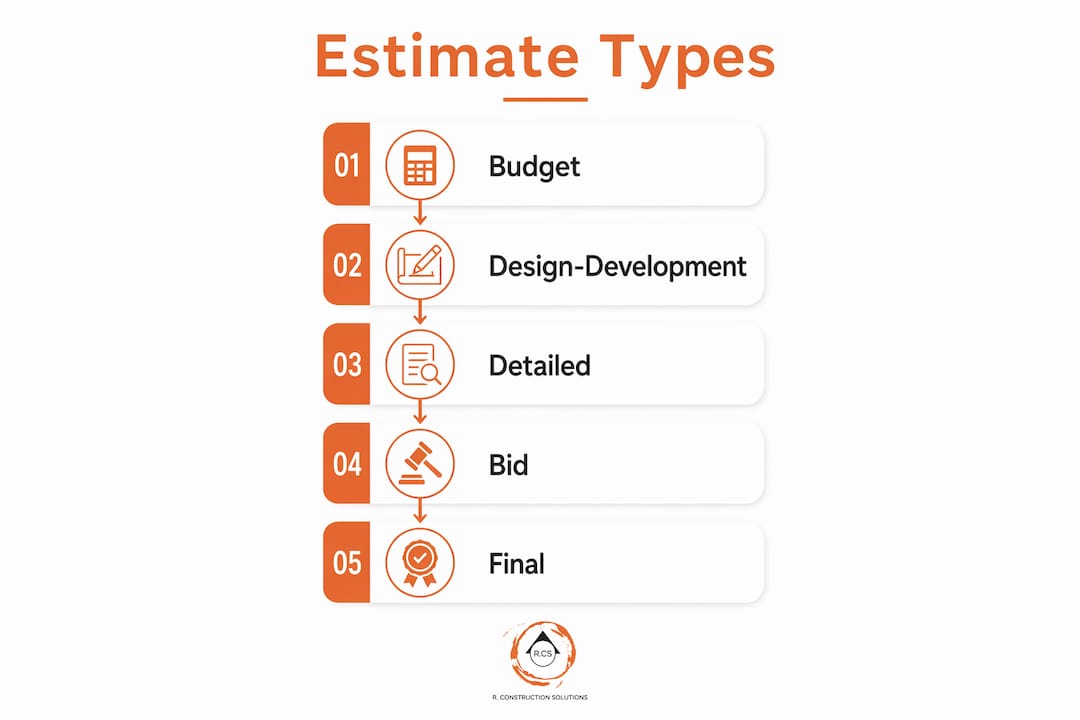
Four estimate types show up most often in residential and light-commercial projects:
- Preliminary (budget) estimate: Prepared early, often from a sketch or concept description. Accuracy varies because scope details are still loose. Useful for go/no-go decisions and early financing conversations.
- Design-development estimate: Produced once schematic drawings exist. Accuracy improves as structural and MEP systems become defined.
- Construction-document estimate: Based on permit-ready drawings and specifications. This is the most precise class and the one lenders and insurers prefer.
- Comparison/validation estimate: Prepared specifically to normalize contractor bids against a common scope baseline, often using a Work Breakdown Structure (WBS) to align line items across multiple proposals.
The estimate type you need depends on where you are in the project, not just how much you want to spend. Commissioning a construction-document estimate before drawings exist wastes money. Relying on a budget estimate to sign a contract exposes you to significant overrun risk.
Each type fits a specific decision point: budget estimates support planning and financing, design-development estimates guide design trade-offs, and construction-document estimates anchor contract negotiations.
How an independent estimate is actually prepared
A qualified estimator follows a disciplined sequence. Understanding the steps helps you confirm that whoever you hire is doing the work correctly, not just producing a number.
- Define scope. The estimator reviews your drawings, specifications, and any existing site conditions. Gaps get flagged before pricing starts.
- Develop a Work Breakdown Structure (WBS). Every element of the project is organized into discrete, priced line items. A WBS makes scope explicit and shifts you from passive bid recipient to informed manager who can compare line items across contractors.
- Perform quantity takeoff. The estimator measures and counts every material, assembly, and labor unit from the drawings.
- Apply unit rates. Costs are assigned using current pricing databases, local supplier quotes, and subcontractor rates. Current pricing databases matter because input prices and regional labor conditions change rapidly and a stale database can skew results by tens of thousands of dollars.
- Apply location and productivity factors. Labor productivity, local wage rates, and regional material costs are layered in. A project in Chicago prices differently than the same scope in Phoenix.
- Run sensitivity and risk analysis. The estimator models how the total changes if key assumptions shift, such as lumber prices rising 10% or a subcontractor rate coming in higher than expected. Sensitivity analysis converts qualitative risk into quantifiable budget levers and should be part of any independent estimate deliverable.
- Document assumptions and exclusions. Every item not included is listed explicitly. This is the section most homeowners overlook and the one that causes the most disputes.
Pro Tip: Ask your estimator to show you the assumptions section before you accept the deliverable. If it is missing or vague, the estimate is incomplete regardless of how detailed the line items look.
What you actually gain from commissioning an independent estimate
The benefits are concrete and measurable, not theoretical.
- Budget accuracy with right-sized contingency. A professional estimate sizes your contingency to match actual risk, not a generic 10% rule of thumb. Best practice calls for a contingency reserve calibrated to scope complexity and market conditions.
- Negotiation leverage. When you walk into a contractor conversation with a documented should-cost model, you are negotiating from data, not instinct. Bid gaps become a conversation about scope differences rather than a guessing game.
- Lender and insurer confidence. An independent estimate acts as a strategic asset that validates your budget for lenders and clarifies cash flow needs across the project lifecycle. Many construction lenders require third-party cost validation before releasing draw funds.
- Reduced dispute risk. Documented assumptions and a line-item WBS give you a clear reference point when a contractor proposes a change order. You can evaluate whether the change is legitimate or whether it reflects scope that was always in the original contract.
- Downstream savings. Catching a scope gap or an inflated allowance before you sign a contract costs nothing. Catching it after construction starts can mean project stoppage, redesign fees, and renegotiated contracts.
“Independent cost consultants work solely for the owner, providing objective, data-driven oversight that helps move cost risk upstream before decisions harden.” — CCS
What an independent estimate will not do, and how to reduce those risks
Candor matters here. An independent estimate is only as good as the inputs it is built on.
- Scope gaps create pricing gaps. If your drawings are incomplete, the estimate will include assumptions. Those assumptions may not match what your contractor prices. Always finalize scope before commissioning a construction-document estimate.
- Allowances shift risk to you. Construction allowances for cabinets, appliances, and fixtures transfer selection risk directly to you. If you choose finishes above the allowance, you pay the overage plus the contractor’s markup on it. Require your estimator to flag every allowance and state the markup rate.
- Stale pricing data erodes accuracy. An estimate prepared six months before procurement can be materially off if material prices have moved. Refresh pricing close to the bid date, especially for lumber, steel, and mechanical equipment.
- Regional variance is real. A national cost database is a starting point, not a final answer. Require your estimator to source at least some local subcontractor quotes to ground the numbers.
Pro Tip: If your project timeline stretches beyond three months from estimate to procurement, ask for an escalation factor in the deliverable. An annual escalation assumption on materials is a reasonable starting point in most North American markets, but your estimator should confirm current local conditions.
Mitigations are straightforward: update pricing near procurement, require a line-item WBS, insist on a documented assumptions section, and ask for at least one sensitivity run showing a high-cost scenario.

When to commission one and what it typically costs in North America

Timing and fee expectations, side by side:
| Project stage | Estimate type | Typical accuracy | Typical fee range | Turnaround |
|---|---|---|---|---|
| Pre-design / concept | Preliminary (budget) | Variable accuracy | Typical fee range | Typical turnaround |
| Schematic design | Design-development | Variable accuracy | Typical fee range | Typical turnaround |
| Permit-ready drawings | Construction-document | Variable accuracy | Typical fee range | Typical turnaround |
| Bid comparison | Validation/normalization | Variable accuracy | Typical fee range | Typical turnaround |
Fee ranges reflect scope complexity, location, and deliverable detail. Professional estimating fees typically run as a small percentage of construction cost. On a renovation, that is a fraction of what a single undetected scope gap can cost.
For projects with significant scope or involving multiple trades, commission a budget estimate before design starts and a construction-document estimate before you sign a contract. Those two checkpoints catch the most expensive mistakes.
How homeowners actually use an independent estimate during a project
Knowing you need one is different from knowing how to deploy it. Here are the most common use cases and the owner actions that make each one work.
- Financing approval. Deliver your permit-ready drawings and the independent estimate to your lender together. Ask the estimator to format the deliverable to match the lender’s draw schedule so the two documents align.
- Contractor bid comparison. Send the WBS from your independent estimate to every contractor bidding the job. Ask each contractor to price against the same line items. Bid variance often reflects scope differences rather than overcharging. A shared WBS makes those differences visible.
- Value-engineering workshop. Use the line-item estimate to identify the highest-cost assemblies. Ask your contractor which substitutions reduce cost without reducing function. This conversation is far more productive when both parties are looking at the same numbers.
- Change-order pricing. When a contractor submits a change order, compare the proposed cost against the unit rates in your independent estimate. A change order with a significant variance from your estimate deserves a line-item explanation.
- Contingency stress test. Run the sensitivity analysis your estimator prepared. If the high-cost scenario exceeds your financing limit, you need to either reduce scope or secure additional funds before construction starts, not during it.
Pro Tip: Use the independent estimate as a reference document, not a weapon. Telling a contractor “my estimator says you’re wrong” damages the relationship. Instead, say “help me understand the difference between your line item and this benchmark.” That framing keeps the conversation collaborative.
Procurement checklist to keep handy:
- Confirm every contractor is bidding the same WBS line items
- Verify that allowances match across all bids
- Check that each bid states what is excluded
- Compare labor hours, not just total labor cost
- Ask each contractor how they handle scope changes mid-project
Choosing an independent cost estimator: what to look for and what to avoid
Not every estimator who calls themselves independent actually is. Here is how to vet them.
Selection criteria:
- Relevant project experience (residential renovation, new construction, or the specific trade mix your project involves)
- Regional market knowledge and access to local subcontractor pricing
- Sample deliverables that include a line-item WBS, unit rates, documented assumptions, and an escalation approach
- Professional affiliations such as AACE International or the Professional Construction Estimators Association
- References from owners, not contractors
Red flags:
- No documented assumptions section in sample work
- Reliance on a single national database with no local sourcing
- Unwillingness to provide a sample WBS before you hire them
- Fee quoted as a flat number with no explanation of scope or deliverable detail
- Estimator who also does contractor referrals (that is a conflict of interest)
Questions to ask before you hire:
- What data sources do you use, and how current is your pricing?
- Can you show me a sample WBS from a comparable project?
- Do you include sensitivity runs and escalation modeling as standard?
- What is your liability coverage?
- Have you worked with lenders or insurers in this market?
Understanding how estimating software fits into a qualified estimator’s workflow helps you evaluate whether they are using tools to support judgment or to replace it. The best estimators use current databases as a starting point and adjust for local conditions, not the other way around.
Pro Tip: Ask for a sample deliverable from a project similar to yours before you sign anything. A qualified estimator will provide one without hesitation. If they cannot or will not, move on.
A practical WBS checklist you can send to any estimator
Use this as your RFP template or hand it directly to an estimator to standardize what you receive back.
| WBS category | What to request | Why it matters |
|---|---|---|
| Site preparation | Unit cost per SF, scope of clearing/grading | Prevents hidden mobilization costs |
| Demolition | Line-item by assembly (walls, slab, fixtures) | Scope gaps here inflate change orders |
| Structural framing | Labor hours + material by linear/SF | Largest single cost driver on most projects |
| Exterior envelope | Sheathing, weather barrier, cladding separate | Material substitutions are easiest to value-engineer here |
| Roofing | Material type, square footage, flashing detail | Allowances here are frequently underestimated |
| Windows and doors | Unit count, size, specification, hardware | Allowance overruns are common; confirm markup rate |
| Mechanical (HVAC) | Equipment cost separate from labor/ductwork | Equipment lead times affect schedule and cost |
| Plumbing | Rough-in separate from fixtures and trim | Fixture allowances shift risk to owner |
| Electrical | Rough-in, panel, fixtures, low-voltage separate | Low-voltage is frequently excluded without notice |
| Finishes | Flooring, tile, paint by room and material type | Highest allowance risk category |
| Permits and soft costs | Permit fees, engineering, inspections | Often omitted from contractor bids |
| Contingency | Stated percentage with methodology explained | Must be sized to risk, not set at a flat 10% |
Additional deliverables to request in writing:
- Line-item unit costs with quantities shown separately
- All assumptions listed explicitly, not buried in footnotes
- All exclusions listed explicitly
- At least one sensitivity run (base case + high-cost scenario)
- Value-engineering options with cost impact for each
- Escalation factor if procurement is more than 90 days out
A structured estimating checklist gives you a consistent framework for comparing what each contractor actually priced versus what the independent estimate covers. Scope gaps show up fast when you align line items side by side.
Is an independent estimate worth it for homeowners?
For projects with significant scope or involving multiple trades: yes, without qualification. The fee is small relative to the overruns it prevents, and the lender confidence it builds can be the difference between a loan approval and a delayed project.
- Essential: Multi-trade renovations, new construction, projects requiring construction financing, or any job where bids vary by more than 15%
- Strongly beneficial: Single-trade projects above $50,000, phased renovations, or projects where you are managing multiple contractors directly
- Optional: Small cosmetic jobs under $15,000 with a single contractor and a fully itemized bid
The math is direct. An estimating fee is small compared to the cost risk posed by an undetected scope gap or an underpriced allowance. The estimate does not just protect your budget; it protects your financing, your timeline, and your relationship with your contractor by establishing a shared baseline before work begins.
Your next step: write a one-page scope description, then contact a qualified independent estimator for a preliminary budget estimate. That single action gives you a defensible number to take to a lender, a baseline to compare bids against, and a contingency sized to your actual risk.
Key Takeaways
An independent cost estimate is one of the highest-return steps a homeowner can take before committing to a renovation or new-build contract.
| Point | Details |
|---|---|
| Scope first, price second | Define scope before contacting contractors; a one-page description anchors every estimate and bid. |
| WBS enables real comparison | Require a line-item WBS so you can compare contractor bids against the same scope, not different assumptions. |
| Fee vs. overrun math | Estimating fees typically run as a small percentage of construction cost, far less than the overruns a professional estimate prevents. |
| Assumptions section is non-negotiable | Always require a documented assumptions and exclusions section; missing it is the most common source of change-order disputes. |
| Refresh before procurement | Update pricing if procurement is more than 90 days from the estimate date, and require an escalation factor for longer timelines. |
Pro Tip: Request your estimator’s deliverable in a format your lender can read directly. Aligning the estimate to the draw schedule saves time during financing review and signals to the lender that your project is professionally managed.
The advisor’s perspective: what homeowners consistently get wrong
Most homeowners approach a renovation the same way they approach a retail purchase: they start with a number and work backward. They have a budget in mind before they have a scope, and they use contractor bids to validate that number rather than to price actual work. That approach almost always ends in overruns, scope cuts, or both.
The second most common mistake is treating the WBS as optional. Homeowners accept bids in whatever format a contractor prefers, which means three bids from three contractors often cover three different scopes. The bid that looks cheapest frequently excludes the most. Without a shared WBS, you cannot tell.
Contingency is the third failure point. A flat 10% contingency sounds reasonable until you realize it was sized to the contract value, not to the actual risk profile of the project. A renovation with significant demolition and unknown existing conditions warrants a larger reserve. A sensitivity run from a qualified estimator tells you exactly how much.
The practical fix for all three is the same: commission an independent estimate before you talk to contractors, require a line-item WBS and a documented assumptions section, and ask for at least one sensitivity run. Those three steps shift you from reacting to cost surprises to managing them before they happen.
R Construction Solutions LLC provides estimating support and bid preparation for construction projects across the United States. If you are planning a renovation or new build and want a professional review of your scope and budget before you commit, that is exactly the kind of advisory engagement we are built for.

Sources and further reading
For homeowners who want to go deeper on independent estimating standards, vetting estimators, or regional cost data, these North American-focused resources are worth your time.
- AACE International — The professional association for cost engineers and estimators. Their recommended practices define estimate classification standards (Class 1–5) used across the construction industry.
- Professional Construction Estimators Association (PCEA) — A U.S.-based organization for professional estimators; their member directory helps homeowners find credentialed practitioners.
- RS Means Cost Data — The most widely used North American construction cost database. A qualified estimator should be using current RS Means data adjusted for your local market, not national averages alone.
- R Construction Solutions LLC — Estimating and Consulting Services — Estimating support, bid preparation, and advisory services for homeowners and contractors across the United States.
- Buildberry AI — Preconstruction Workflow — A practical look at how digital tools support the preconstruction and estimating process, useful context for understanding how modern estimators work.
For regional pricing accuracy, ask your estimator to supplement any national database with local supplier quotes and subcontractor rates specific to your market. National averages can vary by 20–30% from local conditions in high-cost metros like San Francisco, New York, or Chicago.
This article is general information for educational purposes. It is not professional legal, financial, or construction advice. Confirm costs, licensing requirements, and financing terms with qualified professionals for your specific project and location.