
Why Construction Projects Experience Scope Creep
Construction projects experience scope creep because scope of work stays undefined enough to interpret, and change requests get approved verbally instead of through a formal process. Every downstream problem, cost overruns, blown schedules, disputes with owners, traces back to those two failures. The Project Management Institute has documented this pattern for years: vague objectives and undisciplined change control are consistently the top drivers, regardless of project size or trade.
A peer-reviewed study on scope creep in construction found that communication effectiveness within owner entities accounts for roughly 16.5% of scope changes, with multiple oversight entities contributing another 15%. Industry guidance separately estimates that a substantial share of U.S. construction projects experience scope growth exceeding 30% of the original budget. That is not a rounding error. That is the difference between a profitable job and one that quietly bleeds out your margin over six months.
Here is a checklist you can apply on your next job walk or owner meeting, starting today:
- Confirm the scope of work names specific exclusions, not just inclusions.
- Verify every change order requires a signature before work begins, no exceptions for “small stuff.”
- Check that verbal site approvals get documented in writing within 24 hours.
- Track cumulative change value as a percentage of the original contract, weekly.
- Ask whether the project has more than one owner-side decision maker, and if so, who has final authority.
Key Takeaways
Construction projects experience scope creep when scope of work stays ambiguous and change requests bypass a formal, signed approval process.
| Point | Details |
|---|---|
| Enforce the SOW boundary | Write explicit exclusions into every scope of work so ambiguous requests have a documented line to point to. |
| Require signatures before work | Adopt a strict no-work-until-signed rule for every change order, regardless of size. |
| Track cumulative change value weekly | Escalate to the owner when cumulative changes exceed 5% of contract value within 30 days. |
| Account for complexity upfront | Add staged approvals and narrower decision authority on projects with multiple funding phases or JV partners. |
| Build lasting discipline with advisory support | R Construction Solutions LLC helps contractors design change-order processes and governance that hold across an entire project portfolio. |
Table of Contents
- Why Construction Projects Experience Scope Creep on the Jobsite
- Root Causes: Why Scope Creep Happens in Construction
- How Scope Creep Impacts Cost, Schedule, and Quality
- A Practical Framework for Preventing Scope Creep
- What to Do When Scope Creep Is Already Happening
- Why Complex Projects See More Scope Creep
- Templates and Contract Clauses You Can Use Tomorrow
- KPIs That Catch Scope Creep Before It Compounds
- What the Research Actually Shows About Scope Creep
- A Consultant’s Checklist for Building Change-Order Discipline
- How R. Construction Solutions Helps Contractors Stop Scope Creep
- Frequently Asked Questions
- Sources
Why Construction Projects Experience Scope Creep on the Jobsite
Scope creep rarely announces itself. It shows up as a series of small, reasonable-sounding requests that nobody bothers to formalize. An owner walks the site on a Tuesday and asks the superintendent to “just swap the tile in the master bath while you’re at it.” The super says sure, because saying no to a client standing three feet away feels petty. Six weeks later, that conversation is one of forty similar ones, none of them documented, all of them eating into labor hours nobody billed for.
Look for these patterns in your project records:
- Finish upgrades requested after material selections were already locked in the SOW.
- Site-level approvals given by a foreman or super without a corresponding change order.
- New deliverables added to punch lists that were never in the original drawings.
- RFIs answered informally in a text thread instead of through the project’s RFI log.
- Design revisions issued after the GMP or lump-sum contract was signed.
The metrics matter more than the anecdotes. Watch your RFI volume too. More than a handful of late RFIs per week, especially ones tied to drawing discrepancies rather than genuine field conditions, often signals that the design was incomplete when bidding closed.
Add a short line item to your weekly PMO report: total open change requests, dollar value of unsigned changes performed in the field, and number of verbal approvals logged that week. That one addition surfaces creep while it’s still cheap to stop.
Pro Tip: Ask your superintendent to log every verbal request the same day it happens, even if it seems too minor to matter. The pattern only becomes visible once you have thirty days of data, not three.
Root Causes: Why Scope Creep Happens in Construction
Scope creep has identifiable causes, and they cluster into four categories. Treating creep as one undifferentiated problem is why so many prevention efforts fail. You need different controls for different root causes.
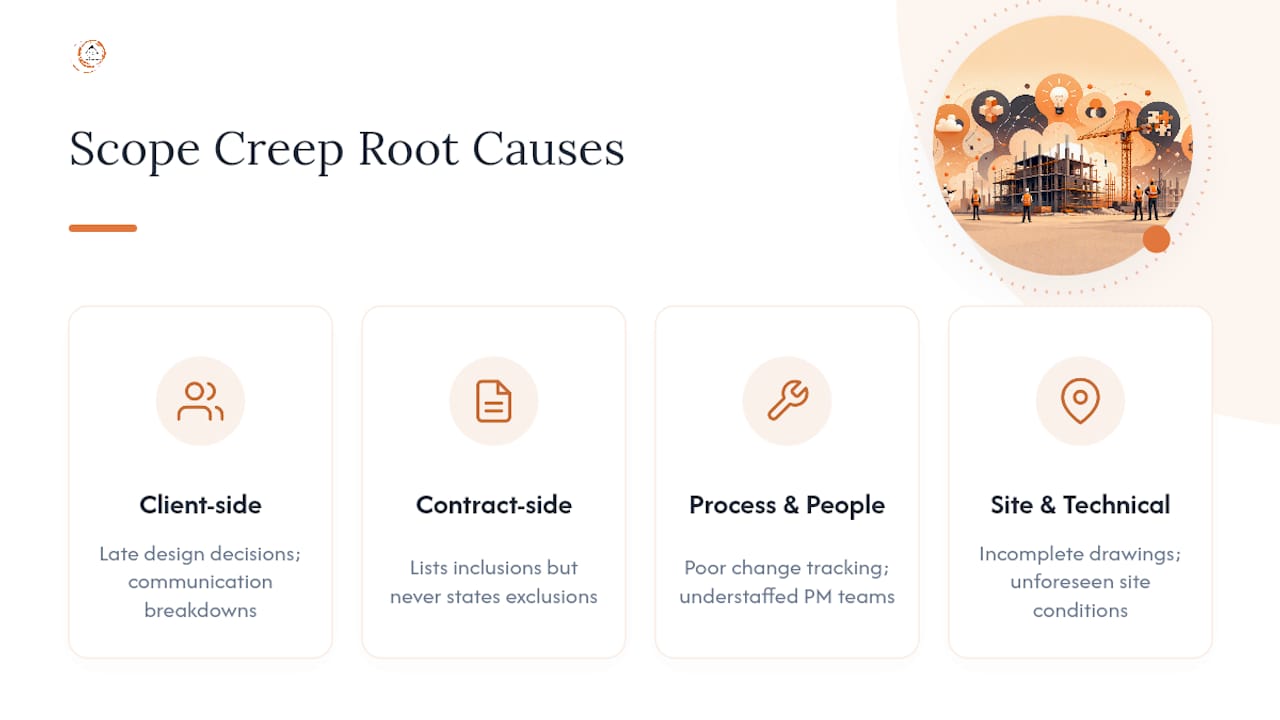
Client-side causes. Owners frequently start construction with objectives that sound clear in a kickoff meeting but turn out to be interpretations, not specifications. Late design decisions are the biggest offender here. An owner who hasn’t finalized finish selections by the time framing starts will keep making decisions throughout construction, and each decision after the baseline is technically a change. Poor communication among the owner’s own internal stakeholders compounds this. Research on scope creep indicators found that communication breakdowns within owner organizations account for a larger share of scope changes than almost any other single factor, because the contractor ends up caught between two people on the owner’s side who disagree about what they asked for.
Contract-side causes. A scope of work that lists inclusions but never states exclusions leaves everything ambiguous open to interpretation. A properly structured SOW with explicit exclusions and a defined change-order mechanism closes that gap before it opens. Weak or missing change-order rules do the same damage from a different angle: if the contract never specifies who can request a change, who approves it, and how it gets priced, everyone defaults to informal handshakes.
Process and people causes. Poor change tracking is the operational failure that turns small, individually harmless requests into a compounding financial problem. Contractors often absorb minor changes to keep the client happy in the moment, and those small favors accumulate into significant margin loss over the life of a project when every change, regardless of size, doesn’t follow the formal process. Understaffed PM teams and insufficient stakeholder involvement during planning make this worse, because there’s nobody dedicated to tracking the drift.

Site and technical causes. Incomplete drawings and specification errors surface constantly once excavation and framing begin. Practitioner reviews of scope creep on construction projects consistently cite incomplete design documents and delayed approvals as frequent triggers for change orders, and unforeseen site conditions, whether it’s rock where soil was expected or utilities that weren’t marked, generate legitimate but unbudgeted rework.
Pro Tip: Treat your SOW’s exclusions list as a negotiation asset, not a defensive document. When an owner asks for something outside scope, point to the specific exclusion clause and offer a priced change order on the spot. It reframes the conversation from “why won’t you just do this” to “here’s exactly what it costs to add.”
How Scope Creep Impacts Cost, Schedule, and Quality
The financial damage from scope creep rarely shows up as one big number. It shows up as a hundred small ones that nobody adds up until the project closes out and the margin has evaporated.
Direct cost impacts hit labor first. Crews performing unscoped work outside the original sequencing lose efficiency, and expedited material orders to accommodate late changes routinely carry rush fees that eat into contingency. Industry guidance on change-order management points to scope growth affecting a large share of U.S. construction projects, with growth in some cases exceeding 30% of the original contract value. That’s not a marginal overrun. That’s a project that started as one financial commitment and became a materially different one.
Schedule impacts follow close behind. Every unscoped change has a real chance of shifting the critical path, especially when it requires a design revision or a material substitution with a longer lead time. Subcontractor conflicts multiply because trade sequencing gets disrupted, and site overhead, the daily cost of keeping the job trailer staffed, equipment on site, and supervision in place, keeps accruing during the delay.
Quality suffers in a less obvious way. Rework performed under schedule pressure, squeezed into gaps between other trades, tends to get less careful attention than work performed on the original plan. A single change that seemed minor at the time, say, a plumbing rough-in relocation requested mid-framing, can force rework in electrical and drywall that never gets billed separately because nobody connected the dots.
Undocumented changes create the most expensive consequence of all: disputes. When an owner and contractor disagree about whether a change was requested, approved, and priced, and there’s no paper trail, that disagreement often ends in withheld payment, mediation, or litigation. Cash-flow problems follow directly, because contractors performing unapproved work are financing that work out of their own pocket until, and unless, the dispute resolves in their favor.
- Labor inefficiency from disrupted sequencing and rework
- Rush fees on expedited materials tied to late-added scope
- Critical-path delays from design revisions after baseline
- Increased site overhead during schedule extensions
- Payment disputes stemming from undocumented verbal changes
A Practical Framework for Preventing Scope Creep
Prevention starts at the contract, not at the site meeting. If you wait until the job is underway to establish scope discipline, you’re managing creep instead of preventing it.
Write an enforceable scope of work. A construction SOW needs three things to hold up under pressure: specific inclusions tied to drawings and specs by reference number, an explicit exclusions list, and a defined change-order mechanism baked into the same document. A well-structured SOW with clear exclusions gives you a defensible line to point to when an owner asks for something that wasn’t priced.
Build a formal change-order process with no exceptions. The process needs to answer four questions before the job starts: who can request a change, who has authority to approve it, how it gets priced (unit rate, time and materials, or lump-sum estimate), and what happens if work proceeds before signatures are collected. That last point deserves its own rule: no work begins on any change until it’s signed by both parties. Verbal site approvals are one of the most common, and most under-documented, sources of creep, and the only reliable fix is a hard no-work-until-signed policy enforced at the field level, not just in the office.
Add contract clauses that support the process. Ask your attorney to draft language covering approval thresholds (who signs off at what dollar amount), documentation requirements (written form, required fields, turnaround time), and payment timing explicitly tied to approved changes rather than assumed into the next draw.
Invest in front-end planning and alignment. Partnering sessions and pre-construction alignment workshops, where owner, architect, and contractor walk through objectives and contingencies before the first shovel hits dirt, measurably reduce late-stage changes by clarifying scope and allocating contingency earlier in the process. R Construction Solutions LLC’s work on process improvement for contractors covers how these upfront disciplines translate into fewer disputes down the line.
Your operational checklist: finalize SOW exclusions before signing, define the change-order approval chain in writing, set a no-work-until-signed rule and communicate it to every super, and schedule a pre-construction alignment session for any project over a set dollar threshold.
Pro Tip: When negotiating scope with an owner who resists formal change orders, frame it as protecting their budget, not slowing down their project. Most owners come around once they understand that skipping the paperwork is what leads to disputed invoices at closeout, not the other way around.
What to Do When Scope Creep Is Already Happening
If you’re reading this because creep is already eating your margin on a live job, the sequence matters more than the individual tactics.
- Freeze further changes immediately. Announce to the site team and the owner’s representative that no additional work outside the current SOW proceeds without a signed change order, effective now.
- Document every informal approval that already happened. Go back through texts, emails, and field notes to reconstruct what was verbally approved, by whom, and when. This becomes the basis for pricing.
- Quantify the cumulative impact. Add up labor hours, material costs, and schedule days attributable to unscoped work. Get a real number before you go back to the owner.
- Price and submit retroactive change orders. Present the documented, quantified changes as formal change orders, even after the fact. Owners are more receptive to paying for work already completed than they are to open-ended disputes.
- Re-baseline the schedule. Once changes are priced and approved, update the project schedule to reflect the real critical path, not the original one.
- Apply resource-leveling and lean construction tactics to recover time. Root-cause identification followed by critical-path optimization and resource leveling can recapture some of the schedule lost to creep without adding overtime costs across the board.
A project three weeks behind schedule due to undocumented changes might recover two of those weeks within a month of implementing a freeze and re-baseline, simply because the team stops absorbing new unscoped work while still trying to catch up on the old.
Pro Tip: Institute a weekly owner review meeting focused solely on pending decisions. Forcing the owner to decide on open items every seven days, instead of letting them linger for a month, prevents the backlog of “small requests” from ever reaching critical mass.
Why Complex Projects See More Scope Creep
Complexity is not a vague qualitative descriptor. It’s measurable, and it correlates directly with change-order frequency and value. Research on construction phase change orders found that high-complexity projects issue significantly more change orders than low-complexity ones, with specific indicators driving that increase: number of joint venture partners, number of funding phases, and number of executive oversight entities involved in decision-making.
That same research found an interesting pattern in who issues the changes. On high-complexity projects, owners tend to issue fewer but higher-value changes, while contractors on lower-complexity work issue more numerous, smaller changes. That distinction changes how you should design your controls. On a joint-venture project with staged funding, your biggest risk is a small number of large, late owner-driven changes tied to funding milestones. On a straightforward single-owner renovation, your bigger risk is death by a thousand small, contractor-absorbed changes.
Practical strategies for complex, multi-party projects:
- Narrow decision authority to one named individual per owner entity, documented in the contract.
- Require staged approvals tied to each funding phase, so scope can’t drift ahead of committed capital.
- Invest more heavily in front-end scope definition proportional to the number of oversight layers involved.
- Gate funding releases to specific, signed-off deliverables rather than calendar dates.
The data callout worth remembering: with owner communication effectiveness alone accounting for roughly 16.5% of scope changes, a project with three or four separate funding sources or JV partners multiplies that risk before a single hammer swings. If you’re structuring financing for a complex build, understanding how funding phases add structural complexity to a project’s decision-making chain helps you anticipate where scope drift is most likely to originate.
Templates and Contract Clauses You Can Use Tomorrow
You don’t need custom software to fix most scope creep. You need a document and the discipline to use it every time, no exceptions for “quick” requests.
Change-order template minimum fields. At minimum, your change-order form should capture: the requesting party’s name and date, a description of the change referencing the original SOW section it modifies, the pricing method used (unit rate, time and materials, or lump sum), the cost impact in dollars, the schedule impact in days, and signature lines for both owner and contractor with a date field for each.
Clause snippets to bring to your attorney. Ask counsel to draft language covering:
- An approval threshold clause defining who signs at what dollar amount.
- A no-work-until-signed clause stating explicitly that no additional work proceeds without a countersigned change order.
- A documentation requirement clause specifying the required form and turnaround time for approvals.
- A payment timing clause tying draw requests to approved, signed changes only.
- An exclusions clause listing everything the SOW does not cover, by category.
- A dispute-resolution clause specifying how disagreements over change pricing get resolved.
Tools and workflow. A centralized change log, even a shared spreadsheet accessible to the PM, super, and owner’s rep, beats scattered texts and email threads every time. Pair it with a weekly review cadence where open changes get discussed and closed out, and integrate the log with your estimating process so pricing on new changes stays consistent with your original bid assumptions. R Construction Solutions LLC’s guidance on construction workflow optimization walks through how to build that reporting cadence without adding administrative overhead your field team will resist. For contractors managing specialized scopes, reviewing how other trades structure detailed scope definitions for complex installations can highlight gaps in your own SOW language.
Adopt these artifacts at three points: the SOW draft (exclusions and change mechanism), the pre-construction meeting (change log setup and review cadence), and the first owner meeting (walk the owner through the no-work-until-signed policy before any work starts).
KPIs That Catch Scope Creep Before It Compounds
The projects that avoid runaway scope creep aren’t the ones with the most paperwork. They’re the ones tracking the right three or four numbers every week and acting on them immediately when a threshold gets crossed.
Change-order count per month. A jump from one or two per month to five or more is an early warning sign, even before the dollar value looks alarming.
Cumulative change value as a percentage of contract. Track this weekly, not monthly.
Ratio of verbal approvals logged versus formal change orders signed. If your field team is logging verbal approvals faster than your office is turning them into signed changes, you have a backlog problem that will surface as a dispute later.
Suggested thresholds and triggers:
- Cumulative change value exceeding 5% of contract within any 30-day window triggers an owner escalation meeting.
- More than three unsigned verbal approvals logged in a single week triggers a mandatory freeze until the backlog clears.
- Change-order count doubling month over month triggers a root-cause review with the PM and super together.
Reporting cadence matters as much as the metrics themselves. Weekly site reports should include the raw numbers; monthly owner reports should include the trend and any triggered escalations; and executive or portfolio-level reports should flag any single project crossing more than one threshold simultaneously, since that combination usually signals a deeper process failure rather than an isolated bad week.
What the Research Actually Shows About Scope Creep
The academic literature on construction scope creep is more specific than most industry blog posts suggest, and the specificity matters because it tells you exactly where to focus your controls.
Communication effectiveness within owner entities accounts for roughly 16.5% of scope changes on construction projects, and the presence of multiple executive oversight entities accounts for another 15%, according to research identifying manageable scope creep indicators. Together, these two factors, both rooted in how owners organize and communicate internally, explain a larger share of scope drift than site conditions, weather, or almost any other commonly blamed cause.
That finding, from a study on scope creep indicators and best practice strategies, should reshape how contractors think about risk. Most prevention advice focuses on the contractor’s own documentation habits, which matter, but the research says the owner’s internal communication structure is the bigger lever.
A separate study on project complexity and change orders found that complexity indicators, joint venture partners, funding phases, and oversight entities, correlate with both a higher frequency and a higher dollar value of change orders across the construction phase. The PMI’s own guidance on scope creep independently arrives at a similar conclusion from a different angle: undisciplined change management, not any single external factor, is the common thread across projects that experience severe scope growth.
Front-end planning research adds one more piece: partnering and alignment sessions held before construction begins measurably reduce late-stage changes by forcing clarity on objectives and contingency allocation earlier in the process, when changes are cheapest to absorb.
A Consultant’s Checklist for Building Change-Order Discipline
The pattern I see most often when contractors bring us in after a scope creep problem has already cost them margin isn’t a lack of intelligence or effort. It’s that scope control got treated as a paperwork chore instead of a revenue-protection system. The firms that fix this permanently are the ones that build change-order discipline into how every project manager and superintendent operates, not just into a template sitting in a shared drive nobody opens.
If you’re a firm owner deciding where to start, prioritize in this order:
- Audit your last five closed projects for cumulative change value as a percentage of contract, and identify which ones exceeded 10%.
- Standardize one change-order template across every active project this quarter, no project-specific variations.
- Train every superintendent, not just project managers, on the no-work-until-signed rule, since supers are the ones fielding informal requests in real time.
- Build the weekly change-log review into your existing PMO meeting rather than creating a separate meeting nobody attends.
- Revisit your standard SOW language with counsel at least once a year to tighten exclusions based on disputes from the prior year.
Training has to be recurring, not a one-time onboarding session. New hires, particularly superintendents coming from firms with looser scope discipline, will default to old habits unless the no-work-until-signed rule gets reinforced explicitly and repeatedly. Build it into your onboarding checklist and revisit it at your quarterly operations review, not just when a problem surfaces.
How R. Construction Solutions Helps Contractors Stop Scope Creep
R Construction Solutions LLC is the advisory partner contractors call when scope creep has already cost them a season of margin, or when they want to build the controls before it happens. Where generic project management software gives you a place to log changes, R Construction Solutions LLC helps you build the actual contract language, approval chains, and estimating discipline that stop the changes from becoming disputes in the first place.

The firm’s relevant services include:
- Scope-of-work drafting support that builds explicit exclusions and change mechanisms into your standard contract templates.
- Change-order process design tailored to your firm’s approval chain and field structure.
- Estimating support and bid preparation to keep change pricing consistent with your original bid assumptions.
- Governance implementation, including KPI reporting cadences and executive-level scope tracking.
Contractors who implement these controls with structured advisory support typically see fewer payment disputes and better-protected margins across their project portfolio, not just on one job. If your firm is ready to build change-order discipline that holds up across every project, not just the one currently in crisis, explore R. Construction Solutions’ consulting services and schedule a conversation about where your scope controls currently break down.
Frequently Asked Questions
Why do construction projects experience scope creep so often, even with experienced project managers on staff? Scope creep happens even to experienced teams because the failure points aren’t about skill. They’re about contract structure and process discipline. An SOW without explicit exclusions, or a change-order process that allows verbal approvals, will produce creep regardless of how capable the PM is.
What is the single most effective way to prevent scope creep in construction? A well-structured scope of work with explicit exclusions paired with a strict no-work-until-signed change-order rule is the most effective combination. Contract clarity closes the ambiguity that invites informal requests, and the signature requirement closes the loophole that lets those requests proceed unpriced.
How much does scope creep typically cost a construction project? Industry guidance indicates that a substantial share of U.S. construction projects experience scope creep that impacts cost.
Do complex projects with multiple stakeholders really see more scope creep? Yes. Research on construction change orders found that complexity indicators, including joint venture partners, funding phases, and executive oversight entities, correlate with a measurable increase in both the frequency and dollar value of change orders.
What should a contractor do if scope creep is already happening on a live project? Freeze further unscoped work immediately, document every informal approval that already occurred, quantify the cumulative cost and schedule impact, submit retroactive change orders for that documented work, and re-baseline the schedule once approvals are signed.
Sources
- Identifying Manageable Scope Creep Indicators and Selecting Best Practice Strategies for Construction Projects
- Entity-Based Investigation of Project Complexity Impact on Size and Frequency of Construction Phase Change Orders
- Top five causes of scope creep (PMI resource)