Copy Ready 1–5 Scorecard for Construction Project Manager Interviews
Ask these questions first and score every answer against three accountabilities: schedule, budget, and safety. Start with a largest-project walkthrough, a schedule-recovery scenario, and a subcontractor conflict story, then run every candidate through a 1 to 5 scorecard before you compare notes. Use a two-stage process: a short phone screen to filter fit, then a structured interview built around the questions below.
TL;DR:
- Candidates who owned their largest projects can answer cost variances within seconds, while those managing from the sidelines will hedge or avoid specifics.
- Verifiable figures like dollar amounts, schedule dates, or change-order sizes are critical for confirming a candidate’s actual hands-on experience.
- Strong candidates demonstrate specific outcomes, such as recovering days or reducing costs with exact figures, rather than vague process descriptions.
- Weigh safety questions at least 10 percent of the score, especially for high-risk trades, and verify safety records through references and certifications.
- Conduct a three-stage interview process: a brief phone screen, a structured in-depth interview, and timely reference checks for reliable candidate evaluation.
Table of Contents
- Project Manager Interview Questions That Reveal Real Competence
- Scoring the Answers: A Competency Rubric That Removes Guesswork
- Running the Interview: A Three-Stage Process That Doesn’t Waste Anyone’s Time
- Red Flags That Should Slow Down or Stop an Offer
- Copyable Scorecard: Competencies, Weights, and Anchors
- What Thirty Years of Hiring Advisory Taught Me About This Process
- How R Construction Solutions LLC Helps You Hire the Right PM Faster
- Sources
- FAQ
Project Manager Interview Questions That Reveal Real Competence
Most hiring mistakes at small-to-mid-sized construction firms trace back to one habit: letting a confident interview replace a verified track record. The fix is asking questions that force candidates to produce numbers, names, and decisions, not philosophy.
Verification questions come first. Ask a candidate to walk you through their largest project, then interrupt with follow-ups: What was the final budget variance? Who signed the change orders? What was the actual substantial completion date versus the contract date? A candidate who owned the project can answer in seconds. One who managed from the sidelines will hedge.
Technical questions test whether the candidate can run the mechanics of the job: scheduling logic, cost coding, change-order documentation, and permitting sequences. Situational and crisis questions expose judgment under pressure. Leadership questions reveal how the candidate handles subcontractors and safety culture, which systematic competency research now ranks alongside technical skill as a critical hiring factor.
Here is a copy-ready set of prioritized project manager interview questions for construction hiring:
- Walk me through your largest completed project: contract value, final budget variance, and schedule outcome.
- Describe a time a project fell behind schedule. What caused it, and how did you recover the days?
- Tell me about a serious conflict with a subcontractor. How did you resolve it, and what changed afterward?
- How do you track cost codes against budget on a weekly basis?
- Walk me through your change-order process from field discovery to owner approval.
- What permits have you pulled or managed directly, and what delayed one of them?
- How do you handle a subcontractor who is consistently behind schedule?
- Describe your safety walk-through routine and a time you stopped work over a hazard.
- What project management software have you used, and how did you use it for daily reporting?
- How do you communicate schedule slippage to an owner before it becomes a crisis?
- Tell me about a time you disagreed with a superintendent. How was it resolved?
- What is your process for closing out a project and collecting retention?
- How do you onboard a new subcontractor to your job site standards?
Scoring the Answers: A Competency Rubric That Removes Guesswork
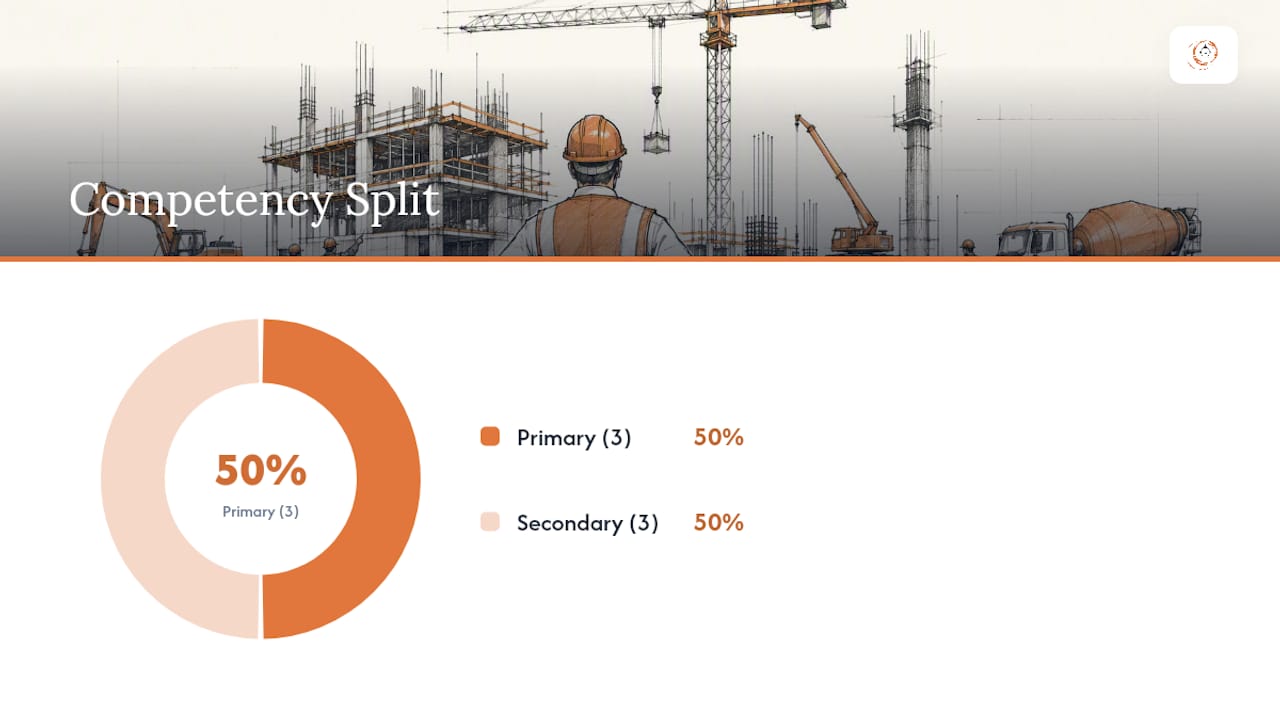
A great answer told well still needs a number attached to it. Score every candidate on three primary accountabilities, schedule, budget, and safety, plus secondary axes for stakeholder management, digital competency, and leadership.
- Schedule management: did the candidate name specific recovery tactics, or only describe the delay?
- Budget control: did they cite variance percentages, cost codes, or change-order dollar amounts?
- Safety culture: did they describe a specific stop-work event, or generic policy talk?
- Stakeholder management: did they name who they communicated with and when?
- Digital competency: could they describe actual use of tools like Procore or Buildertrend, not just familiarity?
Anchor your 1 to 5 scale so every interviewer rates the same way. A 1 sounds like vague generalities with no numbers. A 3 sounds like a correct process description with one supporting detail. A 5 sounds like a specific outcome, a dollar figure or a day count, tied to a decision the candidate made personally.
Weight the accountabilities to match your project mix. A firm running tight-margin residential remodels should weight budget control heavier; a firm juggling multiple crews across sites should weight stakeholder management and digital reporting heavier, a shift job-ad and resume analyses confirm is already happening industry-wide. If two interviewers score the same candidate, average the numeric scores per competency rather than averaging a final gut-feel total. That keeps one enthusiastic interviewer from skewing the result.
Pro Tip: Ask every interviewer to write down their score before the group debrief. Comparing written scores first prevents the loudest voice in the room from anchoring everyone else’s opinion.
Running the Interview: A Three-Stage Process That Doesn’t Waste Anyone’s Time
Small construction firms lose strong candidates by dragging the process out over weeks. A tight pipeline fixes that.
- Phone screen, 20 to 30 minutes. Cover the largest-project walkthrough and one schedule question. Eliminate clear mismatches on experience level or availability before anyone invests more time, a sequence practitioner hiring guides recommend as the fastest filter for construction roles.
- Structured interview, 45 to 60 minutes. Run six to eight questions from the priority list above, covering all three core accountabilities plus one leadership question. Score immediately after, while details are fresh.
- Reference checks, same week. Call two references, ideally one former owner or GC and one subcontractor the candidate managed directly.
For the structured interview, put an owner or president, a superintendent, and an estimator or safety lead on the panel. The owner probes business judgment, the superintendent probes field credibility, and the estimator or safety lead probes cost and compliance fluency. Make a decision within 48 hours of the final reference call. Top construction PM candidates rarely stay on the market long, and a slow decision cadence is how competitors close on your first choice.
Red Flags That Should Slow Down or Stop an Offer
A candidate who cannot name a single budget figure, completion date, or specific decision from their “biggest project” is describing someone else’s work, not their own. Watch for these signals during the interview and before you sign an offer letter.
- Cannot name a specific budget variance, schedule date, or change-order amount from any project discussed.
- Speaks about subcontractors or trades with contempt rather than describing management strategy.
- Resume dates don’t line up with the timeline described verbally.
- Deflects every technical question toward “the team handled that.”
Before extending an offer, verify the story. Ask for the candidate’s EMR history if they managed safety programs, confirm OSHA 10 or OSHA 30 completion, and call at least one former owner and one subcontractor. A strong verification process asks references pointed questions: Did this person deliver on budget? On schedule? Would you hire them again for a bigger project? Confirmation from practitioner checklists backs this up: EMR and safety-course verification catch misrepresentation that interviews alone miss. If a reference hesitates on the on-time or on-budget question, probe further before you stop the process entirely.
Copyable Scorecard: Competencies, Weights, and Anchors
Paste this structure into Excel or Google Sheets and adjust weights to match your project mix. Each row gets a score from 1 to 5, a weight based on what matters most for your firm, and a weighted score you calculate by multiplying the two.
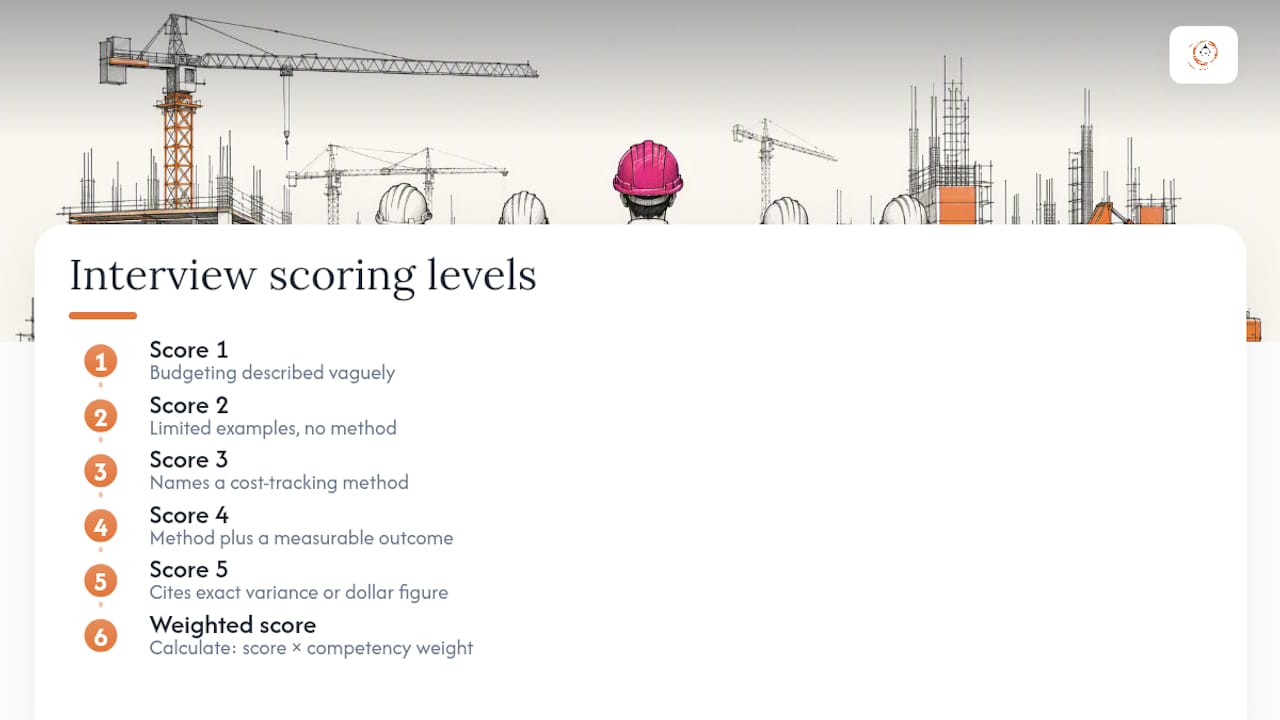
Anchor examples: a 1 on cost control describes budgeting only in general terms. A 3 names a cost-tracking method but no specific outcome. A 5 cites an exact variance percentage or dollar figure tied to a decision the candidate made.
What Thirty Years of Hiring Advisory Taught Me About This Process
The strongest signal in any construction hiring interview isn’t confidence or vocabulary. It’s specificity: numbers, names, and decisions. A candidate who says “we brought it in under budget” tells you nothing. One who says “we cut $40,000 by renegotiating the concrete package after a supplier delay” tells you everything.
Adapt the rubric depending on the role. A single large-project PM needs deeper budget and schedule fluency. A multi-site PM needs stronger stakeholder management and reporting discipline, since they can’t be on every site every day. For small-to-mid firms, I weigh leadership fit as heavily as software fluency in hiring criteria that predict performance. A PM who knows Procore inside and out but alienates your best subcontractor will cost you more than one who’s still learning the software.
— Rowena Tulacz
How R Construction Solutions LLC Helps You Hire the Right PM Faster
Running this process well takes time most owners don’t have between bids, punch lists, and payroll. R Construction Solutions LLC builds the scorecard around your specific project types, sources qualified candidates from our construction industry network, and runs structured interviews using the accountabilities that actually predict performance on your jobs.
Engagements are typically structured as fixed-fee hiring advisory packages or standalone scorecard licensing arrangements, depending on how much of the process you want handled directly. Reference checks, safety record reviews, and project claim verifications are part of the process before offers are extended. If you’re evaluating PM software fluency as part of your rubric, tools like The Build are worth reviewing alongside a candidate’s stated experience with project controls platforms. Reach out to R Construction Solutions LLC’s construction consulting services to build a scorecard for your next project manager search and get candidates in front of you within weeks, not months.
Sources
This guide draws on construction PM competency research, resume-based digital capability analysis, and practical hiring guidance built for contractors making real hiring decisions.
- Systematic review of the most relevant competencies for projects managers in the construction industry
- Competence requirements for construction project managers: a big-data resume analysis
- Construction PM interview guide and sample questions (practitioner checklist)
FAQ
How Many Questions Should a Construction PM Interview Include?
Plan for six to eight structured questions in a 45 to 60 minute interview, covering schedule, budget, safety, and one leadership scenario, plus two questions during an earlier 20 to 30 minute phone screen.
What’s the Single Best Question to Ask a Construction PM Candidate?
Ask them to walk through their largest project’s final budget variance and completion date. Candidates who owned the work answer with specific numbers immediately.
Should I Weight Safety Questions as Heavily as Budget Questions?
Weight safety at least 10% of your total score, and higher if your firm works in high-risk trades like structural steel or excavation, since safety failures carry legal and financial exposure beyond any single project.
How Do I Verify a Candidate’s Claimed Project Outcomes?
Call at least one former owner or general contractor and one subcontractor the candidate directly managed, and ask each whether the project delivered on time and on budget under that candidate’s leadership.
Can R Construction Solutions LLC Help Build a Custom Scorecard?
Yes. R Construction Solutions LLC builds interview scorecards weighted to your specific project types and can run candidate sourcing, structured interviews, and reference verification as part of a hiring advisory engagement.
Recommended
- Project Manager Hiring Criteria That Actually Predict Performance
- How to Protect Yourself Hiring a Construction Project Manager
Running the job and the business at the same time? One short email a week — change orders, billing, job costing, scheduling. Free, no pitch. Subscribe.
Free and unconditional. No call required, no obligation, unsubscribe anytime.