Avoid IRS Look Back: Percent Complete Accounting for Contractors
Percent complete accounting, also called the percentage-of-completion method (PCM), recognizes revenue in proportion to the work finished on a long-term contract rather than waiting for final delivery. The IRS requires it for most construction contracts lasting longer than one tax year under IRC Section 460. The core formula is simple: percent complete times total contract price equals revenue earned to date.
TL;DR:
- Cost-to-cost remains the default method for measuring percent complete, but switching to alternatives requires similar results unless specific circumstances apply.
- Reliance on billings rather than actual costs is a common mistake that can trigger IRS audits, especially if under or overbilling swings become large.
- Accurate estimates depend on consistent, current job-cost data, including signed change orders and approved forecasts, to ensure reliable revenue recognition.
- The look-back method forces contractors to recalculate prior-year income and interest based on final contract outcomes, requiring detailed year-by-year schedules.
- If cost estimates are too unreliable, switching to the completed-contract method is necessary, documented as a change in accounting estimate.
Table of Contents
- How does percent complete accounting work?
- What are the IRC §460 tax rules for long-term contracts?
- How do you build estimates and controls that hold up under audit?
- What are the biggest PCM mistakes that trigger audits?
- How do you close the month using PCM on a live contract?
- What advisors learn from watching contractors get PCM wrong
- Getting your WIP schedule audit-ready
- Where to verify the rules yourself
- Sources
How does percent complete accounting work?
The most common way to measure percent complete is the cost-to-cost method: costs incurred to date divided by total estimated costs. It dominates PCM calculations because costs are objective and verifiable, while billings reflect negotiated payment schedules that often have nothing to do with actual progress. A contractor who front-loads billing to improve cash flow would badly overstate revenue if billings drove recognition instead of costs.
Two alternate output methods exist, though they apply in narrower circumstances:
- Efforts-expended method. Measures progress using labor hours, machine hours, or other input metrics when cost data alone doesn’t reflect true progress, common in engineering-heavy contracts.
- Units-of-delivery method. Recognizes revenue as discrete units are completed and accepted, useful for contracts involving repetitive, separately identifiable deliverables like utility poles or precast panels.
Cost-to-cost remains the default expectation under Cornell Law’s summary of Section 460, and switching to an alternate method generally requires that it produce a materially similar result.
Here’s a worked example. A contractor has a contract with a total value where costs to date and estimated remaining costs indicate a certain percentage of completion. Revenue to date is calculated as that percentage times the total contract price. The revenue recognized in the current period is the increase from the prior period’s cumulative revenue.
The journal entries follow that math directly:
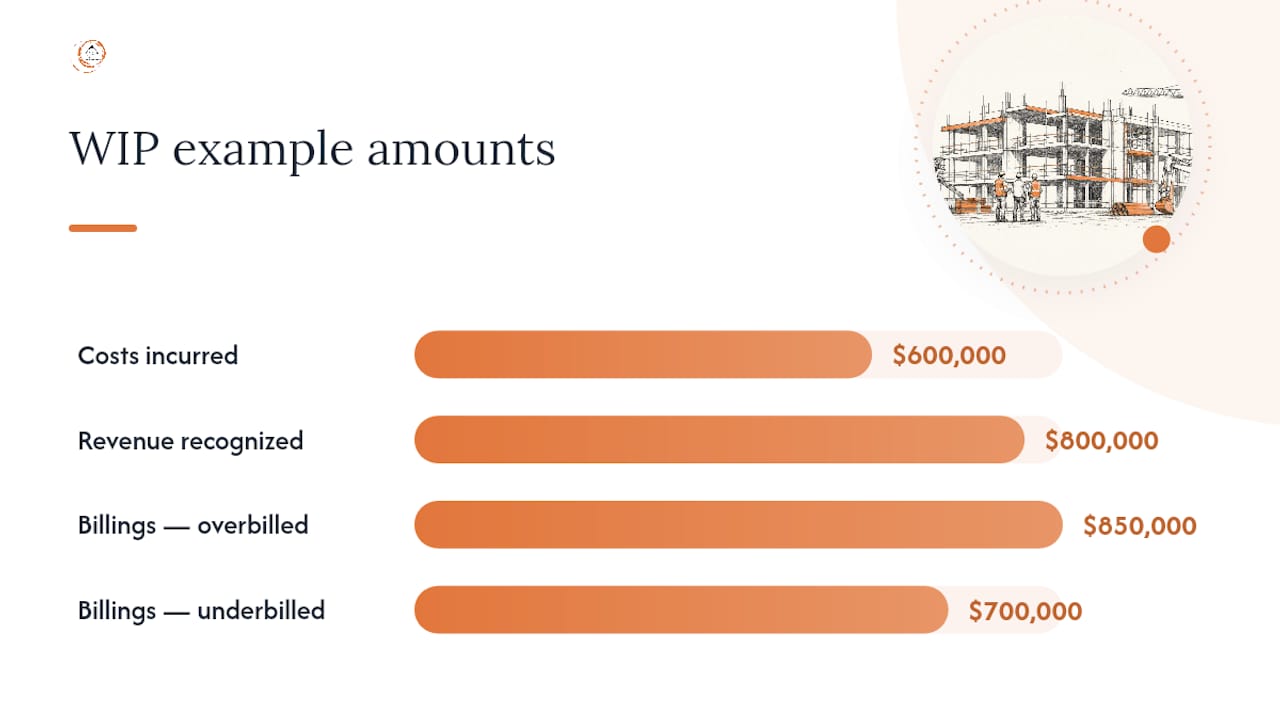
- Debit Construction in Progress (WIP asset) for costs incurred: $600,000
- Credit Cash/Accounts Payable for the same costs: $600,000
- Debit Costs of Construction and Construction in Progress to record recognized revenue and gross profit for the period
- Credit Revenue from Long-Term Contracts for $300,000 (the current-period amount)
- Adjust Billings in Excess of Costs or Costs in Excess of Billings depending on whether cumulative billings exceed or trail the $800,000 revenue recognized
That last entry is the heart of WIP reporting construction teams rely on every month. If billings to date on this job were $850,000, you’d book $50,000 as overbilling (a liability). If billings were $700,000, you’d book $100,000 as underbilling (an asset). Either imbalance shows up immediately on your work in progress schedule, and a pattern of large swings in either direction is usually the first sign something in your estimating or billing rhythm needs attention.
When estimates aren’t reliable enough to compute a defensible percent complete, AICPA guidance recommends a zero-profit approach: recognize revenue equal to costs incurred, with no profit booked, until better cost data emerges.
What are the IRC §460 tax rules for long-term contracts?
Under IRC Section 460(a), taxpayers must generally use PCM to report taxable income from long-term construction contracts, defined as contracts not completed within the tax year they’re entered into. The statute specifies cost-to-cost as the default completion measure, and it only allows other output methods under narrow exemptions.
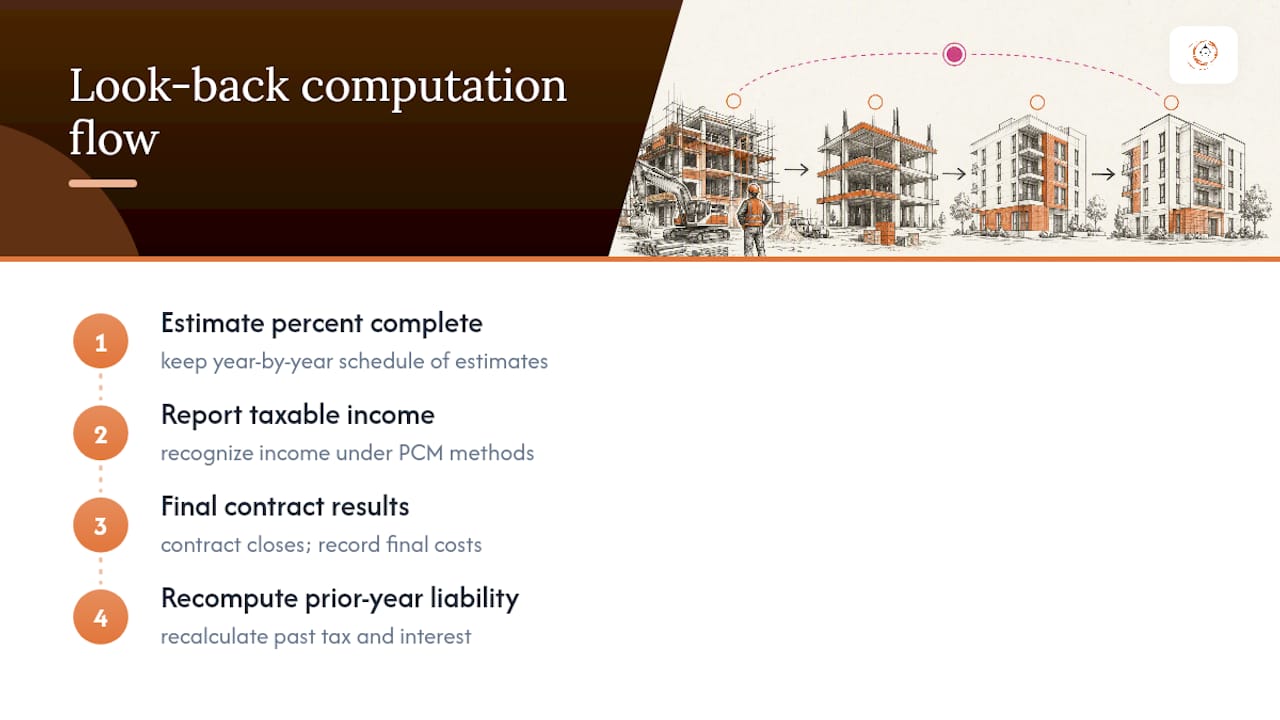
The trickiest provision for most firms is the look-back method. Once a contract closes, the IRS requires you to recompute what your tax liability would have been in each prior year had you known the final numbers, then calculate interest on any difference between what you actually reported and what hindsight shows you should have reported. This applies whether the difference favors the contractor or the government. Keeping a year-by-year schedule of your estimated percent complete and reported income is not optional paperwork. It’s the only way to support a look-back computation without scrambling when a contract finally closes.
Several exemptions modify or eliminate the PCM requirement, including exceptions for small contractors with contracts likely completed within a two-year period and where average gross receipts fall under tax code thresholds, as well as for home construction contracts. Additionally, contractors may elect methods like the 10-percent method to defer revenue recognition until progress reaches a certain stage, and simplified cost tracking methods may be available to reduce administrative burdens.
None of these exemptions are automatic elections you can flip on and off year to year. Talk to your tax advisor before assuming your contract mix qualifies, and if IRS correspondence or audit exposure is already a concern, a firm like Independent Contractor IRS Help can help sort out prior-year filings tied to contract classification disputes.
How do you build estimates and controls that hold up under audit?
PCM is only as trustworthy as the cost-to-complete estimate behind it, and that estimate lives or dies on the discipline of your job-cost system. Committed-cost reports (open purchase orders, subcontracts, and outstanding change orders) need to feed directly into your remaining-cost forecast, not sit in a separate spreadsheet that gets updated whenever someone remembers.
Here’s a practical sequence for keeping that estimate current:
- Pull the job-cost ledger for actual costs to date, broken out by cost code.
- Reconcile committed costs (subcontracts, purchase orders, pending change orders) against the original budget for each cost code.
- Update the estimate to complete with input from the project manager, not just the accounting department working from stale numbers.
- Document every change order and claim with a signed approval trail before it enters the cost-to-complete forecast. Unpriced or unapproved work is one of the fastest ways to distort percent complete in either direction.
- Recalculate percent complete and revenue only after the above steps are current for the period.
Practitioner guidance consistently points to poor change-order documentation as the single biggest source of unreliable percent-complete numbers, because it breaks the link between what’s actually happening on the job and what the cost-to-complete forecast assumes. Aligning your estimator’s assumptions, your project manager’s field updates, and your accountant’s month-end close into one shared number is what actually makes PCM defensible. A strong estimating process upstream reduces how often that reconciliation turns up surprises.
Pro Tip: Set a standing recurring calendar reminder for project managers to submit change-order status updates three business days before your accounting close, not on close day itself. That buffer is usually the difference between a clean WIP schedule and a scramble.
What are the biggest PCM mistakes that trigger audits?
The single most common error is letting billings, not costs, drive the percent-complete calculation. It flatters short-term numbers but collapses the moment a job’s real cost trajectory catches up.
Other recurring red flags include:
- Unrecorded change orders. Work performed but not yet priced or approved gets left out of the cost-to-complete forecast, understating total costs and overstating percent complete.
- Overly optimistic cost-to-complete estimates. This recognizes profit before it’s actually earned, a pattern the IRS Construction Industry ATG specifically flags for scrutiny.
- Weak documentation trails. Auditors test whether your cost estimates tie back to signed subcontracts, approved change orders, and dated project manager sign-offs, not verbal assurances.
Preparing means keeping that paper trail current every month, not reconstructing it during audit season.
How do you close the month using PCM on a live contract?
Before calculating anything, pull four data points: actual costs to date, current estimated cost to complete, total contract value including approved change orders, and cumulative billings.
- Compute percent complete using costs to date divided by total estimated cost.
- Calculate cumulative revenue by multiplying percent complete by total contract price.
- Subtract prior-period cumulative revenue to isolate current-period revenue.
- Compare cumulative revenue to cumulative billings to post the over/under billing report entry.
- File supporting documentation (change-order log, committed-cost report, PM sign-off) with the WIP file for that period.
If cost estimates become too unreliable to support PCM, that’s your trigger to switch to the completed-contract method. Document the rationale as a change in accounting estimate, not a silent policy shift, so your financial statements and tax return stay consistent.
What advisors learn from watching contractors get PCM wrong
Three patterns repeat: firms that separate their estimator from their accountant lose the thread on cost-to-complete. Firms that update estimates sporadically instead of monthly get blindsided at contract close. And firms that ignore early WIP warning signs, like a growing underbilling balance, usually have a cash flow problem before anyone notices. Bring in outside advisory support before the look-back computation becomes a crisis, not after.
— Rowena Tulacz
Getting your WIP schedule audit-ready
R Construction Solutions LLC works with contracting firms that need PCM applied correctly, not just theoretically understood. If your work in progress schedule shows unexplained overbilling swings or your estimating team and accounting team aren’t working from the same numbers, that gap tends to widen with every project, not shrink on its own.

Our team reviews your job-cost setup, tightens the estimating inputs that feed your percent-complete calculations, and helps structure a repeatable monthly WIP close your accountant and your bank can both trust. We also support the estimating and bid preparation work that determines whether your cost-to-complete forecasts start accurate in the first place, along with federal contracting compliance for firms pursuing government work. Visit our Construction Consulting Services page to schedule a conversation about where your PCM process currently breaks down and what fixing it would look like this quarter.
Where to verify the rules yourself
For the statutory language governing mandatory PCM use, read 26 U.S. Code § 460 directly. IRS examiners work from the Construction Industry Audit Technique Guide, worth reviewing before your next audit. For accounting treatment beyond tax compliance, the AICPA’s construction accounting guidance remains the standing reference for estimate reliability and disclosure practices.
Sources
- 26 U.S. Code § 460 - Special rules for long-term contracts
- Construction Industry Audit Technique Guide
- AICPA guidance on construction accounting (excerpt)
Recommended
- Public Works Contracts: What Contractors Must Do to Comply
- Contractor Business Consulting Mistakes to Avoid in 2026
- Contractor Business Assessment Explained for Contractors
- Commercial Contractor Licensing Requirements Checklist 2026
Running the job and the business at the same time? One short email a week — change orders, billing, job costing, scheduling. Free, no pitch. Subscribe.
Free and unconditional. No call required, no obligation, unsubscribe anytime.

