
How to Get an Accurate Home Construction Estimate Guide
Get accurate home construction estimates by pairing rigorous quantity takeoffs with cost-loaded assemblies and a job-costing system that tracks estimated, committed, and actual costs. In practice, that means measuring every system off current drawings, pricing each assembly with labor and waste built in, leveling subcontractor bids against each other, validating the total against benchmarks like RSMeans, and converting the final number into a job budget your bookkeeping system can track using CSI MasterFormat cost codes.
Before you touch another bid, run this checklist:
- Confirm the current drawing revision and log any addenda.
- Perform a full quantity takeoff organized by system, not by guesswork.
- Cost-load assemblies with material, labor, and waste factors.
- Level subcontractor bids side by side to catch scope gaps.
- Add indirects, overhead, and a real contingency line.
- Convert the finished estimate into a schedule of values tied to cost codes.
Pro Tip: Pick one active bid right now and re-run its takeoff against this checklist. You’ll likely find at least one line item priced from memory instead of measured quantities.
R Construction Solutions LLC built this framework from years of estimating audits with residential contractors who were bidding tight and still losing margin on the back end.
Key Takeaways
Accurate home construction estimates require disciplined quantity takeoffs, cost-loaded assemblies, and a job-costing system that tracks estimated, committed, and actual costs side by side.
| Point | Details |
|---|---|
| Takeoff is the foundation | Measure by system off current drawings; missing structural sheets underestimates framing costs. |
| Burden labor rates properly | Apply full labor burden, not base wage, to every hour priced in the estimate. |
| Separate contingency from allowances | Contingency covers the unforeseen; allowances cover client selections not yet made. |
| Track committed costs early | Log signed POs and subcontracts immediately so overruns surface before closeout. |
| Get advisory support when needed | R Construction Solutions LLC offers estimating validation and job-cost implementation for residential contractors scaling their systems. |
Resources to Consult Next
For deeper reference, keep these on hand: CSI MasterFormat for cost-code taxonomy, RSMeans for benchmark unit pricing, the Bluebeam estimating guide for takeoff workflow, and the allowance and contingency primer for contract language. If pre-engineered structural elements are part of your scope, metal building pricing guides offer a useful cross-check on that portion of the bid.
Table of Contents
- How to Get an Accurate Home Construction Estimate Guide Started: Why Precision Matters
- What Steps Make Up an Accurate Estimating Workflow?
- How Do Cost Codes Keep an Estimate Accurate After the Job Starts?
- What’s the Difference Between Contingency and Allowances?
- Which Tools Help Contractors Price Materials and Labor Accurately?
- How R Construction Solutions LLC Supports Contractors on Estimating and Job Costing
- Sources
How to Get an Accurate Home Construction Estimate Guide Started: Why Precision Matters
Weak estimating doesn’t just cost you one bad job. It compounds. A contractor who underprices framing on a $180,000 remodel doesn’t just eat that loss. He carries the habit into the next five bids, because nobody went back to find out why the number was wrong.
Mid-size residential remodels are especially exposed here. Projects in the $75,000 to $300,000 range are where scope creep and margin erosion hit hardest, largely because these jobs involve enough unknowns (existing conditions, client-driven finish changes) to invite drift, but not enough contract complexity to force disciplined change management.
Three failure modes show up again and again: takeoffs pulled from rough plan reads instead of full quantity counts, labor priced at base wage instead of a burdened rate, and committed costs (signed subcontracts, issued purchase orders) that never make it into the job-cost report until the invoice lands. Burdened labor rates typically run materially higher than base wages once you account for payroll taxes, insurance, and benefits, and skipping that math is one of the fastest ways to bid yourself into a loss.
Pro Tip: Track one thing religiously on every job: the running total of committed costs. If your PO and subcontract log isn’t updated within 48 hours of signing, you’re flying blind on the number that matters most.
What Steps Make Up an Accurate Estimating Workflow?
A repeatable estimate follows the same sequence every time, whether you’re bidding a kitchen remodel or a full custom build.
- Review bid documents. Confirm the drawing revision, read specs in full, and log every addendum before you measure anything.
- Perform a full quantity takeoff by system. Framing, MEP, finishes, sitework: each gets its own count, not a blended guess.
- Build cost-loaded assemblies. Price material, labor hours, and waste factors together at the assembly level rather than as separate line items.
- Apply labor burden and equipment rates. Use burdened rates, not base wage, for every labor hour.
- Collect and level subcontractor bids. Compare scope line by line to catch gaps and outliers before you accept a number.
- Add indirects, overhead, and contingency. General conditions and profit margin get their own visible lines.
- Validate against benchmarks. Check cost-per-square-foot and unit rates against historical jobs or RSMeans data.
- Generate the proposal and schedule of values. Tie every line to the cost codes you’ll use for job tracking later.
The foundation of that whole sequence is the takeoff itself. Skip a structural sheet and you’ll underprice framing and engineered lumber almost every time, a mistake that shows up consistently in residential takeoff reviews. Before pricing anything, confirm: current drawing revision, structural cross-check against the framing plan, finish schedule cross-check, MEP scope verification, allowances identified and coded separately, and waste factors built into each assembly. Our estimating checklist for general contractor projects walks through this in more detail if you want a printable version.
AI-assisted takeoff tools have changed the math on throughput. Vendors report 70% to 80% time savings on standard residential plan sets compared to manual measurement, though structural and complex MEP scope still need a human estimator’s eyes before you price it.
Use a quick sanity-check table before you lock the number:
| Benchmark check | Typical range |
|---|---|
| Manual takeoff time (standard residential set) | Full working days per estimator |
| AI-assisted takeoff time savings | 70% to 80% reduction vs. manual |
| Labor burden multiplier over base wage | Materially higher, varies by state and benefits package |
When leveling sub bids, line up scope, not just totals. A framing sub that comes in $8,000 lower than three others usually means missing scope, not a better price. Once the number is locked, convert it into the job budget using the exact same cost-code structure you’ll use for tracking and invoicing later. That single decision determines whether your estimate stays useful after the job starts.
How Do Cost Codes Keep an Estimate Accurate After the Job Starts?
An estimate that isn’t structured for tracking becomes fiction the moment work begins. Cost codes are what keep the number honest, because they create a consistent link between the estimate, the schedule of values, every invoice, and the job-cost report that follows.
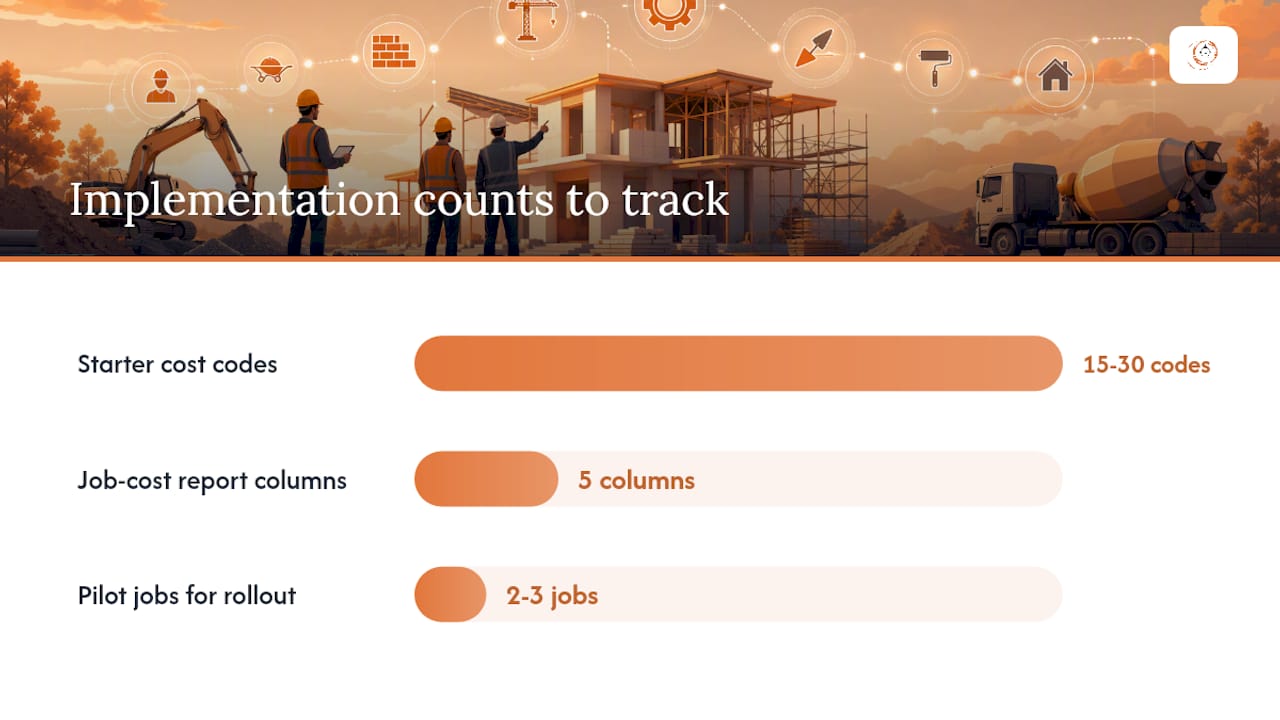
CSI MasterFormat is the industry-standard taxonomy, but most residential remodelers don’t need its full division set. A lean starter list of 15 to 30 codes covering site work, foundation, framing, MEP rough-in, finishes, and general conditions is usually enough to run meaningful reports without drowning your bookkeeper in categories.
Rolling out job-costing for the first time takes longer than most owners expect. Realistic implementation runs 12 to 24 months for a small firm, not because the software is complicated, but because getting your whole team to code time and materials consistently is a habit change, not a software install.
- Kick off with your team and explain why codes matter, not just what they are.
- Choose your starter code set and keep it lean.
- Integrate the codes with your bookkeeping or project management platform.
- Pilot on two or three active jobs before rolling out firm-wide.
- Review results monthly and adjust the code list based on what’s actually useful.
Assign clear roles: the project manager codes daily field time and material receipts, the bookkeeper enters committed costs from signed POs and subcontracts, and the owner or PM runs the weekly budget-versus-actual review.
A working job-cost report needs five columns, run weekly on every active job: original estimate, costs to date, committed costs, cost to complete, and projected variance. That last column is the one to watch. A small negative variance early in a job is normal noise. A variance that grows week over week on the same cost code is the early warning that something in the field doesn’t match what was priced.
The reason committed costs get their own column matters more than it looks. A three-layer approach (estimated, committed, actual) surfaces overruns while there’s still time to fix them, instead of after the final invoice lands.
What’s the Difference Between Contingency and Allowances?
Contingency and allowances get lumped together constantly, and that confusion is where a lot of change-order fights start.
Contingency is a buffer for unforeseen conditions: rot behind a wall you couldn’t see until demo, soil conditions that surprise the foundation crew. Allowances are placeholders for items the client hasn’t selected yet, like light fixtures, tile, or plumbing trim. One protects against the unknown; the other protects against the undecided.
Present both as separate, clearly labeled lines in your proposal and schedule of values, not folded into a single “miscellaneous” number. Clients who see the distinction sign off faster because they understand exactly what they’re agreeing to. Our breakdown of contingency budgeting for project managers covers sample language you can adapt directly into your contracts.
When scope moves beyond what’s covered by an allowance, run a short, repeatable change-order process:
- Document the scope change in writing, including what triggered it.
- Price the added or changed work using the same cost-loading method as the original estimate.
- Get signed client approval before ordering material or starting work.
- Code the change order to the same cost code as the original line item.
- Update the job budget and future invoices immediately.
Pro Tip: Never let a crew start work covered by a verbal change order. Require a signature first, every time, no exceptions for “small” changes. Small changes are exactly how a $180,000 remodel turns into a $210,000 one nobody budgeted for.
Which Tools Help Contractors Price Materials and Labor Accurately?
You don’t need an enterprise tech stack to estimate well, but a few categories of tools consistently separate accurate bidders from guessers.
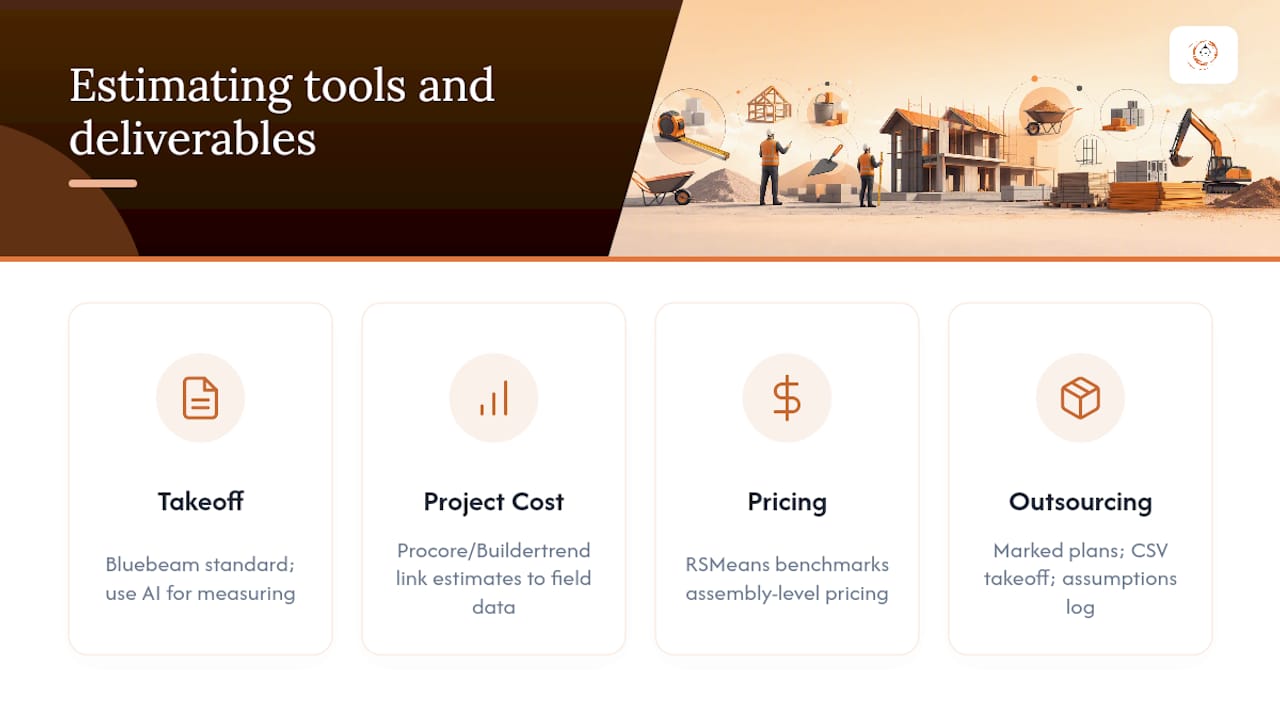
For takeoff, Bluebeam remains a standard for marking up plans and extracting quantities, and AI-assisted takeoff platforms are worth adopting if measuring plans is your bottleneck rather than pricing them. For project and cost management, Procore and Buildertrend both handle the link between estimate, schedule of values, and field reporting, provided your team commits to entering data consistently. For pricing, RSMeans cost data gives you a benchmark to check assembly-level pricing against, especially useful when a sub bid comes in unusually low or high.
Outsourcing estimating makes sense in a few specific situations: your backlog has outgrown your in-house estimator’s throughput, you want a third-party check on a complex bid before you submit it, the job involves structural or MEP scope beyond your team’s comfort zone, or you’re covering a temporary staffing gap. When you bring in outside help, request a specific set of deliverables: marked-up plans, a CSV takeoff tied to cost codes, an assumptions log, a completed schedule of values, and a draft change-order library for the project type.
Pro Tip: Before you hire an outside estimator, ask to see a sample assumptions log from a past project. It tells you more about their rigor than their resume does.
R Construction Solutions LLC provides estimating support built around exactly this deliverable set, positioned to plug into your existing bid process rather than replace it. See our full guide to improving your construction estimating process for more on where most firms lose accuracy first.
An Advisor’s View on Fixing Estimating Systems
When I audit a contractor’s estimating process, I look first at whether the takeoff drives the price or the price drives the takeoff. Too often, the number gets set by instinct and the takeoff gets built backward to justify it.
My highest-leverage advice: pull your last three completed jobs and find the single cost code with the biggest recurring variance. Fix that one thing before touching anything else. As an advisor, not a tradesperson, I approach this from the operations and numbers side. That’s usually where the leak actually is.
How R Construction Solutions LLC Supports Contractors on Estimating and Job Costing
R Construction Solutions LLC is the advisory alternative for contractors who need estimating discipline without hiring a full-time estimator or building a job-cost system from scratch. We offer estimating support and takeoff validation, job-costing implementation, cost-code integration with your existing bookkeeping, weekly reporting setup, and change-order process templates built for residential scope.

Engagements scale to fit where you are. A pilot engagement covers one job takeoff and a full job-cost report so you can see the method work before committing further. A full implementation runs the 12 to 24 month horizon it typically takes to roll out job costing across your whole operation, with phased milestones along the way. If your estimates keep missing and you’re not sure whether the problem is the takeoff, the labor burden, or the reporting, a discovery call is the fastest way to find out. Visit our construction consulting services page to schedule one.
Sources
- Job cost accounting: How to set it up and get value
- The complete guide to construction estimation in 2026
- Single family residential takeoff: The estimator’s playbook for faster, more accurate bids
- Job costing for contractors: Labor burden, cost codes, and committed costs
- Contractor job costing: The complete guide (+ formula)

