
Outsource Construction Estimating After 8+ Monthly Bids, For Contractors
Construction estimating outsourcing pays off when you’re bidding steadily on a moderate to high number of projects each month, on scopes that follow repeatable measurement rules. It doesn’t pay off for one-off, highly custom bids where your judgment on pricing strategy is the entire value. The upside is speed and variable cost. The trade-offs are onboarding time, quality control, and losing a little local market feel. The rest of this guide shows you how to pilot it without losing pricing control.
TL;DR:
- Outsourcing construction estimates is most cost-effective for contractors with steady monthly volume, typically bidding eight or more projects on repeatable scopes.
- It improves bid turnaround time, especially on specialty scopes like mechanical or electrical, and offers flexibility during seasonal workload fluctuations.
- Accurate quality control depends on outsourcing only takeoffs, which are rules-based and auditable; final pricing should always remain in-house.
- A thorough onboarding process, including a pilot project and detailed agreements on assumptions and deadlines, minimizes risks of scope and quality issues.
- Hidden costs such as review hours, onboarding, rush fees, and revisions often outweigh headline savings, making outsourcing advisable mainly for volume-driven firms.
Table of Contents
- What Are the Real Benefits of Construction Estimating Outsourcing?
- Which Estimating Tasks Should You Outsource?
- When Does Outsourcing Actually Beat Hiring In-House?
- How Do You Integrate Outsourced Estimating Into Your Workflow?
- What Risks Should You Control Before You Outsource?
- What Software and File Formats Should You Confirm Upfront?
- How Do You Choose and Onboard an Estimating Partner?
- How R. Construction Solutions Implements Outsourced Estimating Safely
- Get Estimating Support Without Losing Pricing Control
- Where I’d Draw the Line on Outsourcing Estimates
- Sources
- FAQ
What Are the Real Benefits of Construction Estimating Outsourcing?
The clearest benefit is throughput. A contractor stuck reviewing three bids a week because that’s all one estimator can handle suddenly has room to chase six or eight, because the labor-intensive measuring work is happening somewhere else while your team focuses on pricing strategy and client relationships.
Cost is the second driver. A full-time estimator carries salary, benefits, software seats, and overhead whether you have five bids or fifteen that month. Outsourced construction estimating services scale with volume instead, which matters most for contractors whose bid pipeline swings seasonally.
Accuracy tends to improve too, particularly on specialty scopes. A firm that does nothing but mechanical or electrical takeoffs all day sees more variation and catches more errors than a generalist estimator juggling five trades.
What outsourcing typically improves:
- Bid turnaround time, often cutting days off your submission window
- Access to trade-specific expertise for mechanical, electrical, or civil scopes
- Capacity during seasonal surges without a hiring commitment
- Consistency in takeoff quality across similar project types
Pro Tip: Track your win rate for three months before and after adding outsourced support. If your bid-to-award ratio doesn’t move, the benefit is capacity, not accuracy, and that changes how you negotiate fees.
The benefit compounds most for contractors with steady monthly volume. A firm bidding the same 10 to 12 jobs every month gets a partner who learns their preferences and unit rates. A contractor with three bursty months a year and nine slow ones will feel onboarding friction more than any savings.
Which Estimating Tasks Should You Outsource?
A quantity takeoff measures materials and labor units from drawings. An estimate applies pricing, markup, and risk judgment on top of that measurement. That distinction is the entire safety boundary of outsourcing.
Takeoffs are rules-based and auditable, which is why guides on outsourcing construction estimates consistently recommend starting there rather than handing off full pricing. You can check a takeoff against the drawings. Pricing strategy, contingency decisions, and markup on a bid you actually want to win are harder to audit and carry more risk if delegated blind.
Here’s how to draw the line in practice:
- Send out quantity takeoffs by CSI division for divisions where your team lacks depth, such as mechanical, electrical, or civil earthwork.
- Require a documented assumptions sheet with every deliverable, listing measurement rules, waste factors, and exclusions.
- Confirm the return format matches your templates before work begins, whether that’s Excel, PlanSwift, or a Bluebeam markup set.
- Spot-check at least 10 to 15 percent of line items against the drawings on every early engagement.
- Keep final pricing sign-off in-house, always, regardless of how accurate the takeoff proves to be.
When Does Outsourcing Actually Beat Hiring In-House?
Run the math before you commit to either path. A mid-level in-house estimator typically costs a significant fixed annual amount including salary, benefits, software seats, and overhead, regardless of how many bids that person produces.
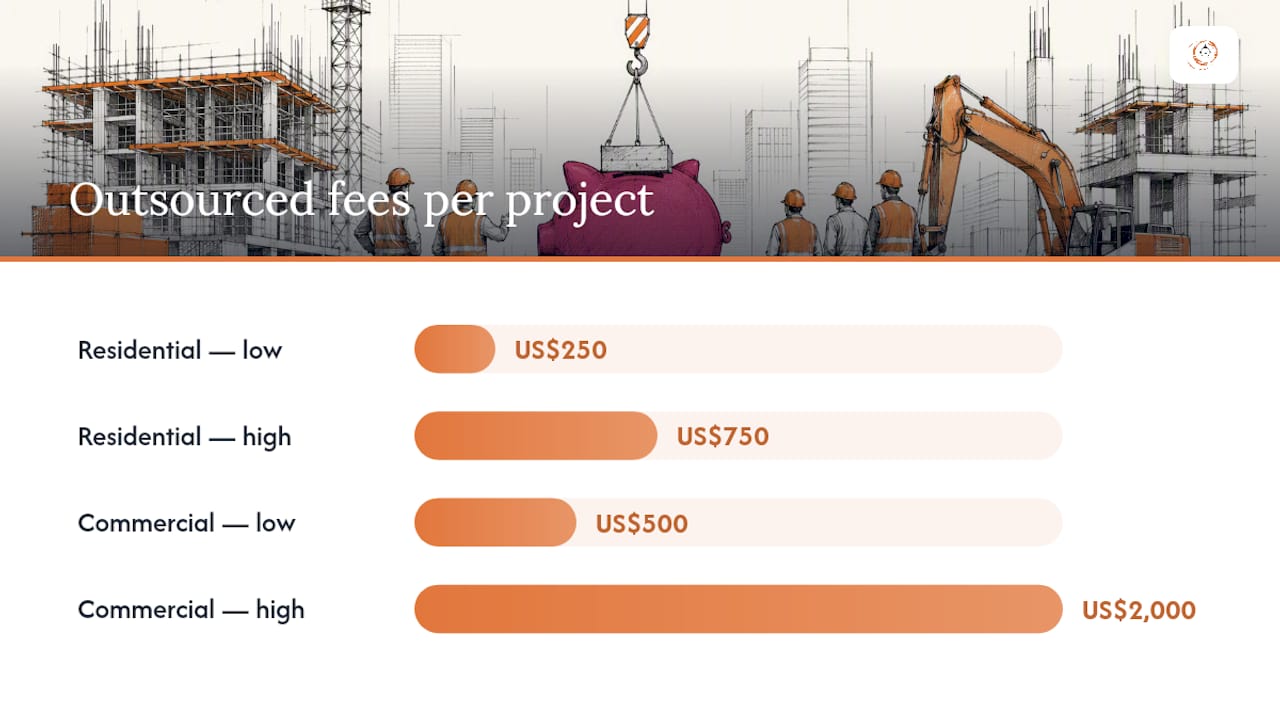
Outsourced estimating fees run differently. Published market examples show residential takeoff and estimating work priced around $250 to $750 per project, with commercial scopes running $500 to $2,000, though cost comparisons for outsourcing estimating warn that advertised fee ranges routinely omit hidden costs.
Those hidden costs matter more than the headline number:
- Internal review hours spent verifying every early deliverable, which shrinks as trust builds
- Onboarding time to hand over templates, unit rates, and drawing standards
- Rush fees for compressed bid deadlines, which construction bidding produces constantly
- Revision rounds when addenda or scope changes hit mid-bid
A rough rule of thumb: contractors bidding a moderate to high number of projects a month tend to hit break-even or come out ahead once setup costs are spread across that volume. Below that, a part-time or full-time in-house estimator usually wins on cost, because the fixed overhead of vetting and onboarding an outside partner doesn’t have enough volume to amortize against.
Many growth-stage firms land on a hybrid model instead: keep a senior estimator in-house for pricing strategy and client-facing bids, and route routine takeoffs to an outsourced partner. That combination protects your pricing judgment while still buying back hours from the most repetitive part of the job.
How Do You Integrate Outsourced Estimating Into Your Workflow?
The handoff process determines whether outsourcing saves time or creates a second job checking someone else’s work. Build a routing sequence and stick to it on every project.
- Make a go/no-go call on whether the bid is worth pursuing before sending anything out.
- Send drawings, templates, and unit rate sheets together, so the partner isn’t guessing at your preferences.
- Receive the takeoff or estimate back on an agreed timeline, typically 24 to 72 hours for standard scopes.
- Run an internal spot-check against the drawings and your own benchmark data.
- Finalize pricing and submit, with your team owning that last step every time.
Revision control breaks down fastest when addenda arrive mid-bid. Lock a baseline version before you send drawings out, name every revision clearly (Rev 1, Rev 2), and require the partner to update the bill of quantities against the specific revision, not a fresh recalculation from scratch.
Pro Tip: Ask your partner to flag any measurement assumption that changed between revisions in a one-line note. That single habit catches more pricing errors than a full re-review.
What Risks Should You Control Before You Outsource?
Most outsourcing failures trace back to governance gaps, not incompetent partners. Unclear scope, mismatched measurement rules, and no internal oversight process account for the bulk of problems contractors report, according to industry analysis of outsourcing estimation risk.
Build these into every contract before you sign:
- A documented assumptions sheet on every deliverable, not just the first one
- A sample estimate the partner produces before you commit to volume, so you can see their work standard
- A written SLA covering turnaround time, revision limits, and fees for rush or out-of-scope requests
- Proof of errors and omissions insurance, with limits appropriate to your typical project size
- Data security commitments, including role-based access, encrypted storage, multi-factor authentication, and a signed non-disclosure agreement
The NIST Cybersecurity Framework gives contractors a practical baseline for evaluating any partner’s data protection posture, even if you’re not a security specialist yourself.
A firm that can’t produce a sample estimate with documented assumptions on request is telling you something about how they’ll handle your actual bids. That single ask filters out more bad partners than any reference check.
What Software and File Formats Should You Confirm Upfront?
Tool mismatches cause more rework than pricing disagreements. Confirm compatibility before the first drawing set goes out, not after the first deliverable comes back in the wrong format.
- Bluebeam for markup and measurement, common enough that most partners already work in it
- PlanSwift for takeoff-specific measurement files, which need to match your own licensing setup
- Autodesk Takeoff for firms working inside the Autodesk ecosystem already
- Sage or ProEst exports if your estimating software expects a specific import schema
- Excel or CSV as a fallback format with a defined naming convention and column structure
Require the partner to work directly in your templates, or to deliver a mapped export that matches your schema exactly, according to best practices for outsourcing construction estimation. When platforms simply won’t reconcile, build a standardized export step and keep an audit log of every conversion, because manual remapping is where transcription errors creep in.
How Do You Choose and Onboard an Estimating Partner?
Selection criteria should go beyond price per takeoff. Look for documented trade experience in your specific scopes, proficiency in the software you actually use, verifiable references, and a QA process they can describe in specifics rather than generalities.
- Request proof of E&O insurance and a written data security policy before sharing any drawings.
- Run a paid pilot on two or three real bids, not hypothetical scopes.
- Require a sample estimate with full assumptions documented, matching the guidance in Hard Hat Helpers’ contractor guide.
- Set a turnaround SLA and track whether the pilot deliverables actually hit it.
- Define success metrics upfront, including rework percentage and internal review hours spent per deliverable.
A detailed estimating checklist built around your own templates makes onboarding faster for every partner you evaluate afterward, not just the first one.
How R. Construction Solutions Implements Outsourced Estimating Safely
Rowena Tulacz has spent more than three decades in construction operations and business development, advising contracting firms on the financial and strategic side of running a business rather than the trade work itself.
R Construction Solutions LLC structures every estimating support engagement around a signed engagement letter, a defined pilot period, and templates the contractor already owns so the handoff doesn’t reinvent your process.
Safeguards built into that structure include:
- Sample estimates with fully documented assumptions before any volume commitment
- Verified errors and omissions coverage on every estimating partner used
- Data-handling practices informed by NIST-aligned security controls
- Integration support for Bluebeam and PlanSwift workflows you already run
Get Estimating Support Without Losing Pricing Control
R Construction Solutions LLC is the alternative to hiring blind or gambling on an unvetted overseas firm: a structured pilot that shows you the partner’s work quality before you commit to any real volume. You get construction estimating services built around your own templates and measurement rules, not a generic process you have to adapt to.

A pilot engagement typically includes a sample estimate with documented assumptions, an onboarding checklist covering your templates and unit rates, and a defined SLA with the review metrics from the table above already built in. That gives you a real basis for the volume decision, not a guess based on advertised per-project fees.
If you’re bidding enough volume that the break-even math in this guide applies to your business, request a pilot estimate and see the deliverable before you decide anything about scale.
Where I’d Draw the Line on Outsourcing Estimates
Most of the outsourcing failures I’ve seen advising contracting firms had nothing to do with the partner’s competence and everything to do with a contractor skipping the pilot because a deadline felt too tight to slow down for one. That instinct is understandable and it’s exactly backward. The pilot is what protects your pricing judgment, not what delays it.
Treat every outsourced deliverable as a second opinion on the numbers, never as the final word on strategy. Track your review hours, your revision rate, and your variance against past bids for the first six months, and let those numbers, not a vendor’s sales pitch, tell you whether to scale the relationship.
— Rowena Tulacz
Sources
For contractors who want to verify the recommendations here against primary sources, start with these:
- NIST Cybersecurity Framework
- What to outsource in construction estimation: Complete guide — RemoteAE
- Estimating outsourcing: how construction businesses can save… — ShoreAgents
- Outsource estimating services for contractors (2026 guide) — Hard Hat Helpers
FAQ
Can ChatGPT Do Construction Estimates?
General AI tools can help draft rough quantity lists from simple descriptions, but they can’t read construction drawings reliably or apply the trade-specific pricing judgment a real takeoff and estimate require.
Is Outsourcing a Dying Concept in Construction?
No. Bid volume in construction is inherently unpredictable, and outsourced estimating support remains one of the more practical ways contractors add capacity without a permanent hire.
What Is the Highest Salary for a Construction Estimator?
Senior estimators at large commercial or specialty firms can earn well into six figures, though pay varies widely by region, trade specialty, and project size.
What Is the Most Used Construction Estimating Software?
PlanSwift, Bluebeam, and ProEst are among the most widely used platforms, and confirming which one a partner works in before you send drawings avoids format headaches later.
How Do I Know if My Bid Volume Justifies Outsourcing?
If you’re consistently bidding eight or more projects a month on repeatable scopes, the break-even math in this guide typically favors outsourcing over adding another in-house hire.
Recommended
- How to Improve Your Construction Estimating Process
- Build an Estimating Checklist for General Contractor Projects
- General Contractor Estimating Best Practices 2026
- Remote Estimating Service Contractors: What You Need to Know
Running the job and the business at the same time? One short email a week — change orders, billing, job costing, scheduling. Free, no pitch. Subscribe.
Free and unconditional. No call required, no obligation, unsubscribe anytime.