
Audit Burdened Labor Rates by Trade Before Next Bids, Contractors
A fully burdened labor rate is what an employee actually costs you per hour, wages plus every employer-paid expense stacked on top. Use this rate, not the base wage, in every estimate you build. Payroll taxes alone add roughly 7.65% for employer FICA, and once you layer in insurance and benefits, total burden commonly lands between 30% and 65% of base pay.
TL;DR:
- Contractors often underestimate the true labor cost, which typically ranges from 30% to 65% above base wages, significantly affecting bid accuracy.
- Using an incorrect, uniform burden rate across trades or relying solely on paid hours instead of productive hours leads to underpriced bids and margin erosion.
- Regularly updating workers’ compensation rates, benefits, and overhead allocations is essential for maintaining an accurate burdened rate throughout the year.
- Building a trade-specific burden model and training estimators in the productive-hours method can prevent costly mispricing and bid inaccuracies.
- Auditing and applying precise burden calculations before each bidding cycle can uncover hidden cost gaps and protect profit margins.
Table of Contents
- What Is a Burdened Labor Rate and Why Contractors Confuse It With Wages
- Why the Burdened Labor Rate Determines Whether Your Bids Make Money
- Every Cost That Belongs in Your Labor Burden Calculation
- Labor Burden vs. Overhead: Don’t Double-Count These
- How to Calculate Your Fully Burdened Labor Rate Step by Step
- A Worked Example: What a 45% Burden Does to a Real Bid
- Keeping Your Burdened Rate Accurate All Year
- What Estimators Get Wrong About Labor Burden
- Get Your Burdened Rates Audited Before Your Next Bid Cycle
- An Advisor’s Take: Fix Your Burden Rate Before You Fix Anything Else
- Sources
What Is a Burdened Labor Rate and Why Contractors Confuse It With Wages
A burdened labor rate, sometimes called the loaded labor cost or effective labor rate, represents the true total cost of putting one employee on a job for one hour. It’s the number that should appear in your estimating software, not the number on their pay stub. Contractors who quote jobs off base wages are pricing against a number that doesn’t exist anywhere in their actual cost structure.
The confusion usually starts with terminology. “Labor burden,” “loaded labor cost,” and “total labor cost” all describe the same underlying concept: wages plus taxes, insurance, benefits, and the other employer-side costs required to keep that person employed and working. Once you calculate this correctly and build it into your estimating process, the base wage becomes almost irrelevant for pricing purposes. It’s a payroll number, not a bidding number.
Why the Burdened Labor Rate Determines Whether Your Bids Make Money
Estimators who price labor at $28 an hour when the fully burdened cost is actually $42 an hour aren’t building a competitive bid. They’re building a loss. That gap between wage-based pricing and burdened-rate pricing shows up months later as a cash shortfall you can’t explain, because the job “looked profitable” on paper.
Typical labor burden in construction runs between 30% and 65% of base wages, with field trades like roofing and concrete often sitting at the higher end. That’s not a rounding error. On a $30-an-hour framer, a 45% burden means the real cost is $43.50 an hour. Multiply that gap across a 12-person crew over a six-month job and you understand why margins evaporate on projects that were priced correctly on the labor line item alone, and wrong everywhere else.
The burdened rate isn’t just an estimating tool. It belongs in three places: pricing bids, deciding whether a new hire actually pencils out, and forecasting cash flow for the next quarter. Skip it in any of those three and you’re operating on guesswork dressed up as a spreadsheet.
Every Cost That Belongs in Your Labor Burden Calculation
Building an accurate burdened rate means gathering real numbers from real sources, not estimating from memory. Here’s the full list of inputs, and where to find each one.
- Employer payroll taxes: employer FICA (Social Security and Medicare), FUTA, and state SUTA, pulled directly from your payroll provider’s tax reports.
- Workers’ compensation premiums: sourced from your insurance renewal documents, broken out by class code since rates vary sharply by trade and claims history.
- Health insurance and retirement match: taken from benefits invoices and plan documents, allocated per employee or per eligible class.
- Paid time off (PTO): vacation, sick leave, and holiday pay, converted into an hourly allocation based on annual hours paid.
- Vehicle, fuel, and equipment allocations: for roles where the company provides a truck or mobile equipment.
- PPE, tools, and training costs: annual spend divided across the crew members who use them.
- Per-diem and travel pay: for out-of-town jobs, allocated to the specific projects or crews that incur them.
- Overtime premiums: time-and-a-half or double-time pay, which compounds the burden percentage rather than diluting it.
Workers’ compensation deserves special attention because it’s usually the largest and most volatile line in the entire calculation. A framing crew and an office estimator each carry wildly different comp classes, and lumping them into one blended rate hides real cost differences.
Pro Tip: Pull your workers’ comp experience modification rate (EMR) before you finalize any burden calculation. A rising EMR from last year’s claims can quietly push your true burden up several points without anyone noticing until the renewal invoice lands.
Labor Burden vs. Overhead: Don’t Double-Count These
Labor burden and overhead are not the same bucket, and mixing them is one of the fastest ways to mis-price a bid. Labor burden follows the employee. It’s the direct cost of employing that specific person: their taxes, their insurance, their PTO. Overhead is company-wide and gets allocated separately across all revenue, things like office rent, administrative salaries, and marketing.
- Labor burden: payroll taxes, workers’ comp, benefits, PTO tied to a specific employee or role.
- Overhead: rent, utilities, office staff, insurance on the building, software subscriptions.
- The rule: if the cost exists because you employ this specific person, it’s burden. If the cost exists because you run a business at all, it’s overhead.
Confuse the two and you’ll either double-count a cost in both the labor line and the overhead markup, inflating your bid past competitive range, or you’ll drop it entirely from both, underpricing the job. Neither mistake shows up until the job is already underway.
How to Calculate Your Fully Burdened Labor Rate Step by Step
The calculation of burdened labor rate runs on two linked formulas. Get the inputs right and the math itself is straightforward.
Formula 1: Labor Burden Percentage
Labor Burden % = Total Indirect Labor Costs ÷ Total Direct Wages
Formula 2: Fully Burdened Hourly Rate
Fully Burdened Rate = Base Hourly Wage × (1 + Labor Burden %)
A practical approach totals every indirect cost first, divides by direct wages to get the burden percentage, then applies that percentage to the base wage. Here’s the step-by-step process:
- Total your annual direct wages for the employee or role you’re calculating.
- Add up every indirect cost from the checklist above: taxes, workers’ comp, benefits, PTO, vehicle, PPE.
- Divide indirect costs by direct wages to get your burden percentage.
- Apply that percentage to the base wage using Formula 2 above.
- Divide by productive hours, not paid hours, to get the true cost per hour worked.
That last step matters more than most estimators realize. Using productive hours instead of the standard paid hours produces a more accurate cost per hour, because it accounts for the reality that nobody works every paid hour in a year. Vacation, sick days, weather delays, and training time all reduce actual production time without reducing pay.
| Input | Where to source it |
|---|---|
| Base wages | Payroll register |
| Payroll taxes | Payroll provider tax reports |
| Workers’ comp | Insurance renewal, by class code |
| Health/retirement | Benefits invoices |
| PTO | HR policy and payroll records |
| Vehicle/equipment | Fleet and asset records |
For salaried roles you’re converting to an hourly equivalent, divide annual salary by productive hours rather than the standard 2,080. And when a job carries expected overtime, run your burden percentage against the overtime rate too, since payroll taxes and payroll-based insurance compound on time-and-a-half pay just like they do on straight time.
A Worked Example: What a 45% Burden Does to a Real Bid
Take a carpenter earning a $32 base wage. Using the percentage method with a 45% burden, the fully burdened rate comes to $46.40 an hour ($32 × 1.45). Using the productive-hours method, if that carpenter is paid for 2,080 hours but only produces 1,820 (accounting for PTO and downtime), the true cost per productive hour climbs higher still.
On a five-person crew billed at base wages instead of burdened rates, the estimate can understate true labor cost by thousands of dollars over a single job, which is exactly why burden ranges of 30% to 65% matter so much at the bid stage. A piping labor unit estimating approach applies this same productive-hours logic to unit pricing, and it’s worth reviewing if you estimate by unit rather than by crew-hour.
Keeping Your Burdened Rate Accurate All Year
A burdened rate calculated once and never revisited becomes wrong the moment your insurance renews. Build a review cadence and assign an owner.
- Update workers’ comp and insurance inputs quarterly, right after renewal documents arrive.
- Review benefits and PTO allocations annually, tied to your open enrollment period.
- Push updated rates into your estimating software or QuickBooks immediately after each recalculation, not at the next slow week.
- Recalculate immediately if any of these red flags appear: a workers’ comp EMR increase, a new benefits plan, a minimum wage change in your state, or a shift in overtime frequency.
Keep a dated assumptions sheet alongside each rate. It lets you explain, six months later, exactly why a bid’s labor cost changed. This habit alone resolves most of the “why did our numbers move” conversations before they start, and it pairs naturally with broader efforts to improve your construction estimating process.
Pro Tip: Set a calendar reminder tied to your insurance renewal date, not the calendar year. Burden drift almost always starts with a comp premium change, and if your review cycle doesn’t line up with renewals, you’ll catch it three months late.
What Estimators Get Wrong About Labor Burden
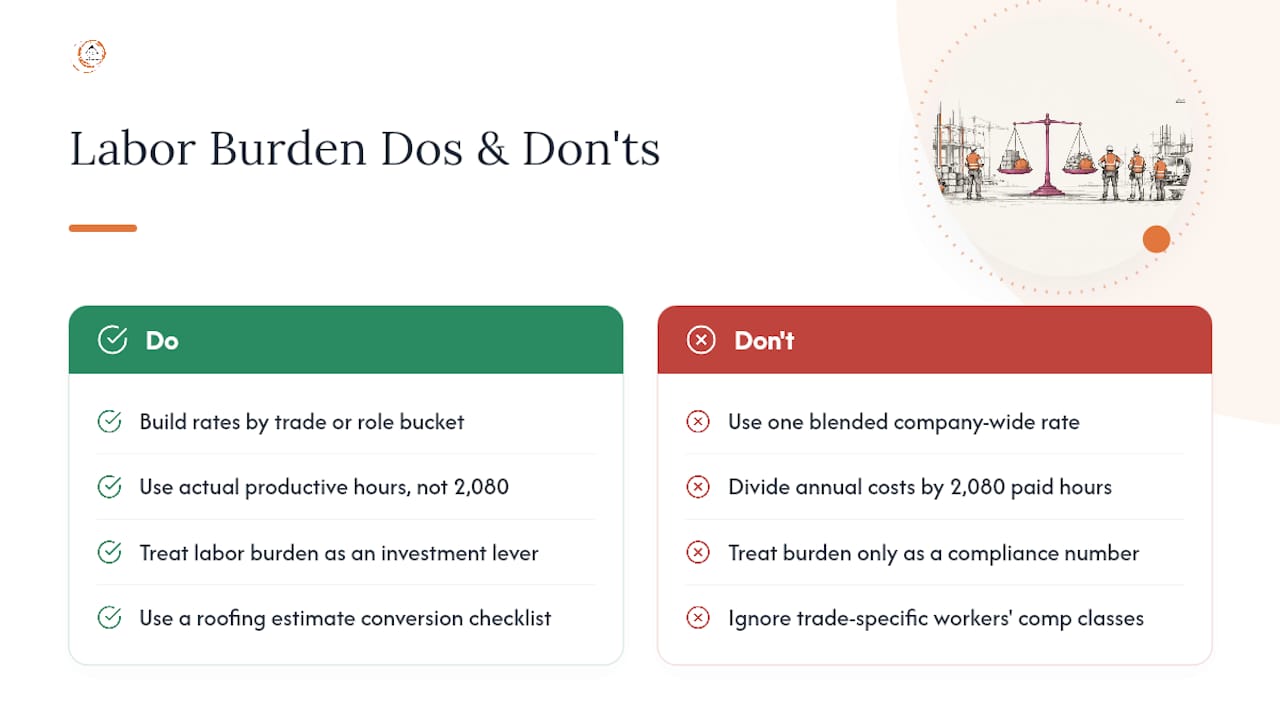
The single most common mistake is using one blended labor burden rate for the whole company. It looks efficient on a spreadsheet, and it’s wrong for almost every job you price. Workers’ comp class codes shift so widely between trades that a roofer and an office estimator should never share a burden percentage. Build rates by trade or role bucket instead: roofing, concrete, framing, interior finish, and so on.
The second mistake is dividing annual costs by 2,080 paid hours instead of actual productive hours, which understates true cost on every single bid.
Treat labor burden less like a compliance number to survive and more like an investment lever. The trades where you carry the highest burden, often the ones with the richest benefits, are frequently the ones with the lowest turnover. Benefit investments that raise your burden percentage can also be the reason you keep skilled crews when competitors are still scrambling to hire.
For roofing contractors specifically, whose comp classes sit near the top of the burden range, a roofing estimate conversion checklist can help translate labor unit pricing into bids that actually reflect the real cost of that trade.
Get Your Burdened Rates Audited Before Your Next Bid Cycle
If you’ve never separated your burden percentage by trade, or you’re still estimating off base wages out of habit, that gap is costing you margin on every job you price. R Construction Solutions LLC’s estimating support works through a straightforward sequence: audit your current numbers, build a burdened-rate model specific to your trades and classifications, then train your estimating team to apply it consistently across every bid.

A typical engagement starts with a review of your payroll, insurance, and benefits data to calculate real burden percentages by role, not a single company-wide guess. From there, we build the model into your existing estimating workflow so it doesn’t create extra steps for your team, and we train whoever owns your bids to keep it updated. Visit the construction consulting services page to request a diagnostic review of your current labor pricing and see exactly where your bids are leaving money on the table.
An Advisor’s Take: Fix Your Burden Rate Before You Fix Anything Else
Across three decades of watching contracting firms scale, the labor burden calculation is consistently the first financial control that gets skipped and the last one that gets fixed. Owners chase bigger contracts and better project management systems while pricing every one of those jobs off a wage number that hasn’t reflected true cost in years.
This week, do three things: run your numbers through a proper burden calculator instead of a rough guess, pull your current workers’ comp experience modification rate and confirm it matches what’s in your estimates, and sit down with whoever builds your bids to walk through the productive-hours method until they can do it without a spreadsheet template open.
— Rowena Tulacz
Sources
- Fully burdened labor rate (Procore library)
- What Is Burdened Labor Rate? Definition for Contractors | Level
- Labor Burden Rate Calculator + Excel Template | Simpro
Recommended
- Construction Bid Automation Best Practices for 2026
- General Contractor Estimating Best Practices 2026
- Build an Estimating Checklist for General Contractor Projects
- Public Works Contracts: What Contractors Must Do to Comply
Running the job and the business at the same time? One short email a week — change orders, billing, job costing, scheduling. Free, no pitch. Subscribe.
Free and unconditional. No call required, no obligation, unsubscribe anytime.