
Avoid Costly Change Orders: 7 Step Bid Leveling for GCs
Bid leveling turns messy proposals into an apples-to-apples comparison by normalizing every bid to a scope baseline before award. The lowest submitted price is often not the lowest real cost once exclusions and unclear items get priced out. Build your scope baseline from the specs and addenda before a single bid arrives, then normalize every proposal against it rather than against how each bidder chose to format their own numbers.
TL;DR:
- Building a scope baseline from specifications and addenda before bid invitations ensures accurate bid normalization and reduces scope gaps later.
- Using a standardized bid form and a detailed leveling matrix with flagged inclusions, exclusions, and uncertainties improves bid comparison transparency and defensibility.
- Sourcing plug numbers from recent projects, industry data, or subcontractor quotes, and documenting them precisely, prevents disputes and supports fair adjustments.
- Reading qualifications before price and thoroughly documenting every scope clarification significantly enhance the accuracy of bid ranking and award recommendations.
- Implementing a documented bid leveling process with templates, workflows, and AI tools reduces manual effort, speeds up analysis, and protects profit margins.
Table of Contents
- What Is Bid Leveling and Why Does It Matter?
- How Do You Build a Scope Baseline Before Bids Arrive?
- How Do You Build and Populate a Leveling Matrix?
- How Do You Source Plug Numbers and Issue Bid Clarifications?
- What Tools and AI Can Speed Up Bid Leveling?
- What Do the Best Precon Teams Do Differently?
- How Do You Produce a Defensible Award Recommendation?
- Practitioner Perspective on Making Bid Leveling Defensible
- Why Bid Leveling Discipline Protects Margin Long Before Award
- How R Construction Solutions Can Help You Build a Bid-Leveling System
- Primary Sources and Templates Referenced in This Guide
- Sources
- FAQ
What Is Bid Leveling and Why Does It Matter?
Bid leveling is the process of adjusting subcontractor or trade bids so they all reflect the same scope of work, then comparing the adjusted totals instead of the raw numbers on the bid form. Without it, you’re comparing five different definitions of the same job and calling it a competition.
The workflow runs in a fixed sequence: prepare a scope baseline, collect bids, analyze them against that baseline, issue clarifications on the gaps, normalize the pricing, and produce a ranked recommendation. Skip a step and the recommendation loses defensibility, which matters the moment a change order dispute lands on your desk six months into the job.
Here’s the sequence that top precon teams follow, in order:
- Build the scope baseline from specs, drawings, and addenda before bids are due.
- Collect bids on a standardized bid form so every subcontractor prices the same line items.
- Read qualifications first, not price, to catch exclusions before they distort your view of the number.
- Populate the leveling matrix, marking each line item included, excluded, or unclear for every bidder.
- Issue bid clarification requests (BCRs) on every gap above your dollar threshold.
- Normalize the numbers with documented plug values for excluded or unclear scope.
- Rank the leveled totals and produce the award recommendation with rationale.
The biggest time sink isn’t collecting bids. It’s chasing clarifications after the fact because the baseline wasn’t built early enough to catch gaps before bid day. A stepwise leveling process like this typically takes an estimator 2 to 4 hours per trade package when done manually, and most of that time goes to chasing down answers rather than building the matrix itself.
The deliverables that come out the other end are what make the process defensible later: a completed leveling matrix, a log of every BCR sent and answered, and scope letters for anything that changed the subcontract’s assumed scope. Those three documents are what an owner’s rep, a bonding company, or a change order dispute will ask to see. If you can’t produce them, your award recommendation is an opinion, not an analysis.
How Do You Build a Scope Baseline Before Bids Arrive?
The baseline comes from the project specifications and every issued addendum, not from whatever the low bidder happened to include. Build it before invitations to bid go out, so it becomes the yardstick every proposal gets measured against instead of a document you’re reverse-engineering from someone else’s assumptions.
The most effective preconstruction teams treat the scope baseline as a deliverable owned by the estimating team before bid day, not a task assembled under deadline pressure once proposals start coming in. That distinction is what separates a team that catches a missing fire-stopping scope in week one from a team that discovers it in a $40,000 change order request in month four.
Certain items get excluded from bids more often than any others, so build them into your baseline template by default:
- Permits and inspection fees
- Commissioning and startup support
- Closeout documentation and as-builts
- Temporary protection of adjacent finishes
- Hoisting, crane time, and material handling
- Testing and balancing where applicable
Store a baseline template for each trade you bid regularly. Electrical, mechanical, and concrete each carry their own recurring exclusion patterns, and a trade-specific template saves you from rebuilding the same checklist from scratch every project.
Pro Tip: Keep a running “gotcha” list per trade, updated after every project closeout. If drywall bids omitted fire caulking twice last year, that line goes into next year’s baseline template before you ever send out an invitation to bid.
Budget enough time to build a baseline for a moderately complex trade package, less once you have a reusable template. That time comes back tenfold the first time it prevents a scope dispute after award.
How Do You Build and Populate a Leveling Matrix?
The matrix is a table with line items down the rows and bidders across the columns, and each cell shows three things: the as-bid figure, any plug adjustment, and the resulting leveled total. That structure lets a reviewer see both what a subcontractor actually submitted and what you adjusted it to, without losing the paper trail between the two.
Every line item gets marked with one of three flags for each bidder:
- INC — the item is clearly included in the bid, with a reference to where the bid form or qualifications confirm it
- EXC — the item is explicitly excluded, usually stated in the qualifications section
- UNCLEAR — the bid form or qualifications don’t say either way, which is its own category of risk
An UNCLEAR flag is not the same problem as an EXC flag, and treating them identically is a common way estimators undersell risk to reviewers. An explicit exclusion tells you exactly what to price in. An unclear item might already be priced in, might not be, and you won’t know until you ask.
Present both numbers to reviewers, always. Show the as-bid total right next to the leveled total, with the plug adjustments itemized between them. A reviewer who only sees the leveled number has no way to sanity-check your adjustments, and that’s exactly the gap that gets exploited when someone challenges a recommendation later.
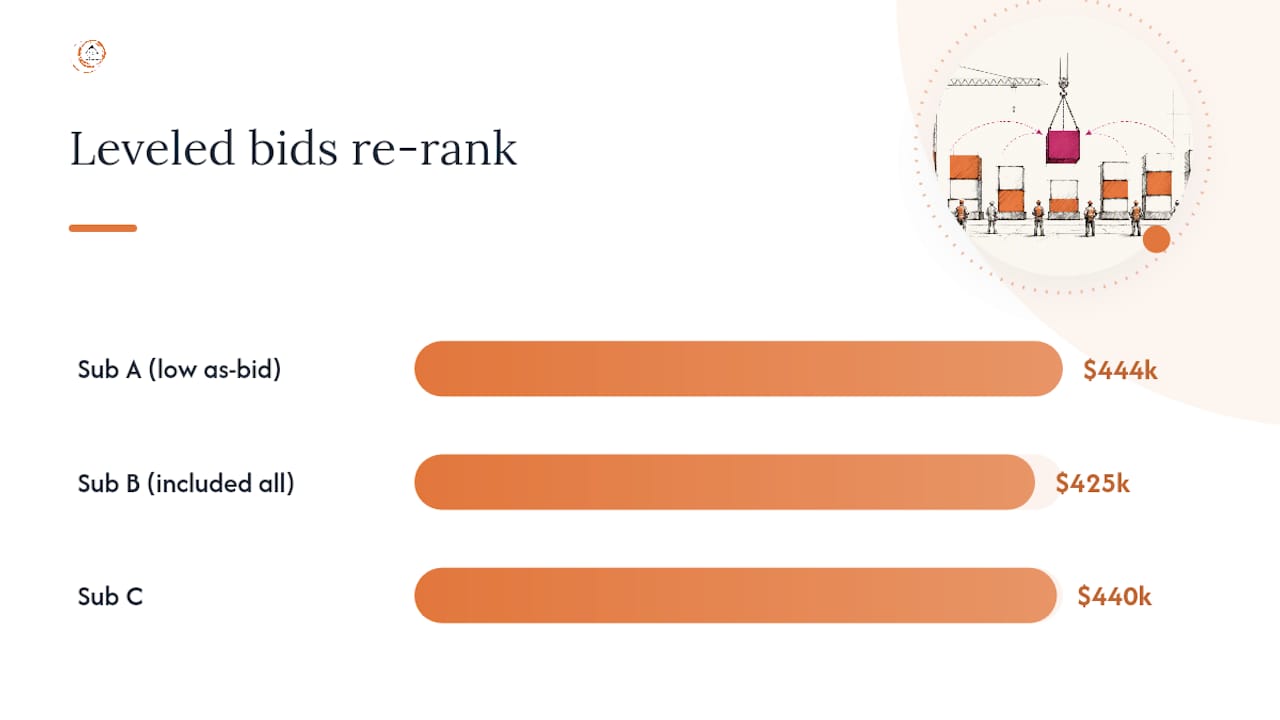
Here’s where leveling changes outcomes: say three drywall subs bid $410,000, $425,000, and $440,000. The low bidder’s qualifications exclude fire-rated assembly testing and after-hours access fees, worth a combined $34,000 based on your plug pricing. Leveled, that bid becomes $444,000, the highest of the three. The $425,000 bidder, who included everything, is now the actual low bid once you compare like to like.
That re-ranking is the entire point of the exercise. Without it, you’d have awarded to the bidder who simply excluded more.
How Do You Source Plug Numbers and Issue Bid Clarifications?
Plug numbers need a documented source, every time, with no exceptions for line items that seem obvious. Undocumented plugs are one of the most common reasons an audit or dispute overturns a bid recommendation, because a plug pulled from memory or gut feel can’t be defended when someone asks where the number came from.
Use a sourcing hierarchy, in this order of preference:
- Pricing from a comparable recent project in your own job cost history
- Published industry cost data, such as RSMeans unit costs, adjusted for local labor and material conditions
- Internal takeoffs, when neither of the above applies and the item is significant enough to warrant a quick quantity survey
- A vetted subcontractor quote for the specific excluded item, obtained as a one-off if time allows
Set a dollar threshold for mandatory bid clarification requests, scaled to the package’s overall risk. A $500 exclusion on a $2 million mechanical package doesn’t need a formal BCR. Set the threshold as a percentage of package size, not a flat dollar figure across every trade.
When you issue a BCR, be specific about what you’re asking. Reference the exact specification section or drawing detail in question, state a clear deadline for response, and send it to every bidder on that package when the clarification affects scope interpretation broadly rather than one subcontractor’s individual submission. Sending it to only one bidder when the ambiguity is universal creates fairness problems that can surface later if that bidder isn’t the one awarded the contract.
Pro Tip: Log every BCR and its response directly in the matrix, with a timestamp and the responder’s name. When a change order argument comes up eighteen months into construction, that log is often the single document that resolves it.
Update the matrix the moment a response comes in. A BCR response that sits in an email inbox for a week while the matrix stays stale defeats the entire purpose of asking.
What Tools and AI Can Speed Up Bid Leveling?
Four categories of tools handle bid leveling today, and they sit on a spectrum from fully manual to largely automated. Spreadsheets remain the default for smaller GCs and single-trade packages. Dedicated bid management platforms add structured intake and standardized bid forms. Specification-intelligence platforms parse the project specs themselves to flag likely exclusion points. AI-assisted scope extraction tools read submitted bid documents and auto-populate a starting matrix.
What automation actually speeds up is the mechanical part of the job: pulling text out of PDF bid forms, flagging qualification language that suggests an exclusion, and building the first-pass matrix so an estimator isn’t typing every line item by hand. AI scope extraction can produce an initial matrix in minutes rather than the hours a manual build takes.
What it doesn’t replace is judgment. An AI tool flags a phrase that resembles an exclusion, but deciding whether that phrase actually changes the scope, and how much a fair plug number costs, still requires an estimator who understands the specification and the local market. The tool shifts the estimator’s role from data entry to validation, which is a different skill than typing numbers into cells, not a smaller one.
A practical combination pattern that works for most precon teams:
- Run bid PDFs through an AI extraction tool for a first-pass matrix
- Have the estimator validate every INC/EXC/UNCLEAR flag against the actual bid language
- Confirm plug numbers manually against your sourcing hierarchy, never accept an AI-suggested figure without a citation
- Store the final matrix, BCR log, and source documentation together in one project folder
On data governance, keep every version of the matrix, not just the final one. If a reviewer or auditor asks how a number changed between the second and third round of clarifications, you want that history intact, not overwritten.
What Do the Best Precon Teams Do Differently?
The teams that consistently produce defensible bid recommendations share a handful of habits, and none of them are complicated. They’re just consistently applied when other teams cut corners under bid-day time pressure.
- Build the scope baseline before bids go out, never after
- Read the qualifications section before looking at the summary price
- Use a standardized bid form and a saved trade-specific baseline template for every recurring package type
- Issue a BCR for every gap above the dollar threshold, no exceptions for “probably fine” items
- Convert every material clarification into a written scope letter before the subcontract is signed
- Document the source of every plug number at the time it’s entered, not reconstructed later from memory
Reading qualifications before price produces measurably better gap detection than starting with the bottom-line number, because a low number anchors your read of everything that follows. Once you’ve seen $410,000, it’s hard to read that bidder’s exclusions with a fully open mind.
The single most common mistake is the opposite habit: anchoring on the submitted price and only checking qualifications on the low bidder, if at all. That approach misses the exact scenario the drywall example above illustrates, where the apparent low bid becomes the actual high bid once you level it.
Pro Tip: Print the qualifications pages separately from the summary sheet when you’re reviewing bids for the first time. Read qualifications for all bidders before you let yourself see a single price figure.
The second most common mistake is treating documented plugs as optional paperwork rather than the evidence that makes your recommendation stand up later.
How Do You Produce a Defensible Award Recommendation?
The award package needs to include the complete leveled matrix, the ranked leveled totals for every bidder, and every plug number with its source cited next to it. A recommendation that shows only a final ranking, with no visible math behind it, invites the exact question you don’t want to answer under pressure: “How did you get to this number?”
Include any non-price factors that affected ranking, such as schedule reliability, bonding capacity, or safety record, and state clearly how much weight each factor carried. If a slightly higher leveled bid won because of a demonstrably better completion schedule, say so explicitly rather than burying it in a footnote.
Before the contract is executed, every clarification that changed the scope needs to become a formal scope letter attached to the subcontract. Connecting the bid-leveling analysis directly to a scope letter is what preserves your negotiated scope in the actual contract documents, rather than leaving it stranded in an email thread that nobody reads again until there’s a dispute.
Archive the final matrix, the full BCR log, and every scope letter together, tied to the project file. When a change order argument surfaces during construction, that archive is usually the fastest way to resolve it, because it shows exactly what was priced, what was clarified, and what both parties agreed to before signing.
For reviewers who don’t need the full detail, format the package as a one-page summary with the ranking and rationale up front, followed by the full matrix and supporting documentation as appendices. Nobody on a review committee wants to dig through 40 line items to find your recommendation.
Practitioner Perspective on Making Bid Leveling Defensible
Bid leveling done well is an advisory discipline as much as an estimating task, which is where a firm like R Construction Solutions LLC fits into a contractor’s preconstruction process. Rowena Tulacz brings more than three decades of operations and business development advisory experience in the construction industry, with a specific focus on the financial and process discipline that separates a defensible bid recommendation from a guess dressed up in a spreadsheet.
Estimating support services can help contractors build standardized templates, trade-specific baselines, and sample scope letters that make bid leveling repeatable instead of reinvented on every project. That kind of process design work pairs naturally with project management system implementation, since a leveling matrix is only as useful as the workflow that gets it into the hands of the people signing subcontracts.
Why Bid Leveling Discipline Protects Margin Long Before Award
The real cost of skipping bid leveling rarely shows up on bid day. It shows up eight months later, in a change order request for scope that everyone assumed was included because nobody wrote it down. Given the workforce pressures already straining precon teams, the temptation to skip the baseline step and just compare bottom lines is real, and it’s exactly the wrong response to being short on staff.
Assign the baseline task to a specific person for every package, with a deadline that sits before bids are due, not after. Train junior estimators on qualifications review before you let them touch pricing analysis. I’ve seen a leveled matrix catch a six-figure exclusion on a mechanical package that would have otherwise gone unnoticed until the first change order request landed. That’s not a rare outcome. It’s what the process is built to catch.
— Rowena Tulacz
How R Construction Solutions Can Help You Build a Bid-Leveling System
Building the templates, baseline checklists, and BCR workflows described above from scratch takes time most precon teams don’t have between live bid packages. Some construction consulting firms work directly with growth-stage contractors to build that system once, so every future bid gets leveled against a proven template rather than a blank spreadsheet.

Estimating support and bid preparation services help contractors improve estimate accuracy and reduce risk on large packages, drawing on operational advisory experience rather than a one-size-fits-all software rollout. That work often pairs with process improvement and workflow optimization, since a leveling matrix only earns its keep when it’s built into how your team actually reviews bids, not treated as a one-off exercise for a single project. For general contractors specifically, the services built for GC preconstruction teams cover estimating support, subcontractor management, and workflow design in one engagement.
If your team is leveling bids manually with no standard template and no documented BCR process, that’s a common gap that specialized consulting can help close. Reach out through the construction consulting services page to scope out what a template build or estimating support engagement would look like for your next bid package.
Primary Sources and Templates Referenced in This Guide
- Bid Leveling Best Practices: What the Best GC Precon Teams Do Differently
- How to Level Subcontractor Bids: A Step-by-Step Process
- Bid Leveling: Complete Guide and Template
- Guide to Subcontractor Bid Leveling
- For trade-specific comparison practices, see this roofing bid comparison process breakdown.
Sources
- Bid Leveling Best Practices — What the Best GC Precon Teams Do Differently
- How to Level Subcontractor Bids: A Step-by-Step Process for GC Estimators
- Bid Leveling: Complete 2026 Guide + Free Template | SpecLens
- Guide to subcontractor bid leveling
FAQ
What Is Bid Leveling in Construction?
Bid leveling is the process of normalizing subcontractor or trade bids to a common scope baseline so you compare apples to apples instead of comparing whatever each bidder chose to include. The leveled totals often re-rank the bidders compared to their raw submitted prices.
How Do You Tell a Contractor Their Price Is Too High?
Show them the leveled matrix alongside their as-bid number, with the specific line items and plug adjustments that account for the difference. A documented matrix turns a potentially awkward conversation into a factual walkthrough of exactly what’s included and excluded in each competing bid.
What Are Common Bidding Mistakes to Avoid?
The two biggest mistakes are anchoring on the submitted price before reading qualifications, and failing to document where plug numbers came from. Reading qualifications first catches exclusions before they distort your read of the price, and sourced plug numbers are what make an award recommendation defensible later.
What Are the Seven Stages of Construction?
Construction projects generally move through planning, design, preconstruction, procurement, construction, commissioning, and closeout. Bid leveling sits inside the preconstruction and procurement stages, where accurate contractor selection has the biggest effect on the budget and schedule that follow.
How Much Does Bid Leveling Support Cost?
Pricing depends on the scope of support needed, from a single template build to ongoing estimating support across multiple projects. Current pricing for R Construction Solutions LLC’s estimating and consulting services is available directly on the site.
Recommended
- General Contractor Estimating Best Practices 2026
- Build an Estimating Checklist for General Contractor Projects
- Construction Bid Automation Best Practices for 2026
- How to Improve Your Construction Estimating Process
Running the job and the business at the same time? One short email a week — change orders, billing, job costing, scheduling. Free, no pitch. Subscribe.
Free and unconditional. No call required, no obligation, unsubscribe anytime.