
What Is a Cost Estimator? Career Guide and Essential Skills | R. Construction Solutions
A cost estimator collects and analyzes data to calculate the time, money, materials, and labor required to complete a project, whether that’s a commercial building, a manufactured product, or a contracted service. According to the U.S. Bureau of Labor Statistics, cost estimators work across construction, manufacturing, and engineering, and the occupation carries a well-defined career ladder from junior roles to chief estimator. O*NET’s SOC code 13-1051.00 classifies the role under Business and Financial Operations, which tells you something important: estimating is as much a business function as a technical one. If you want a career that sits at the intersection of numbers, project strategy, and competitive bidding, this guide maps the full path.
Table of Contents
- Where do cost estimators work and what is the job setting like?
- What skills and tools do you need to succeed as an estimator?
- Which certifications and professional bodies matter most?
- Practical tips to build your estimating career faster
- Key Takeaways
- An advisor’s perspective on what actually moves the needle
- Useful sources and further reading
Where do cost estimators work and what is the job setting like?
Construction is the largest employer of cost estimators, but the role exists wherever projects have budgets: manufacturing, engineering consulting, government agencies, and owner-side project management firms all hire estimators regularly. The BLS Occupational Outlook Handbook lists construction and manufacturing as the two dominant industries, with specialty trade contractors and general contractors making up a large share of construction-side employers.
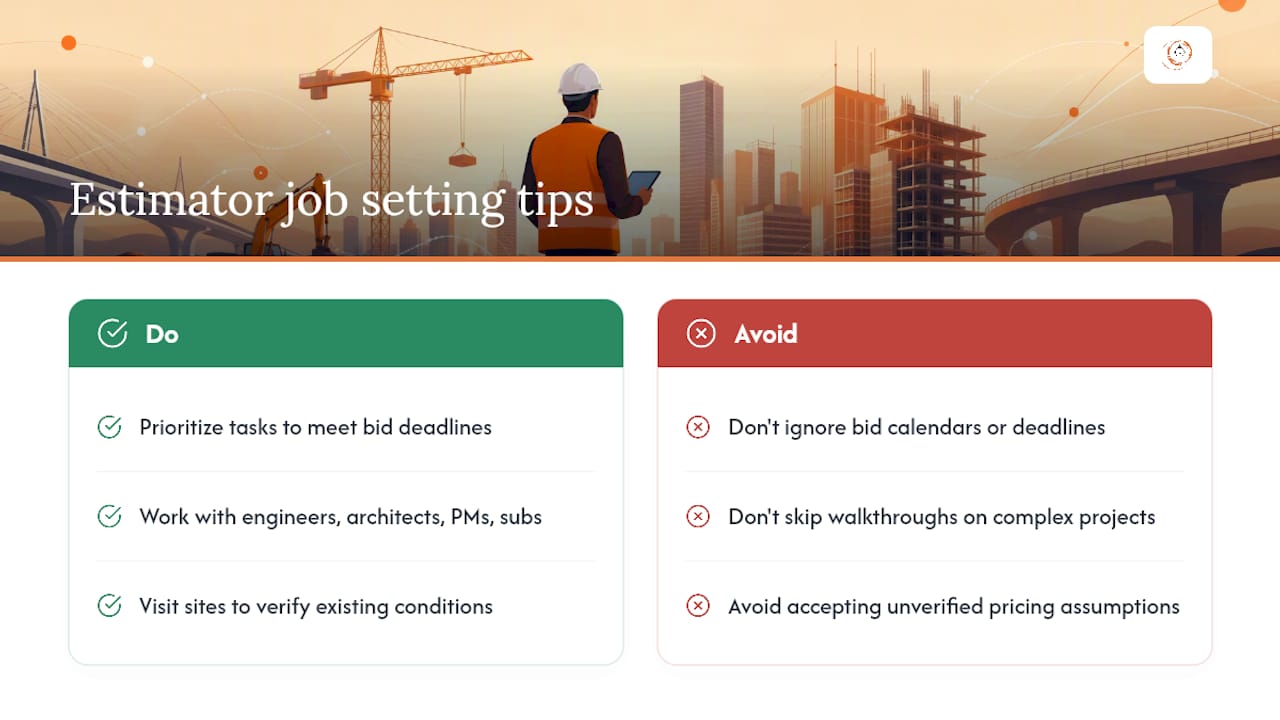
Most of the work happens at a desk. You’ll spend the majority of your time reading drawings, running takeoff software, and building pricing models. Site visits do occur, particularly when you need to verify existing conditions before pricing a renovation or when a project is complex enough that a walkthrough changes the numbers. Collaboration is constant: estimators work alongside engineers, architects, project managers, and subcontractors to validate scope and confirm pricing assumptions.
Bid cycles create natural pressure points. Proposal deadlines compress timelines, and a single estimator at a small firm may be managing several bids simultaneously. At larger firms, estimating teams divide work by trade or project phase. Either way, the rhythm of the job is shaped by bid calendars, and the ability to prioritize under deadline is a real professional skill.
What skills and tools do you need to succeed as an estimator?
Strong estimators combine analytical precision with practical communication. The core skill buckets, as reflected in My Next Move’s occupational profile, are: mathematical reasoning, the ability to read and interpret construction drawings, written and verbal communication, judgment on pricing risk, and proficiency with cost databases and estimating software.
Software tools employers expect
- PlanSwift: Digital takeoff tool for measuring quantities directly from PDF plans; widely used by general contractors and specialty subs
- Bluebeam Revu: PDF markup and collaboration platform used for annotating drawings and coordinating scope reviews
- ProEst: Cloud-based estimating software with built-in cost databases and bid management features
- Sage Estimating: Enterprise-level estimating platform common in mid-to-large construction firms
- Trimble (DESTINI Estimator): Used heavily in commercial construction for detailed cost modeling and historical benchmarking
- RSMeans: Industry-standard cost database for benchmarking labor and material unit prices by region
- Microsoft Excel: Still the backbone of many estimating workflows for custom models, bid comparisons, and cost summaries
For a deeper look at how these tools fit into the bidding process, this breakdown of estimating software in construction bids explains what each category of tool actually does versus what vendors claim.
Self-assessment checklist for candidates:
- Can you perform a quantity takeoff from a set of architectural drawings?
- Do you understand productivity units (labor hours per unit of work)?
- Can you solicit and compare subcontractor quotes for scope gaps?
- Have you set a contingency allowance and explained your reasoning to a project manager?
If you answered no to two or more of those, your near-term training focus is clear. Vendor tutorials for PlanSwift and Bluebeam are free and a practical starting point.
Which certifications and professional bodies matter most?
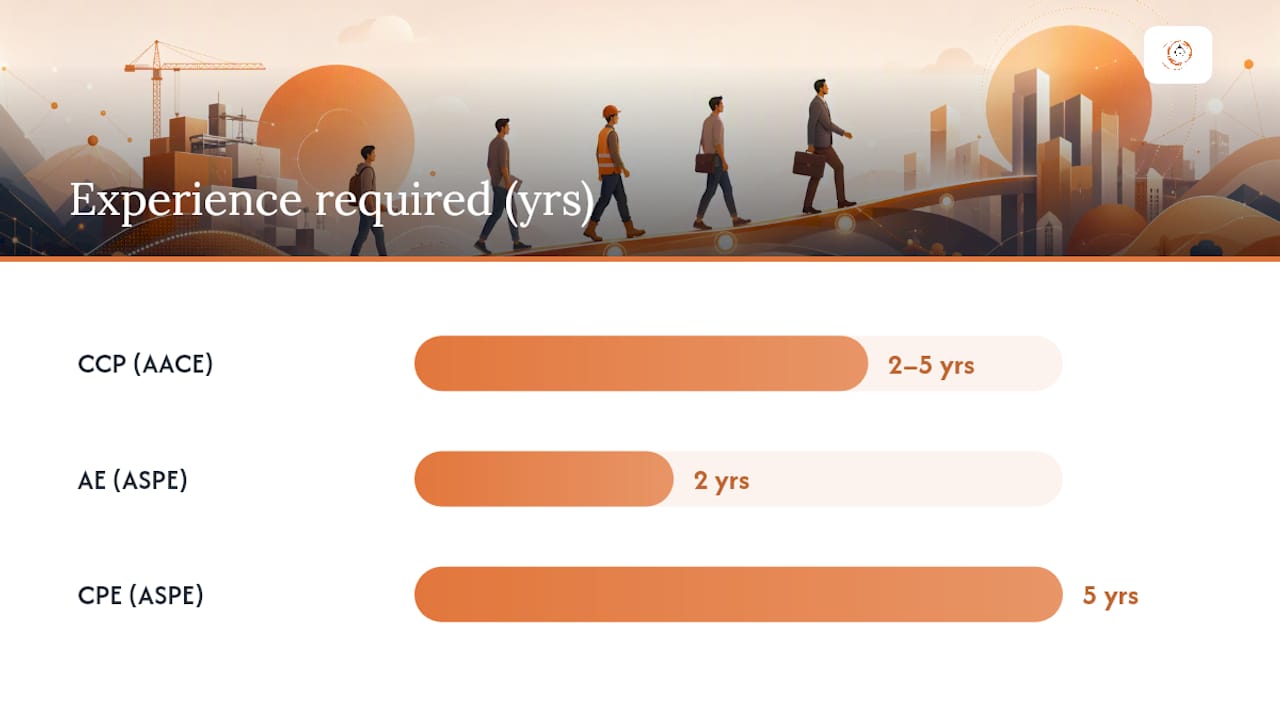
Two organizations dominate professional credentialing for cost estimators in North America: AACE International and the American Society of Professional Estimators (ASPE). Both offer tiered certifications that signal competency to employers and clients.
| Certification | Issuing Body | Typical Prerequisites | Focus |
|---|---|---|---|
| Certified Cost Technician (CCT) | AACE International | Entry-level; no experience required | Foundational cost estimating concepts |
| Certified Cost Professional (CCP) | AACE International | 2–5 years of experience (or degree + fewer years) | Advanced cost management and project controls |
| Associate Estimator (AE) | ASPE | 2 years of experience | Construction estimating fundamentals |
| Certified Professional Estimator (CPE) | ASPE | 5 years of experience | Senior-level construction estimating |
AACE’s framework, outlined in their recommended practice 101R-19, describes a tiered maturity model where junior estimators focus on quantity takeoffs and data collection, while senior practitioners manage methodology, estimate quality, and risk communication. Earning a CCT early signals that you understand the framework, even before you have years of experience behind you.
ASPE’s CPE designation is particularly recognized among general contractors and specialty subcontractors in the U.S. construction market. If your career is construction-focused, ASPE membership also gives you access to local chapters, which are practical networking resources.
Pro Tip: If you’re just starting out, pursue the AACE CCT first. It requires no experience, the study material teaches you the vocabulary and process framework that every employer expects, and it gives you a credential to put on a resume before you have years of experience to list.
Practical tips to build your estimating career faster
Process and judgment produce reliable estimates. Software helps, but an estimator who understands scope, risk, and pricing logic will outperform one who just knows the tools. That’s the single most important thing to internalize early.
Building your portfolio:
- Complete takeoffs on publicly available plan sets (many state and municipal agencies post bid documents online)
- Annotate your takeoffs to show your reasoning, not just the numbers
- Include a sample bid summary that shows how you moved from quantities to a total price
- Add a subcontractor comparison log, even a simple one, to demonstrate bid reconciliation awareness
Quick wins for early-career estimators:
- Master one takeoff tool (PlanSwift or Bluebeam) before branching into others
- Build a regional pricing spreadsheet using RSMeans data for your target market
- Practice bid reconciliation by comparing two subcontractor quotes on the same scope and writing up the differences
- Connect with subcontractors in your area; understanding how they price work makes you a better estimator immediately
For a structured approach to tightening your process, this guide to improving your construction estimating process covers the workflow steps that separate accurate bids from costly misses.
Rowena Tulacz, founder of R Construction Solutions LLC, has spent 30+ years advising construction businesses on operations, business development, and estimating strategy. If you’re a contractor looking to improve estimate accuracy, reduce bid risk, or build out an estimating function, R Construction Solutions LLC offers estimating support and consulting services tailored to growth-stage contracting firms.
Key Takeaways
A cost estimator’s value to any organization comes down to one thing: converting project scope into a number that is both competitive and defensible, and doing it consistently under deadline pressure.
| Point | Details |
|---|---|
| Core definition | Cost estimators calculate time, money, materials, and labor required to complete a project across construction, manufacturing, and engineering. |
| Entry path | A bachelor’s degree in construction management or a related field is the most common route; trade experience can substitute in construction. |
| Essential tools | PlanSwift, Bluebeam, ProEst, Sage Estimating, Trimble, RSMeans, and Excel are the tools employers expect candidates to know. |
| Top certifications | AACE’s CCT is the best first credential; ASPE’s CPE is the benchmark for experienced construction estimators. |
| Salary range | Average yearly earnings vary widely depending on experience, industry, and specialization. |
An advisor’s perspective on what actually moves the needle
Most people entering estimating focus on the wrong thing first. They spend weeks learning software features when the real skill gap is scope reading and pricing judgment. A junior estimator who can read a set of drawings, identify what’s missing, and ask the right questions before the bid goes out is worth more than one who can run every feature in PlanSwift but misses a $40,000 scope gap.
The other thing that gets underestimated: bid reconciliation. Comparing subcontractor quotes line by line, not just total price, is where experienced estimators protect margins. Two subs can be $30,000 apart on the same scope, and the difference is almost never random. One of them is excluding something. Finding that exclusion before you submit the bid is the job.
For anyone building an estimating career, the sequence that works is: learn to read drawings well, master one takeoff tool, build a pricing reference for your market, and then pursue your first certification. In that order. The credential matters more once you have the underlying competency to back it up.
And for contractors who need estimating support now rather than in two years, getting professional help on a complex bid is a legitimate business decision. Accurate estimates protect margins. Inaccurate ones erode them, sometimes on a single job.
Useful sources and further reading
- Cost Estimators : Occupational Outlook Handbook
- 101R-19: Roles and Responsibilities of a Cost Estimating Practitioner
- Daily Tasks of Construction Estimators
- Construction Estimator: Key Roles & Responsibilities
- 13-1051.00 - Cost Estimators
- Cost Estimator - College of Science (Purdue)
- Cost estimator salary ‐ CareerExplorer
- Cost Estimators (My Next Move)