
Electrical Project Cost Components Every Estimator Must Know
A complete electrical estimate covers five broad cost groups: direct (production) costs, indirect and overhead costs, general conditions and site logistics, allowances, contingency, and escalation, and specialty and commissioning costs. Miss any one of them and your bid is either dangerously thin or uncompetitive before you submit it.
Here is what each group contains at the line-item level:
- Direct costs: materials (wire, conduit, fittings, devices, fixtures, switchgear, transformers), labor, equipment and tool costs, subcontracted specialty trades
- Indirect/overhead costs: site supervision, project management, small tools, insurance, bonds, home-office overhead, profit
- General conditions: mobilization/demobilization, temporary power, site trailers, trash removal, permits, QA/QC supervision
- Allowances, contingency, escalation: owner-directed allowances, estimator risk contingency, sales tax, material price escalation
- Specialty and commissioning: factory acceptance tests, commissioning labor, arc-flash labeling, O&M manuals, warranty reserves, spare parts, training
According to job-costing guidance for electrical contractors, materials commonly account for a significant portion of total job cost, with labor making up much of the remainder. That split shifts significantly on gear-heavy projects (switchgear, transformers, large distribution panels) versus labor-intensive retrofit work. Understanding where your project falls on that spectrum before you build the estimate is one of the fastest ways to catch a structural pricing error early.
Key Takeaways
A complete electrical estimate requires all five cost groups: direct costs, indirect/overhead, general conditions, allowances with contingency, and specialty/commissioning items — missing any one group creates structural bid risk.
| Point | Details |
|---|---|
| Labor burden is not the wage rate | A journeyman at $38.00/hour carries a loaded rate near $55/hour once FICA, workers’ comp, benefits, and PTO are added. |
| Materials run 30–50% of job cost | That split shifts on gear-heavy projects; identify your project’s profile before building the takeoff. |
| Contingency scales with design completeness | Carry 15–25% at conceptual stage, 10–15% at schematic, and 3–7% at detailed bid stage. |
| Specialty items are frequently missed | Commissioning labor, arc-flash labeling, O&M manuals, and warranty reserves must be priced, not assumed. |
| Validate unit prices against current sources | Use RSMeans and Craftsman National Estimator as a starting point, then adjust for local labor rates and supplier quotes. |
Table of Contents
- What are the direct cost components you need to itemize in your takeoff?
- How do indirect costs and overhead fit into an electrical estimate?
- What general conditions and site logistics costs belong in your estimate?
- How do you size allowances, contingency, and escalation in a bid?
- Which specialty and commissioning costs do estimators most often miss?
- How do you build a cost breakdown structure and map costs to estimate levels?
- A practical sample electrical cost breakdown for North America
- Estimator’s checklist: what to verify before you submit a bid
- Why disciplined cost-component accounting changes your margin trajectory
- Sources
What are the direct cost components you need to itemize in your takeoff?
Commercial electrical estimating groups costs into production (direct) and non-production (indirect) categories, and the direct side is where every estimate starts. These are the costs that move in direct proportion to the scope: more conduit means more material, more labor hours, more equipment time.
Materials
Material categories for a typical electrical project include:
- Wire and cable: THHN, MC cable, service entrance conductors, low-voltage cabling
- Conduit and fittings: EMT, rigid, PVC, flex, couplings, connectors, straps
- Wiring devices: receptacles, switches, GFCI/AFCI devices, cover plates
- Fixtures and luminaires: LED troffers, high-bays, exit/emergency units
- Distribution equipment: panelboards, switchgear, transformers, disconnect switches, ATS units
- Low-voltage systems: fire alarm devices, data/telecom rough-in, security conduit
Apply a waste factor to every material category. Skipping waste factors on a large commercial project can leave you short on material budget by a meaningful margin.
Labor: NECA units, loaded rates, and the labor-first workflow
Estimators commonly build labor first because it is the largest and riskiest cost bucket. Starting with a validated labor build exposes where productivity adjustments or contingencies are needed before you layer in material pricing.
The standard reference for electrical labor is the NECA Manual of Labor Units, which publishes time values for installed electrical items. A journeyman installing 100 feet of 3/4" EMT in a commercial wall might carry 2.5–3.5 labor hours in the NECA tables, but your actual crew productivity on a congested retrofit site could push that to 4.5 hours. Adjust to your conditions.
The loaded hourly rate is not the wage rate. It includes:
- Base wage (journeyman or master electrician)
- FICA (Social Security and Medicare): 7.65% of gross wages
- FUTA/SUTA (federal and state unemployment taxes)
- Workers’ compensation insurance (rates vary significantly by state and classification)
- Health, dental, and vision benefits
- Paid time off and holidays (typically 10–15% of base wage when annualized)
- Apprenticeship and training fund contributions
The 2026 National Electrical Estimator from Craftsman Book Company provides sample loaded labor cost figures and manhour columns, and it explicitly notes that published tables require adjustment to local conditions and crew productivity. Use those figures as a validated starting point, not a final answer.
Sample unit-pricing reference
The table below shows illustrative unit-pricing structure. Always validate material pricing against current supplier quotes and labor hours against NECA units adjusted for your local market.
Pricing is illustrative. Validate against RSMeans or current supplier quotes. Loaded labor rates vary by region, union/non-union status, and benefit structure.
Pro Tip: Use RSMeans Data and the Craftsman National Estimator Cloud as your primary validation tools for unit prices, but always layer in your own supplier quotes for long-lead or high-value items like switchgear and transformers. Published databases are a floor, not a ceiling.
Equipment and subcontractors
Equipment costs cover rented or owned tools: aerial lifts, cable pullers, conduit benders, and test equipment. For owned equipment, apply a pro-rated ownership cost per job based on annual utilization. Rental costs are straightforward: rate × duration.

Subcontracted specialty trades (fire alarm, structured cabling, AV, security) require a defined scope of work before you price them. Get written sub quotes and add a markup for coordination and risk. Never carry a sub’s number at face value without reviewing their exclusions.
How do indirect costs and overhead fit into an electrical estimate?
Indirect costs do not attach to a single installed unit, but they are just as real as wire and conduit. The distinction matters for cost breakdown structure (CBS) and for understanding where your margin actually lives.
Project-level indirect costs include:
- Site supervision (foreman, general foreman, project manager time allocated to the job)
- Permit fees and inspection fees
- Temporary facilities (portable toilets, first-aid supplies)
- Small tools and consumables (drill bits, tape, wire nuts, PPE)
- Waste disposal and dumpster costs
- Project-specific insurance riders
- Performance and payment bonds (typically 1–3% of contract value, depending on bond amount and contractor credit rating)
Home-office overhead covers the costs of running the firm: estimating staff, accounting, office rent, vehicles, software subscriptions, and executive salaries. Most electrical contractors allocate home-office overhead as a percentage of revenue or direct cost. Job-costing guidance suggests that a practical overhead allocation for many firms runs near 12% of revenue, though the right number depends on your firm’s actual cost structure.
Profit is a separate line, not a component of overhead.
Labor burden: a concrete example
Say your journeyman electrician earns a typical base wage. Labor burden adds payroll taxes, workers’ compensation, benefits, paid time off, and training fund contributions to this wage, resulting in a loaded rate considerably higher than the base wage alone. Estimators who use the base wage instead of the loaded rate systematically underbid labor on every job.
One important scope clarification: some owners furnish fixtures, devices, or specialty equipment directly. When that is the case, remove those material costs from your estimate and flag them as owner-furnished, contractor-installed (OFCI) items. Carry only the labor and any required rough-in material.
What general conditions and site logistics costs belong in your estimate?
General conditions are duration-driven costs. They do not scale with the quantity of wire you pull; they scale with how long your crew is on site. Price them accordingly.
Common general-condition line items for electrical work:
- Mobilization and demobilization: truck time, equipment transport, initial site setup and final cleanup. Price as a lump sum or a day-rate × mobilization days.
- Temporary power: generator rental or utility temporary service, distribution panels, extension cords, GFCI protection. Rate × weeks on site.
- Site trailer or storage container: monthly rental × project duration in months.
- Trash removal and dumpster: monthly rate or per-pull cost × estimated pulls.
- Permits and inspection fees: pull the actual fee schedule from the authority having jurisdiction (AHJ). Many jurisdictions base fees on project valuation; others charge flat fees per inspection.
- QA/QC supervision: dedicated quality-control time, especially on projects requiring special inspections or commissioning sign-off.
- Safety compliance costs: fall protection equipment, lockout/tagout supplies, arc-flash PPE, safety training time, and any OSHA-required documentation. These are real costs and belong in the estimate, not absorbed silently into labor.
A simple duration formula: if a site trailer rents for $350/month and your project runs 14 weeks (3.5 months), your trailer cost is $1,225. Apply the same logic to temporary power, portable toilets, and any other time-based cost.
Some general conditions are billable directly to the job as separate line items; others are absorbed into your overhead percentage. The key is consistency: pick a method and apply it the same way across every bid so your job-cost reports are comparable.
How do you size allowances, contingency, and escalation in a bid?
These three items serve different purposes, and conflating them is one of the most common structural errors in electrical project budgeting.
Allowances cover known unknowns where the owner or design team has not yet made a final selection. A lighting fixture allowance, for example, holds a dollar value per fixture when the specification says “owner to select.” Allowances are owner-directed and should be clearly labeled as such in your bid so the owner understands they are not a contingency buffer.
Contingency is the estimator’s risk reserve. It covers scope gaps, productivity uncertainty, and design incompleteness. The appropriate contingency percentage depends on estimate level and design completeness:
- Conceptual/preliminary estimate (less than 30% design): 15–25% contingency is reasonable
- Schematic/budget estimate (30–60% design): 10–15%
- Detailed/bid estimate (90–100% design documents): 3–7%
An electrical estimate built from drawings is constructed from three layers: quantities, unit costs, and labor. The more complete the drawings, the tighter each layer, and the lower the contingency you need to carry.
Escalation accounts for material price movement between the estimate date and the purchase date. On projects with long lead times (switchgear, transformers, large cable orders), a 6–18 month gap between estimate and procurement is common, and if your contract does not include a price-adjustment clause, you carry that risk.
Sales tax on materials is a direct cost in most U.S. states. Rates vary by state and sometimes by county. Never bury sales tax in your overhead percentage; carry it as a separate line on materials so it is visible and auditable.
| Estimate Level | Design Completeness | Suggested Contingency Range |
|---|---|---|
| Conceptual | Less than 30% | 15–25% |
| Schematic/budget | 30–60% | 10–15% |
| Detailed/bid | 90–100% | 3–7% |
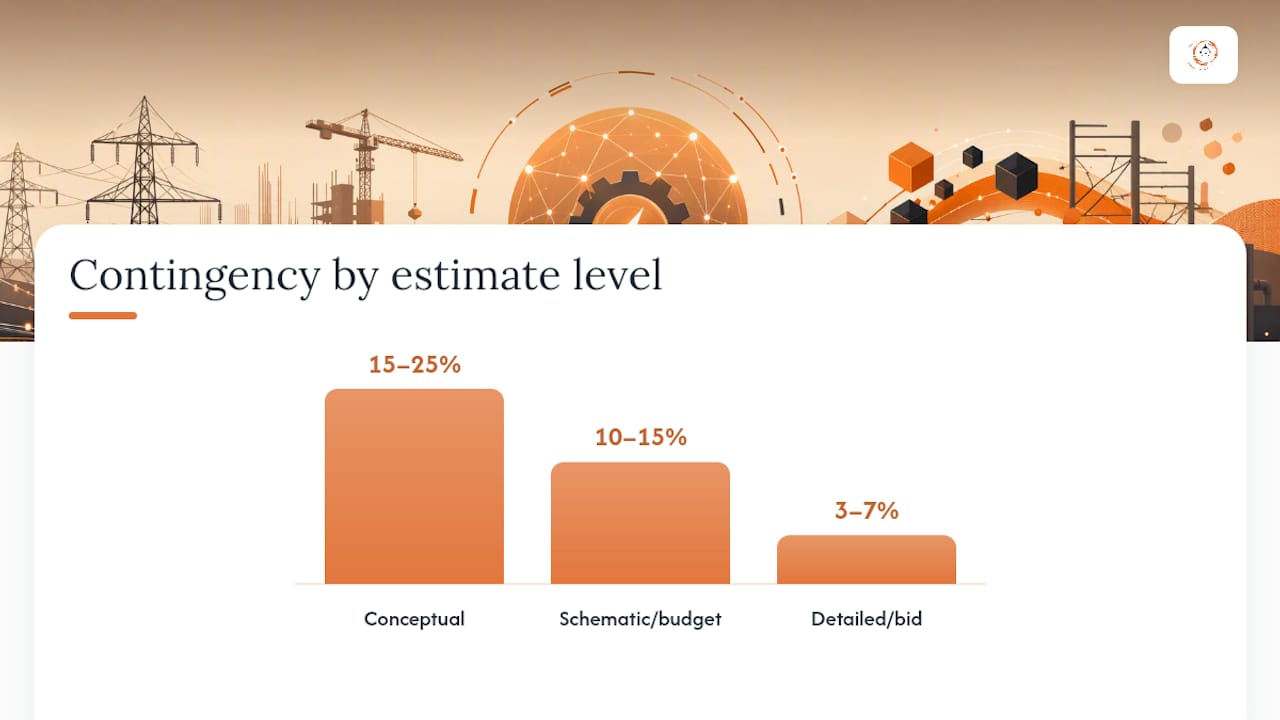
As design documents solidify, roll allowances into priced line items and reduce contingency accordingly. Document every change so the client can see how the number moved and why.
Which specialty and commissioning costs do estimators most often miss?
Specialty and closeout costs are the line items that experienced estimators know to include and less experienced ones forget. Missing them does not just hurt margin; it creates disputes at project closeout when the owner expects deliverables you never priced.
Items to carry in every applicable estimate:
- Factory acceptance testing (FAT): for switchgear, transformers, and ATS units, FAT may be specified. Price travel, per diem, and technician time.
- Commissioning labor: startup and functional testing of distribution equipment, lighting controls, fire alarm interfaces, and building automation tie-ins. This is often a separate scope from installation labor.
- ATS (automatic transfer switch) testing: load-bank testing, transfer time verification, documentation.
- Arc-flash labeling: NFPA 70E requires arc-flash hazard labels on electrical equipment. If the owner requires a full arc-flash study, that is typically an engineering subcontract; labeling itself is a labor line item.
- O&M manuals and as-built drawings: time to compile, review, and deliver operations and maintenance documentation. Often underestimated; on a large commercial project, this can run 20–40 hours of PM and admin time.
- Warranty reserve: a line item covering the cost of returning to address warranty callbacks during the warranty period (typically one year). A common approach is 0.5–1.5% of contract value, depending on system complexity.
- Spare parts and attic stock: many specifications require the contractor to furnish spare lamps, breakers, fuses, or devices. Read the spec carefully and price what is required.
- Owner and operator training: for complex systems (lighting controls, energy management, fire alarm), the specification may require formal training sessions. Price instructor time and any training materials.
Whether these items are self-performed or subcontracted depends on your firm’s capabilities. Either way, they need a dollar value in the estimate. A lump-sum allowance is acceptable at early estimate stages; detailed bids should carry unit-rate or quoted pricing.
Sample line-item phrasing you can drop directly into a bid:
- Testing allowance, electrical systems: $[amount] LS
- Commissioning labor, distribution and controls: $[amount] LS
- Warranty reserve (1 year, 1% of contract): $[amount] LS
- O&M manuals and as-built documentation: $[amount] LS
How do you build a cost breakdown structure and map costs to estimate levels?
A cost breakdown structure (CBS) is the organizing framework that makes your estimate auditable, transferable, and comparable across projects. For electrical work, a practical CBS hierarchy looks like this:
- Division (CSI Division 26 for electrical)
- System (e.g., Power Distribution, Lighting, Low-Voltage, Special Systems)
- Subsystem (e.g., Panelboards, Branch Circuits, Feeders)
- Line item (e.g., 3/4" EMT conduit, 20A circuit breaker, 4" LED downlight)
- Subsystem (e.g., Panelboards, Branch Circuits, Feeders)
- System (e.g., Power Distribution, Lighting, Low-Voltage, Special Systems)
Organizing your estimate this way lets you roll up costs by system for owner reporting, drill down to line items for scope verification, and compare system-level costs across similar projects over time.
Mapping costs to estimate levels
- Conceptual budget: price at the system level using historical cost-per-square-foot or cost-per-unit benchmarks. Allowances dominate; line-item detail is minimal. Contingency is high (15–25%).
- Schematic/budget estimate: price major subsystems with preliminary quantities and unit rates from RSMeans or Craftsman. Allowances remain for unresolved selections. Contingency drops to 10–15%.
- Detailed/bid estimate: full unit-price takeoff at the line-item level. Unit-price analysis separates material, labor, and equipment for each installed unit, producing an auditable estimate that also accelerates change-order pricing. Contingency is 3–7%; allowances are limited to genuinely unresolved owner selections.
As the estimate matures from conceptual to detailed, allowances convert to priced line items and contingency shrinks. Document every conversion so the project record shows how the budget evolved.
A practical sample electrical cost breakdown for North America
The table below shows a simplified line-item breakdown for a small commercial tenant improvement. Assumptions: mid-size U.S. city, non-union crew, journeyman loaded rate approximately $55/hour (consistent with the burden example above), materials at current supplier pricing, sales tax not included (carry separately). Reference: RSMeans Electrical Cost Data and the 2026 National Electrical Estimator.
This is a simplified illustration. Real bids require full takeoff quantities, current supplier quotes, and local labor rate verification. Always document your assumptions.
On labor-intensive retrofit or renovation work, labor often dominates. Knowing which profile your project fits before you start the takeoff helps you allocate your estimating time where the risk is highest.
Estimator’s checklist: what to verify before you submit a bid
Run this checklist before every bid submission. The items below represent the most common omissions that cost contractors money on electrical projects.
High-priority checks
- Permit fees pulled from the actual AHJ fee schedule (not estimated)
- Bond and insurance requirements confirmed (performance bond, payment bond, additional insured endorsements)
- Temporary power scope defined and priced
- Access restrictions noted (occupied building, phased work, after-hours requirements)
- Utility disconnect and coordination requirements identified
Line-item checks
- Waste factors applied to all material categories
- Labor crew mix validated (journeyman/apprentice ratio matches project requirements)
- Long-lead items (switchgear, transformers, specialty fixtures) priced from supplier quotes, not database averages
- Spare parts and attic stock requirements read from the specification and priced
- OFCI items flagged and removed from material cost
Administrative checks
- Supplier lead times confirmed and noted in the bid
- Subcontractor scopes reviewed for gaps and overlaps
- Allowances clearly labeled and separated from your priced work
- Escalation clause included in bid terms if the project timeline extends beyond 60 days
- Contingency percentage documented and explained to the client
Pro Tip: Audit your labor productivity assumptions by comparing your NECA unit values to your last two or three completed jobs of similar type. The Craftsman National Estimator reinforces this: published manhour tables are a starting point, and the estimator’s judgment about local conditions and crew productivity is what separates a winning bid from a losing one.
For a broader look at estimating best practices for general contractors, the same discipline applies: document assumptions, validate labor, and never carry a sub’s number without reviewing their exclusions.
Why disciplined cost-component accounting changes your margin trajectory
The contractors who consistently win profitable work are not always the ones with the lowest overhead or the fastest takeoff software. They are the ones who know exactly what is in their number and can defend every line item when the owner pushes back.
Sloppy cost-component accounting creates two problems. First, it produces bids that are structurally wrong: missing a commissioning allowance or an arc-flash labeling line item is not a rounding error; it is a scope gap that becomes a change-order fight or an out-of-pocket loss. Second, it makes your historical data useless. If your job-cost reports do not match your estimate structure, you cannot learn from completed projects, and every new bid starts from scratch.
The PILARS electrical estimating framework and the RSMeans commercial electrical guide both point to the same discipline: build labor first, validate unit prices against current market data, and stack indirect costs and markup in a documented, repeatable sequence. That sequence is not just good estimating practice; it is the foundation of a scalable estimating process.
For electrical contractors doing $1M–$10M in annual revenue, the gap between a disciplined estimate and an ad-hoc one often shows up as 3–5 margin points per job. Across a year of work, that is the difference between a firm that grows and one that stays stuck.
If your estimating process needs a structural review, or if you want to build a repeatable cost-component framework your whole team can use, R Construction Solutions LLC provides estimating support and bid preparation for electrical and specialty contractors across the United States.

Sources
The following references were used to build the examples and guidance in this article. Keep them current; pricing data and code editions change.
- Commercial Electrical Estimating Guide | RSMeans Data
- 2026 National Electrical Estimator (preview) | Craftsman Book Company
- Electrical Cost Estimating: NECA Labor Units, Unit Pricing, and Bid Math | PILARS
- Quotr
- Job Costing for Electrical Contractors | Track Profitability | Steph’s Books