
Make Estimating a Pipeline Stage: 48 Hour Follow Up for Contractors
A practical construction sales pipeline runs on 5 to 7 stages: lead generation, qualification or bid/no-bid, relationship discovery, estimating and proposal, presentation and follow-up, and negotiation through signoff. The single discipline that matters most is treating qualification and estimating as separate, measured stages rather than folding them into “the quote.” Track days-to-close from first contact to decision, and you’ll spot leaks before they cost you a season of revenue.
TL;DR:
- Tracking days-to-close for won deals around two days and closing quotes within three to four weeks focus on pipeline discipline; longer delays often indicate lost opportunities.
- Qualifying leads before estimating involves assessing funding, bonding capacity, and decision-maker influence; low-probability jobs should be filtered out early to save estimator time.
- Standardized proposals with clear scope, assumptions, and payment milestones, along with quick follow-up within 48 hours, significantly improve the chances of winning bids.
- Weekly pipeline reviews with stage ownership and clear exit criteria help prevent deal stagnation and prioritize faster-moving opportunities; monitor time in stage versus deal value.
- Comparing decided-conversion and all-quote conversion rates reveals pipeline health, with large discrepancies indicating leftover, unmarked lost quotes inflating the pipeline.
Table of Contents
- What Are the Stages of a Sales Pipeline for Construction Companies?
- How Do You Qualify a Construction Lead Before Bidding?
- What Happens During Relationship Discovery Before Estimating?
- Building Proposals That Move the Sales Pipeline Forward
- Why Follow-Up Speed Decides Who Wins the Bid
- Negotiating Contracts Without Giving Away Your Margin
- Keeping Every Stage Owned, Defined, and On Schedule
- The KPIs That Tell You If Your Pipeline Is Actually Healthy
- What Your CRM Needs to Track Construction Pipeline Stages
- A 30/60/90 Plan for Fixing Your Construction Pipeline
- Why Discipline Beats More Leads
- How a construction consulting firm builds pipeline discipline that sticks
- Sources
- FAQ
What Are the Stages of a Sales Pipeline for Construction Companies?
Where you find leads determines how much qualifying you’ll need to do later. Referrals and repeat clients close faster because trust already exists. Bidding platforms and public postings bring volume but weaker fit, and cold outreach to owners, general contractors, architects, and engineers takes longer to convert but builds the relationships that produce steadier work over time.
Whatever the channel, capture the same core fields at intake so nothing slips through:
- Budget range — even a rough number tells you if the job is real
- Timeline — start date and any hard deadlines that affect crew scheduling
- Decision-maker — the actual signer, not just the person who called
- Bonding and insurance requirements — flag these early since they can disqualify a bid outright
A short website form and a standardized intake call script keep every lead entering the sales cycle for contractors with the same baseline information, which is what makes the next stage possible at all.
How Do You Qualify a Construction Lead Before Bidding?
Qualifying before you estimate is what separates firms that win consistently from firms that stay busy losing. Score every opportunity against the same criteria before committing estimator hours:
- Budget realism — does the stated budget match the scope described?
- Timeline feasibility — can your current crew and backlog actually hit the dates?
- Funding confirmed — is the money approved, or still pending a board vote or loan?
- Relationship strength — repeat client, warm referral, or cold contact?
- Bond and capacity fit — can you bond the job without straining other work?
- Competitive field — are you one of 3 bidders or one of 15?
A simple pass/fail threshold works better than a complex scoring model for most growth-stage firms: if a lead fails on funding or bonding, it’s a no-bid regardless of how well it scores elsewhere. Pre-qualification checklists that filter out low-probability jobs save estimator hours and lift realized win rates, because your team spends its limited bandwidth on bids you can actually close.
Pro Tip: Give your estimator veto power over bid/no-bid calls when bonding capacity or crew availability is in question. Sales enthusiasm has sunk more estimating departments than bad leads ever did.
What Happens During Relationship Discovery Before Estimating?
Discovery is where you find out what actually wins the job, and it’s the stage most contractors skip or rush. A short conversation before you estimate should surface the client’s real priorities: is this about lowest price, fastest schedule, or fewest change orders down the road?
Ask direct questions and write down the answers where your estimator can see them:
- What does success look like for this project, beyond “on time and on budget”?
- Who else influences this decision besides the person you’re talking to?
- What’s the realistic decision timeline, and what could delay it?
- Have they worked with a contractor before, and what went wrong?
Documenting decision-makers and influencers here prevents the common failure where a beautifully priced proposal lands on the wrong desk. A client who volunteers a specific decision date, or introduces you to a second stakeholder, is signaling the deal is real. That’s the cue to move it into estimating.
Building Proposals That Move the Sales Pipeline Forward
Estimating should function as its own visible stage in your pipeline, not a black box that swallows sales momentum. RevOps frameworks built for construction treat estimating as a constrained resource that has to be prioritized by win probability, not an internal service department that owes every salesperson a quote.
Every proposal that leaves your office should include the same core sections:
- Detailed scope of work, written specifically enough that there’s no ambiguity later
- Stated assumptions (site conditions, material availability, working hours)
- Clear exclusions, so the client knows what’s not covered
- Payment schedule tied to milestones, not just a lump sum
- A defined change-order process for anything outside scope
The handoff from sales to estimating needs the discovery notes attached, not a verbal summary in the hallway. Standardized proposal templates with explicit assumptions and exclusions cut turnaround time and reduce the back-and-forth that stalls deals.
Pro Tip: Set an internal turnaround target of 5 to 7 business days for standard residential and light commercial bids. Every extra day a proposal sits unfinished is a day your competitor’s version is already in the client’s inbox.
Why Follow-Up Speed Decides Who Wins the Bid
How you present a proposal matters less than how fast you follow up afterward. A walkthrough, whether in person or over video, lets you address site logistics and answer questions live instead of leaving them to a phone tag. Emphasize the same three things every time: scope clarity, your payment schedule, and your change-order process, since those are what clients misunderstand most often.
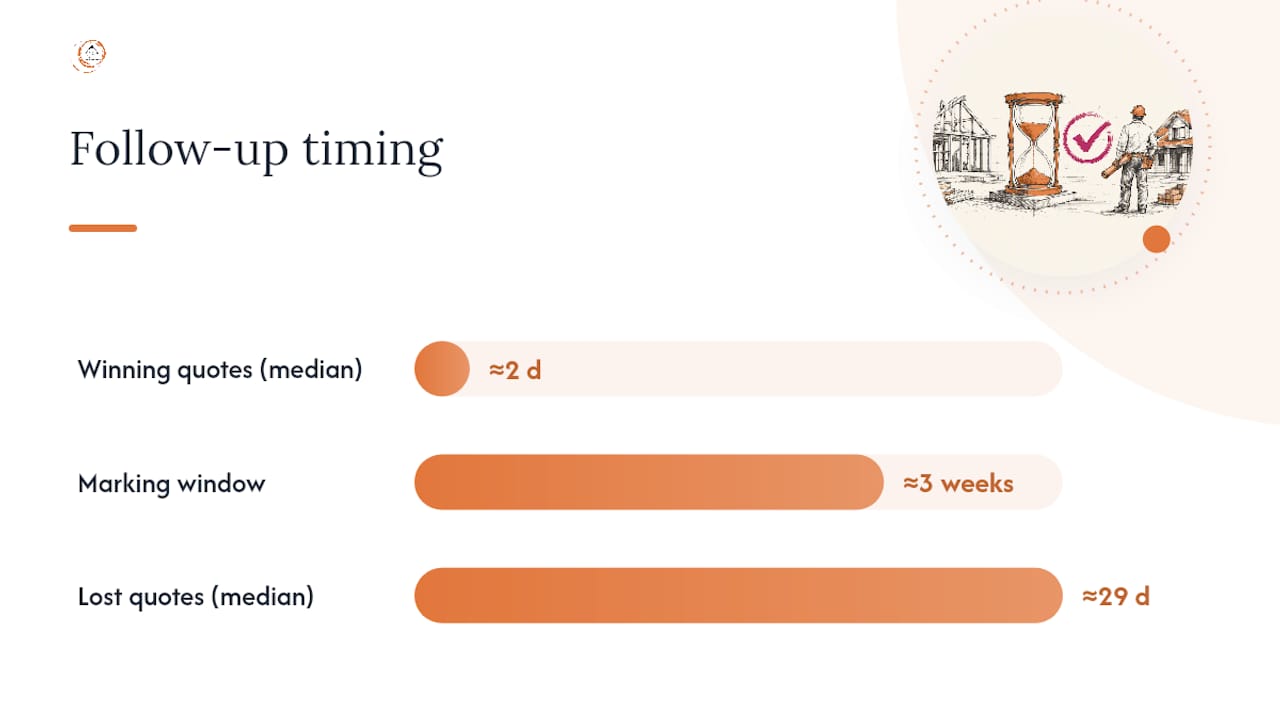
The follow-up cadence is where deals are actually won or lost. Contractor quote data shows a stark pattern: quotes that end up winning close in a median of about 2 days, while quotes that end up lost linger for a median of roughly 29 days before anyone admits they’re dead. That gap tells you almost everything about pipeline discipline.
Build your cadence around three checkpoints:
- Quick first touch — call or email within a couple of days of sending the proposal, no exceptions
- One-week check-in — confirm where the decision stands and surface any new objections
- Marking window — if there’s no real movement after about three weeks, mark it lost and move on
Common objections have standard, honest answers. On price, walk through the scope line by line rather than discounting blind. On schedule, show your actual crew calendar instead of promising a date you can’t defend. On subcontractor concerns, name the specific subs you’ll use and their track record. Vague reassurance loses deals that specifics would have won.
Negotiating Contracts Without Giving Away Your Margin
Negotiation should protect your numbers, not just close the deal faster. The levers that don’t erode margin are phasing (breaking a large project into funded phases), scope clarity (locking down what’s included before you discuss price), and a firm change-order rule that gets written into the contract itself rather than negotiated case by case later.
Before anyone signs, run through a short checklist:
- Insurance certificates confirmed and on file
- Bonding secured and matched to the contract value
- Permits identified, with responsibility for pulling them assigned
- Payment milestones tied to specific, verifiable project events
Once the contract is signed, the handoff to project delivery needs the same rigor as the sales-to-estimating handoff earlier. Hand the project manager the discovery notes, the proposal assumptions, and any verbal commitments made during negotiation. Deals that get renegotiated in the field usually trace back to promises the salesperson made that never made it into the contract.
Keeping Every Stage Owned, Defined, and On Schedule
Stages only work if someone owns each one and everyone agrees on what moves a deal forward. Write down entry and exit criteria for every stage, then assign a name, not a department, to each:
- Lead generation — owned by business development; exit criteria is a complete intake record
- Qualification — owned by BD or sales leadership; exit criteria is a documented bid/no-bid decision
- Relationship discovery — owned by the salesperson; exit criteria is a discovery summary handed to estimating
- Estimating and proposal — owned by the estimator; exit criteria is a delivered, complete proposal
- Presentation and follow-up — owned by sales; exit criteria is a decision, or a marked-lost status
- Negotiation and signoff — owned by leadership or sales; exit criteria is a signed contract and clean handoff to the project manager
A weekly pipeline review keeps this alive instead of becoming a wall chart nobody updates. Fifteen minutes is usually enough: run through every open deal, flag anything sitting in a stage longer than your target, and decide together whether it moves, gets more attention, or gets marked dead. This is also where you prioritize estimating capacity, since not every qualified lead deserves the same turnaround speed. A repeat client with a funded project should jump the queue ahead of a cold referral still confirming financing, even if the cold lead came in first.
Pro Tip: Put “time in current stage” on the same screen as deal value during your weekly review. A $2 million opportunity that’s been stuck in estimating for three weeks is a bigger problem than five smaller deals moving on schedule.
The KPIs That Tell You If Your Pipeline Is Actually Healthy
Two conversion numbers matter, and confusing them hides real problems. Decided-conversion rate measures wins against quotes that reached an actual yes-or-no decision. All-quote conversion rate measures wins against every quote you ever sent, including the ones still sitting in limbo. If your decided-conversion rate looks strong but your all-quote rate looks weak, you have a marking-lost problem, not a selling problem.
| Metric | What it measures | Healthy signal |
|---|---|---|
| Decided-conversion rate | Wins ÷ quotes with a final decision | Rising or stable over time |
| All-quote conversion rate | Wins ÷ all quotes sent | Gap versus decided rate shrinking |
| Days-to-close (won) | Time from quote sent to signed contract | Near the 2-day median for fast-moving deals |
| Days-to-loss (lost) | Time from quote sent to marked lost | Well under the 29-day median stragglers often hit |
The pattern in contractor data is consistent: quotes that will win tend to close in days, and quotes that will lose tend to just sit there unmarked for weeks, which is exactly what inflates pipeline totals with dead weight. When you see a quote aging past three or four weeks with no client response, that’s not a slow-moving opportunity. It’s almost always a lost one you haven’t marked yet. Acting on these numbers means reallocating estimator time toward faster-moving opportunities, enforcing the follow-up cadence without exception, and clearing dead quotes weekly so your real conversion rate stops hiding behind zombie deals.
What Your CRM Needs to Track Construction Pipeline Stages
You don’t need an elaborate system to enforce stage discipline. You need the right fields and a few automated rules that fire without anyone remembering to check.
At minimum, track:
- Current stage — matched to your defined 5 to 7 stage structure
- Estimated contract value
- Decision date — the client’s stated timeline, not a guess
- Decision-maker name — captured at intake, confirmed during discovery
- Bid/no-bid status and reasoning — so patterns in lost qualification decisions become visible
- Lost reason — price, timeline, competitor, no decision, or funding fell through
Automations do the enforcement work humans forget to do: a reminder that fires 48 hours after a proposal goes out, an aging alert when a quote passes three weeks with no update, and an auto-flag (not necessarily auto-delete) for anything past your marking window. A CRM configured with construction-specific stages also needs to talk to your estimating and project management tools, since re-entering the same project data three times is where handoff errors start. For a deeper look at connecting these systems, R Construction Solutions LLC’s guide on construction bid automation walks through the integration patterns that hold up under real workloads. Analytics platforms like The Build’s work on construction data show similar gains when estimating accuracy and CRM data stay connected rather than siloed.
A 30/60/90 Plan for Fixing Your Construction Pipeline
Most growth-stage firms don’t need a new system. They need a disciplined rollout of the one they already have.
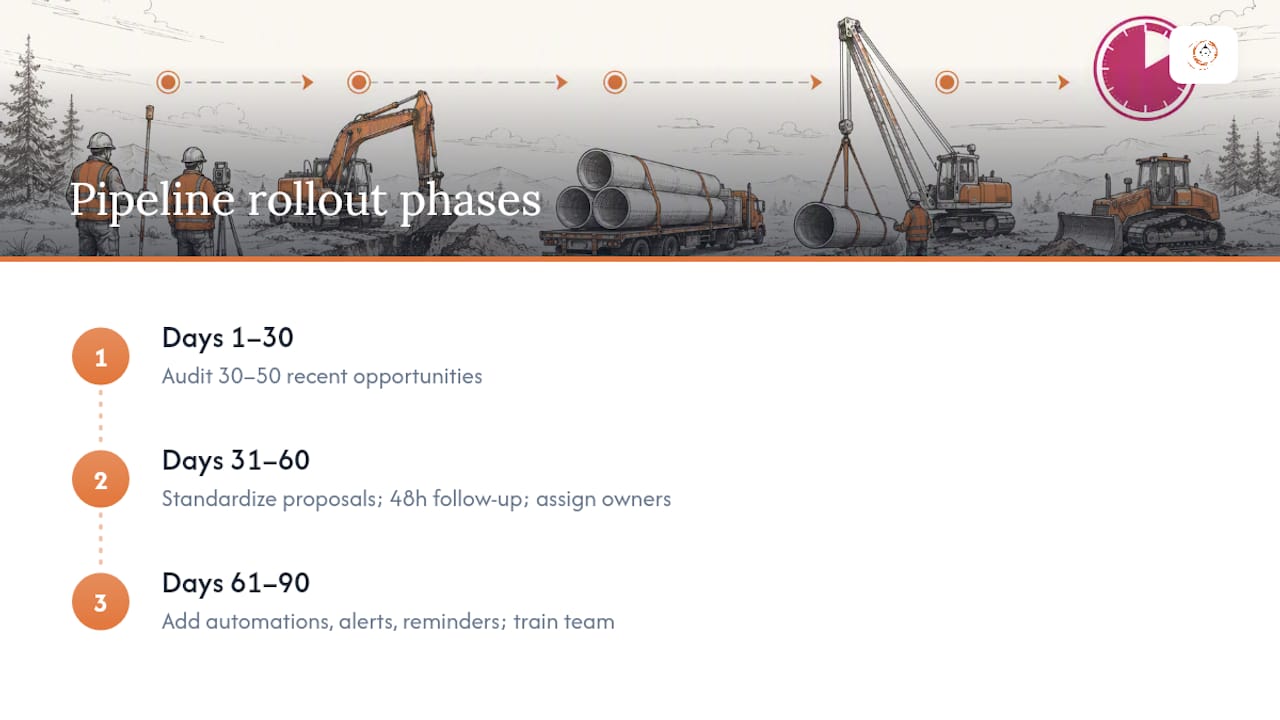
In the first 30 days, audit your last 30 to 50 opportunities against the stage structure above. Find out where deals actually die, whether that’s weak qualification, slow proposals, or follow-up that never happens. Days 31 through 60 are for quick fixes: standardize your proposal template, set the 48-hour follow-up rule as policy, and assign stage owners if you haven’t already. By day 90, layer in the automations (aging alerts, follow-up reminders) and train the whole team on the marking-lost discipline so pipeline numbers stop lying to you.
The pitfalls repeat across firms of every size. Estimator overload happens when sales doesn’t qualify before requesting a quote. Inconsistent qualification happens when the checklist lives in someone’s head instead of the CRM. Poor handoffs happen when discovery notes disappear between the salesperson and the estimator. Reviewing the right hiring criteria before adding estimating staff, covered in R Construction Solutions LLC’s estimator hiring checklist, helps firms scale estimating capacity without repeating the same overload problem at a bigger dollar figure.
Why Discipline Beats More Leads
Most contractors chase more leads when their real problem is what happens after the lead arrives. I’ve watched firms triple their marketing spend and see win rates stay flat, because the leak was never volume. It was a qualification step that got skipped, a proposal that sat unfinished for two weeks, or a quote nobody had the discipline to mark lost.
Run one audit this week: pull your last 20 quotes and check how many are still “pending” past 30 days with no real activity. That number will tell you more about your close rate than any new lead source will. Fast, honest pipelines close deals. Bloated ones just look busy.
— Rowena Tulacz
How a construction consulting firm builds pipeline discipline that sticks
Most firms know their pipeline has leaks. Finding them without an outside set of eyes, and fixing them without disrupting active bids, is the harder part. Construction consultants work directly with growth-stage contractors to audit existing pipelines, rebuild stage definitions around the estimating and follow-up discipline covered above, and implement CRM systems that enforce the 48-hour rule automatically instead of relying on memory.

A typical engagement starts with a pipeline audit: reviewing your last quarter of quotes to find where deals stall, then rebuilding your stage structure with clear ownership and exit criteria. From there, Construction Consulting Services can extend into estimating support, CRM and marketing automation setup, or targeted coaching for your sales and estimating teams depending on where the leak actually is. General contractors looking for segment-specific support can also review the services built around how general contractors manage subcontractor and vendor relationships throughout the sales process. If you’re ready to see where your own pipeline is bleeding time and margin, reach out to a construction consulting firm to schedule a pipeline audit.
Sources
The stage structure and benchmarks in this article draw on the Ultimate Construction Sales Process Guide for proposal standards, Level’s contractor quote benchmarks for follow-up and closing-speed data, Inveo’s RevOps framework for construction for CRM staging, and Salesforce’s pipeline stage overview for general pipeline measurement logic.
- Ultimate Construction Sales Process Guide | Erro
- RevOps for Construction: Proven 5-Stage Framework | Inveo
FAQ
What Are the 5 Stages of a Sales Pipeline in Construction?
The core five stages are lead generation, qualification (bid/no-bid), estimating and proposal, presentation and follow-up, and negotiation through contract signoff. Many firms add a sixth stage, relationship discovery, between qualification and estimating to capture the client information that improves win rates before an estimator spends time on the job.
What Are the 7 Stages of a Construction Sales Cycle?
A fuller seven-stage version splits the process into lead generation, qualification, relationship discovery, estimating, proposal presentation, negotiation, and contract signoff, with post-sale relationship management sometimes added as an eighth. Construction-specific frameworks recommend this level of detail specifically because estimating consumes limited resources and needs its own visibility.
What Are the Four Stages of a Sales Pipeline?
A condensed four-stage version usually collapses down to lead generation, qualification, proposal, and close. Construction firms tend to expand this because estimating alone deserves its own tracked stage; skipping that step is a common reason estimator time gets wasted on unqualified bids.
How Fast Should You Follow Up on a Construction Bid?
Follow up within 48 hours of sending any proposal, since contractor quote data shows winning quotes close in a median of about 2 days while quotes left to linger drag toward a median of 29 days before anyone marks them lost. A one-week check-in and a defined marking-lost window after about three weeks keep your pipeline numbers honest.
How Do You Know if Your Construction Pipeline Is Healthy?
Compare your decided-conversion rate (wins against quotes with a final answer) to your all-quote conversion rate (wins against every quote sent). A large gap between the two usually means stale quotes are sitting unmarked rather than being closed out, which inflates your pipeline and hides your real win rate.
Recommended
- Piping Labor Unit Estimating: A Practical Guide for Estimators
- Build an Estimating Checklist for General Contractor Projects
- Construction Estimator Hiring Checklist for Contractors
- How to Improve Your Construction Estimating Process
Running the job and the business at the same time? One short email a week — change orders, billing, job costing, scheduling. Free, no pitch. Subscribe.
Free and unconditional. No call required, no obligation, unsubscribe anytime.