
How Code Knowledge Changes U.S. Construction Estimates
Code knowledge is one of the most undervalued risk-management tools an estimator carries into a bid. When you understand the applicable building codes before you start a takeoff, you catch scope gaps that would otherwise become post-award change orders, price compliance-driven costs that competitors miss, and write qualifiers that protect your margin when the drawings leave code questions unanswered.
The role of code knowledge for U.S. estimators comes down to four practical impacts:
- Scope additions: Codes mandate assemblies, systems, and materials that drawings often omit or underspecify. An estimator who catches a missing fire-rated corridor assembly before bid day prices it; one who misses it absorbs it.
- Testing and inspection costs: Special inspections under IBC Chapter 17, commissioning under IECC, and third-party testing for fire-suppression systems carry real dollar values that must appear as line items, not assumptions.
- Specification mismatches: Specs frequently reference superseded code editions. Design documents are often issued under time pressure, and code references get copied from prior projects, shifting compliance risk to the contractor.
- Contingency calibration: When a code question cannot be resolved before bid, it needs a priced allowance or a written qualifier. Silent acceptance of “contractor to verify” language is how margins disappear.
Stat to know: Many U.S. jurisdictions adopt new code cycles within a couple of years of a model-code release, which means the edition cited on the drawings is frequently not the edition the authority having jurisdiction (AHJ) enforces.
Table of Contents
- What does an estimator’s code knowledge actually do in the workflow?
- How building codes change quantities, materials, labor, and price
- Which U.S. codes should estimators track, and where do you verify them?
- How do estimators build and maintain the code knowledge they need?
- What tools help estimators manage code-driven scope and reduce risk?
- What are the most common code-related estimating mistakes, and how do you fix them?
- When should you escalate a code question instead of pricing it yourself?
- How do you document code assumptions so your bid is defensible?
- Key Takeaways
- The part most estimators get wrong about code knowledge
- How R Construction Solutions LLC supports your estimating process
- Practical sources and reference links for code research
What does an estimator’s code knowledge actually do in the workflow?
The core duties of a building construction estimator include reviewing plans and specifications, conducting material takeoffs, and verifying compliance with relevant codes. In practice, code knowledge intersects with that workflow at five distinct checkpoints.
- Pre-bid plan review: Confirm the code edition cited in the drawings against the AHJ’s currently enforced edition. Flag discrepancies as RFI candidates before takeoff begins.
- Specification review: Check Division 01 General Requirements and trade-specific sections for testing, inspection, and commissioning obligations. These are the line items most often missed.
- Allowances and alternates: Where code requirements are ambiguous, set a priced allowance rather than a zero-dollar assumption. Document the basis.
- Permit and inspection obligations: Identify permit fees, required inspections, and special-inspection programs. These costs belong in the estimate, not in a post-award surprise.
- Shop drawings and submittals: Code-driven submittal requirements (fire-rated assemblies, energy-envelope documentation) add labor and schedule time that must be priced.
The table below maps common estimating tasks to the code reference most likely to affect them and a typical cost-impact band.
| Estimating Task | Primary Code Reference | Typical Cost Impact |
|---|---|---|
| Fire-rated wall/floor assemblies | IBC, UL listings | Moderate to high (material + labor) |
| Energy envelope (insulation, glazing) | IECC, state energy code | Moderate (R-value upgrades, testing) |
| Electrical rough-in and panel sizing | NEC (NFPA 70) | Moderate (conductor sizing, AFCI/GFCI) |
| Egress and accessibility | IBC, ADA Standards | Low to moderate (hardware, clearances) |
| Special inspections | IBC Chapter 17 | Low to moderate (third-party fees) |
| Fire suppression and alarm | NFPA 13, NFPA 101 | High (system scope, testing, commissioning) |
| Mechanical/HVAC commissioning | IECC | Moderate (Cx agent, documentation) |
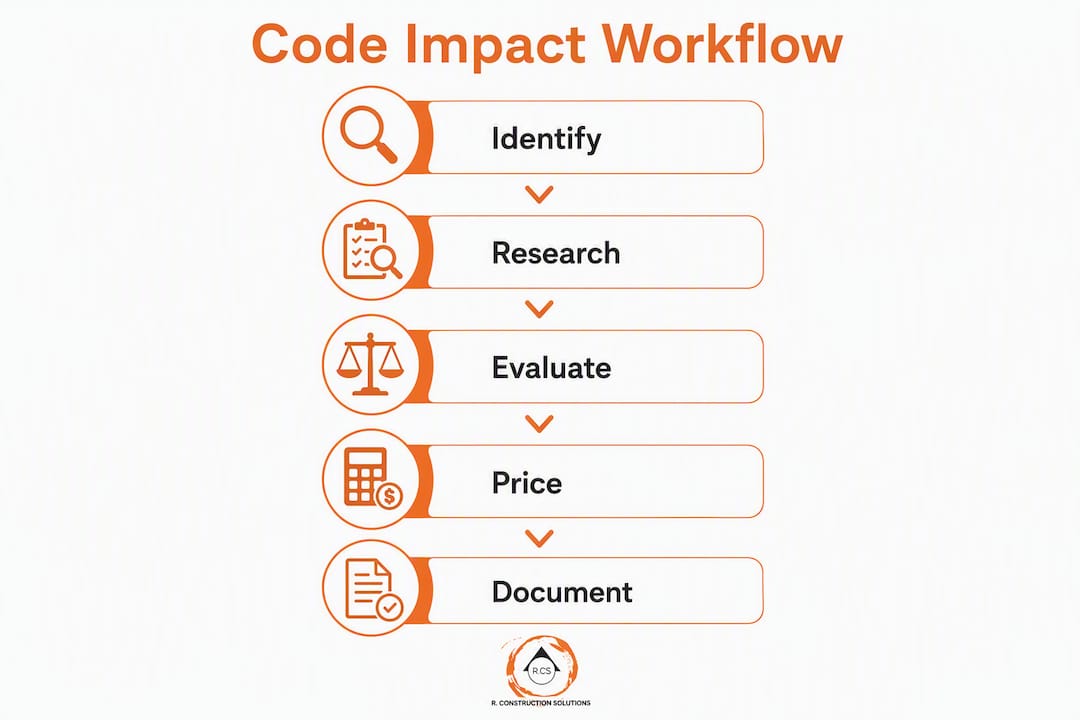
When a code gap surfaces during takeoff, the estimator has two choices: convert it to an RFI (if time allows) or price the residual risk as a line-item allowance. Leaving it blank is not a third option.
How building codes change quantities, materials, labor, and price
Codes do not just add line items. They change the type of work, the sequence of trades, and the documentation burden on the project. A few concrete examples show how that plays out in cost.
Energy code upgrades are the most common driver of unplanned scope. When a jurisdiction adopts a newer IECC cycle, required R-values for walls, roofs, and slabs increase. An estimator using the prior cycle’s values will underprice insulation material, framing depth (for thicker cavity insulation), and blower-door or duct-leakage testing. The testing alone can run several thousand dollars on a mid-size commercial project.
Fire-resistance-rated assemblies require UL-listed products and installation methods. Substituting a non-listed product, even one that looks identical, voids the rating and triggers rework. Pricing the correct assembly from the start, including the listed fastener patterns and joint treatment, avoids that exposure.
Special inspections under IBC Chapter 17 add third-party inspector fees, scheduling coordination, and sometimes re-inspection costs when work fails. These are not overhead items; they belong as discrete line items tied to the specific work requiring inspection (structural steel, high-strength bolting, concrete placement, masonry).
NEC code cycles affect conductor sizing, arc-fault circuit interrupter (AFCI) and ground-fault circuit interrupter (GFCI) requirements, and panel configurations. A jurisdiction that has adopted the 2023 NEC may require AFCI protection in areas where the 2017 NEC did not, adding device cost and labor to every affected circuit.
Pro Tip: Build a short “code-impact” line item in your estimate template for each trade. Label it clearly (e.g., “Code compliance allowance — electrical, NEC 2023 per AHJ”) and price it as an allowance when the scope is unresolved. This creates a visible, defensible placeholder rather than a buried contingency that disappears in value engineering.
Which U.S. codes should estimators track, and where do you verify them?
Six primary code families affect most commercial and residential estimates in the U.S. Knowing what each one controls, and where to confirm the locally enforced edition, is the foundation of coding proficiency in project estimation.
- IBC (International Building Code): Governs occupancy classifications, fire ratings, egress, structural loads, and special inspections. The single most referenced code on commercial projects.
- IRC (International Residential Code): Applies to one- and two-family dwellings and townhouses. Controls framing, energy, mechanical, plumbing, and electrical on residential work.
- NEC (NFPA 70): Sets electrical installation requirements. Adopted by most states, often with local amendments that change device requirements, conductor types, or panel configurations.
- IECC (International Energy Conservation Code): Controls the thermal envelope, mechanical efficiency, and commissioning requirements. Adoption cycles vary widely by state; some states have adopted modified versions that are stricter than the model code.
- NFPA 101 (Life Safety Code): Governs means of egress, occupant load, and fire protection in occupancies where local jurisdictions adopt it alongside or instead of IBC.
- ADA Standards for Accessible Design: Federal accessibility requirements that apply to most commercial construction. Clearances, hardware, ramp slopes, and restroom configurations all carry measurable cost implications.
Where to verify the enforced edition:
- Check the AHJ’s website directly. Most building departments post their adopted code edition and local amendments.
- Use the ICC’s state code adoption map to identify the base model-code cycle for the state.
- Call or email the building department for the specific jurisdiction. A two-minute call before takeoff can prevent a five-figure change order.
- For energy code questions, the U.S. Department of Energy’s Building Energy Codes Program publishes state-by-state adoption status.
Experienced estimators spend about 30 minutes verifying local amendments before starting a takeoff. That half-hour routinely surfaces material deviations from what the drawings cite, particularly on energy, fire, and testing requirements.
How do estimators build and maintain the code knowledge they need?
Code knowledge is not a credential you earn once. It is a working skill that requires regular updates because the codes themselves change on two- to three-year cycles, and jurisdictions adopt them on their own schedules.
Entry-level foundation skills every estimator should have:
- Reading and interpreting Division 01 specs and trade-specific specification sections
- Understanding occupancy classifications and their fire-rating implications
- Recognizing egress triggers (travel distance, exit width, exit count)
- Basic NEC literacy: circuit types, panel sizing, AFCI/GFCI zones
- Familiarity with IBC Chapter 17 special inspection triggers
A practical learning path by role:
- Junior estimator: Shadow a senior estimator through one full pre-bid code check. Use the ICC’s free online code resources to read the sections that came up. Take a one-day “IBC Fundamentals” course through ICC or a local chapter of the American Society of Professional Estimators (ASPE).
- Mid-level estimator: Add IECC basics (thermal envelope, commissioning requirements) and NEC highlights (current adoption cycle for your primary markets). The ASPE Estimating Academy offers focused courses aligned to estimating roles.
- Senior estimator / estimating manager: Maintain a jurisdiction subscription for your top three markets. Attend one code-update seminar per year (ICC, NFPA, or trade association). Build and own the firm’s internal code-check checklist. Review estimator hiring criteria to set code-literacy standards for new hires.
Ongoing resources worth bookmarking:
- ICC’s online code library and state adoption pages
- NFPA’s free online access to NFPA 70 (NEC) and NFPA 101
- Your state’s building code division website (most publish amendment registers)
- Trade association bulletins: NECA (electrical), SMACNA (sheet metal/HVAC), PHCC (plumbing)
- Internal post-project reviews: document every code-driven change order and feed it back into the pre-bid checklist
What tools help estimators manage code-driven scope and reduce risk?

Estimating-software proficiency is a core skill for accurate cost forecasting and managing revisions, and the right tool stack makes code-aware estimating faster and more consistent. The categories below address different parts of the problem.

| Tool Category | Primary Purpose | Strength | Typical Users |
|---|---|---|---|
| Takeoff and estimating platforms (e.g., RSMeans Data, Bluebeam Revu) | Quantity takeoff, cost assembly, addendum tracking | Speed and accuracy on large document sets | All estimators |
| Automated document-review tools | Flag missing code references and conflicting spec language | Surfaces risks human reviewers miss in large spec books | GC estimators, CM firms |
| BIM/model-checking tools (e.g., Autodesk Revit, Navisworks) | Clash detection, assembly verification, version control | Catches design-model conflicts before bid | Senior estimators, VDC teams |
| Code-research portals (e.g., ICC online library, UpCodes) | Jurisdiction-specific code lookup, amendment tracking | Fast verification of enforced edition and local amendments | All estimators |
| Permit and AHJ lookup services | Identify permit fees, inspection requirements, AHJ contacts | Reduces permit-cost surprises | Project managers, estimators |
A few practical notes on integration. Bluebeam Revu is widely used for marking up drawings and specs during takeoff; its markup layers make it straightforward to flag code-related scope questions for RFI follow-up. RSMeans Data provides cost assemblies that can be updated when a code change alters the specified assembly. Automated document-review tools can surface risks human reviewers miss and reduce time spent on large spec books, which matters on projects where the spec book runs several hundred pages.
For teams exploring AI-assisted document analysis, Buildberry’s blog covers emerging approaches to automated spec review and their practical limits. The real role of estimating software is not to replace judgment but to handle document volume so estimators can focus on the decisions that require it.
What are the most common code-related estimating mistakes, and how do you fix them?
Most code-related estimating errors share a common root: the estimator assumed the drawings were code-complete. Code-related gaps found after award frequently lead to change orders and rework. Here is where the exposure concentrates.
- Assuming the drawing’s code edition is the enforced edition. Drawings often reference the code cycle in effect at design start, not at permit. Verify the AHJ’s current edition before takeoff.
- Skipping local amendments. A state or city amendment can change energy requirements, fire-suppression thresholds, or electrical device requirements in ways the model code does not. A 30-minute jurisdiction check catches most of them.
- Omitting testing and inspection costs. Special inspections, commissioning agents, and third-party testing fees are real line items. They do not belong in general conditions overhead.
- Silent acceptance of “contractor to verify” language. When specs or drawings use this phrase, the risk transfers to you unless you respond with an RFI or a written bid qualifier.
- Treating code questions as the design team’s problem. Most estimators mistakenly treat building-code review as the design team’s responsibility. An estimator-run code check during preconstruction is a scoping and pricing tool, not an audit of the architect’s work.
Pre-bid code check: a five-minute checklist
- Confirmed AHJ and enforced code edition? Yes / No
- Local amendments reviewed? Yes / No
- Special inspection requirements identified and priced? Yes / No
- Testing and commissioning obligations in the estimate? Yes / No
- “Contractor to verify” items converted to RFIs or priced allowances? Yes / No
- Bid qualifiers written for unresolved code risks? Yes / No
Pro Tip: Attach a one-page scope review with code citations directly to your bid. List the edition you priced to, the AHJ you verified, and any items you treated as allowances pending clarification. This single document reduces post-award disputes and gives you a defensible paper trail if a code-driven change order surfaces later.
When should you escalate a code question instead of pricing it yourself?
Not every code question belongs in the estimator’s column. Some issues carry enough financial exposure, or enough interpretive complexity, that escalating them is the right call. Estimators want systematic compliance checks but often lack time; structured escalation keeps the process moving without leaving risk unpriced.
Escalate when you encounter:
- Ambiguous life-safety requirements (egress conflicts, occupancy-load disputes, fire-barrier continuity questions)
- Conflicting code references between the drawings and the spec (e.g., drawings show one fire-rating assembly, spec calls a different one)
- Major performance requirements with significant cost variance (energy envelope compliance paths, seismic detailing, fire-penetration systems)
- Items that will require specialty testing or inspection by a third party whose scope is undefined
The escalation flow:
- Estimator notes the issue with a code citation and a dollar-impact estimate.
- RFI drafted with the specific code section cited, the conflict or gap described, and a response deadline tied to bid date.
- If no response before bid, the item becomes a priced allowance with a written qualifier in the bid.
- Post-award, the RFI response drives scope confirmation or a change order.
“Estimators gain leverage at bid by framing code issues as either priced items or RFI clarifications. The value is in turning a code gap into a documented negotiation point rather than silent acceptance.” Code Compliance for Estimators, Helonic
A practical example: an estimator reviewing a mixed-use project notices the drawings reference NFPA 13 for the sprinkler system but the occupancy includes an assembly area that may trigger NFPA 13R or a different hazard classification. Rather than pricing to the lower-cost assumption, the estimator drafts an RFI citing both NFPA 13 and the occupancy classification in question, prices the higher-cost scenario as the base, and notes the allowance in the bid. When the design team confirms the classification, the estimate is either confirmed or adjusted with documentation. That sequence protects margin and avoids a post-award dispute.
Rowena Tulacz and the advisory team at R Construction Solutions LLC work with estimating teams to build exactly this kind of escalation workflow into their pre-bid process, including RFI templates with code citations and bid-qualifier language that holds up in contract negotiations.
How do you document code assumptions so your bid is defensible?
Documentation is where the benefits of code knowledge actually convert into protected margin. An estimate that prices code compliance correctly but documents nothing is still exposed. Estimator-side code review is a scoping and pricing tool, and the documentation is what makes it stick.
What every bid should document:
- The specific code edition priced (e.g., “IBC 2021 as adopted by the City of Chicago with local amendments dated January 2024”)
- The AHJ verified and the date of verification
- Any code questions submitted as RFIs, with the RFI number and response status
- Items priced as allowances pending code clarification, with the allowance amount and the trigger for adjustment
- Written bid qualifiers for unresolved code risks
Sample bid-qualifier language:
For contract negotiations, package your code findings as a one-page attachment to the bid. List the edition, the AHJ, the open RFIs, and the allowances. This framing positions code compliance as a managed process rather than a contractor risk dump, and it gives you a clean basis for change order requests if the design team’s clarifications expand scope.
Key Takeaways
Code knowledge in U.S. construction estimating is a direct margin-protection discipline: estimators who verify jurisdiction, price unresolved code risk, and document their assumptions consistently reduce post-award change orders and protect bid margins.
| Point | Details |
|---|---|
| Verify jurisdiction before takeoff | Spend 30 minutes confirming the AHJ’s enforced code edition and local amendments before starting quantities. |
| Price unresolved code risk explicitly | Convert code gaps into priced allowances or written qualifiers — never leave them as silent assumptions. |
| Use tools for document volume | Takeoff platforms, automated spec-review tools, and code portals reduce manual errors on large bid packages. |
| Escalate clearly with code citations | Draft RFIs that cite the specific code section, describe the conflict, and include a response deadline tied to bid date. |
| Document assumptions in every bid | Attach a one-page code-basis summary listing the edition, AHJ, open RFIs, and allowances to every proposal. |
| R Construction Solutions LLC | Provides estimating support, pre-bid code checklists, RFI templates, and bid-qualification advisory for contractors across the U.S. |
The part most estimators get wrong about code knowledge
The conventional framing treats code knowledge as a compliance function, something you need to avoid getting rejected at permit. That framing undersells it by a wide margin.
The estimators who use code knowledge most effectively treat it as a commercial tool. Every code gap in a set of documents is a negotiation point. Price it, document it, and put it in the bid, and you control the conversation. Leave it blank, and you have handed the owner or GC a free change order to deny later.
What I see consistently in advisory work with contractors is that the firms with the tightest margins on competitive bids are often the ones who priced to the drawings without checking the jurisdiction. They win the job at the lowest number, then spend the first 60 days fighting over scope that was never in the contract because nobody priced the code compliance correctly. The firms that win and make money are the ones who built a 30-minute jurisdiction check into their pre-bid routine and wrote qualifiers for everything they could not confirm.
The other thing worth saying plainly: code knowledge is not a senior-estimator skill. Junior estimators who learn to run a basic jurisdiction check and flag “contractor to verify” language early in their careers develop a habit that compounds over time. The estimating process improvements that move the needle most are usually not the expensive ones. They are the disciplined, repeatable habits that get built into the workflow and executed on every bid.
How R Construction Solutions LLC supports your estimating process
Accurate estimates require more than a good takeoff. They require a pre-bid process that catches code-driven scope before it becomes a post-award problem. R Construction Solutions LLC delivers exactly that kind of support to growth-stage contractors who want to win more bids and protect their margins on the jobs they land.

The firm’s estimating support and advisory services include pre-bid code checklists, RFI drafting with code citations, bid-qualification templates, and scoped estimating reviews for complex projects. Engagements are structured as fixed-fee or retainer advisory, with clear deliverables and no open-ended commitments. Whether you need a one-time review of your pre-bid process or ongoing estimating advisory, the work is scoped, signed, and delivered by advisors who understand how construction businesses actually operate.
If your team is leaving code-driven scope on the table or absorbing post-award change orders that should have been priced at bid, request a scoped estimating review or ask for a sample pre-bid code checklist at rconstructionsolutions.com.
Practical sources and reference links for code research
These are the resources worth bookmarking for ongoing code verification and estimating reference.
Primary code and jurisdiction sources:
- ICC (International Code Council): The authoritative source for IBC, IRC, IECC, and related model codes. Use the state adoption map to confirm the base cycle for any jurisdiction.
- NFPA (National Fire Protection Association): Free online access to NFPA 70 (NEC) and NFPA 101. Essential for electrical and life-safety scope verification.
- U.S. DOE Building Energy Codes Program: State-by-state IECC adoption status and compliance resources. Use before pricing any energy-envelope scope.
- ADA.gov: Primary source for ADA Standards for Accessible Design. Use for commercial projects with public-access requirements.
- BLS Occupational Outlook: Cost Estimators: Labor market context and role definitions for estimating professionals.
Estimating and process resources:
- ASPE Estimating Academy: Focused courses for estimators at all career stages, including code-fundamentals content.
- AACE International Certifications: Professional certification pathways for cost estimators and project controls professionals.
- Building Code Compliance in Pre-Construction (Provision): Practical checklist-oriented guide to pre-bid code review for GC estimators.
- New Construction Codes: Estimating Impact (iBeam): Covers jurisdiction adoption patterns and the case for a pre-takeoff jurisdiction check.
- R Construction Solutions LLC: Estimating Best Practices: Pre-bid code checks and bid-qualification language in the context of a full estimating workflow.