
Stop Losing 30% of Leads: Phased Lead Nurturing for Contractors
Lead nurturing turns a one-time inquiry into a booked job by keeping consistent, relevant contact with a prospect until they’re ready to sign a contract, and for contractors it’s the single highest-leverage fix available before spending another dollar on ads. Contractors who nurture consistently book more jobs at higher average values than those who rely on one-off follow-up. Start today: pull your last 20 leads and check how many got a response within five minutes, then add one required “next contact date” field to whatever system you use to track them.
TL;DR:
- Responding to leads within five minutes significantly boosts contact rates and reduces the risk of losing prospects to competitors with faster follow-up.
- Segmenting leads by project type, urgency, budget, and referral source allows tailored nurturing sequences that increase conversion and project size.
- Maintaining a consistent follow-up process over weeks or months can generate 50% more sales-ready leads at 33% lower cost, with nurtured leads closing at a higher rate.
- Automating quick responses and designing staged sequences for new, warm, and cold leads improves efficiency and keeps prospects engaged without overwhelming staff.
- Clear owner roles, minimal initial fields in CRM, and regular audits are essential to ensure adoption and effectiveness of a contracting lead nurturing system.
Table of Contents
- What Is Contractor Lead Nurturing?
- Why Lead Nurturing Matters More Than Lead Volume
- Lead Nurturing vs. Lead Follow-Up: What’s the Difference?
- Where Nurturing Fits in the Contractor Sales Funnel
- Build a Contractor Lead Nurturing System: Step-by-Step Playbook
- CRM Implementation and Team Roles: A Practitioner Checklist
- Essential Nurturing Tactics: Email, Segmentation, and Speed
- Measure and Optimize: KPIs Contractors Should Track
- Quick Templates and Example Nurture Sequences
- Common Traps and Quick Cultural Fixes
- How R Construction Solutions LLC Helps You Build This System
- Sources
- FAQ
What Is Contractor Lead Nurturing?
Lead nurturing for contractors means running a planned sequence of contact, calls, texts, emails, and check-ins that moves a prospect from first inquiry to signed contract, without pressuring them into a decision before they’re ready. It’s different from generic e-commerce nurturing because construction projects are high-ticket, trust-driven, and slow. A homeowner comparing kitchen remodel bids or a facilities manager vetting a mechanical contractor isn’t clicking “buy” after one email. They’re gathering quotes, checking reviews, and talking to their spouse or their board.
That reality shapes the whole system. Most construction purchases take multiple touches, often six to eight, before a prospect commits to a contractor, and speed matters just as much as persistence. Responding to a lead within five minutes dramatically increases the odds of making contact at all, and contractors who let leads sit lose an estimated 30% of them to competitors who called back faster.
Segmentation is what separates real nurturing from a generic newsletter blast. A few variables matter most:
- Project type (roofing repair vs. full kitchen remodel vs. commercial buildout) changes the sales cycle length and the content that resonates.
- Timeline urgency (storm damage vs. “someday” renovation) determines whether a lead needs same-day contact or a monthly touch.
- Budget band tells you whether to send financing options or premium material galleries.
- Referral source (Google ad, referral, past client) affects how much trust-building content the sequence needs before the pitch.
Why Lead Nurturing Matters More Than Lead Volume
Generating more leads feels productive, but most contractors already have more leads than their follow-up system can handle well. The real leak is in the middle of the funnel, where warm prospects go cold from silence.
Companies that excel at nurturing generate 50% more sales-ready leads at 33% lower cost, and nurtured leads make purchases that are 47% larger than non-nurtured ones.
For a contractor, that 47% gap often shows up as the difference between a $12,000 bathroom job and an $18,000 job with upgraded fixtures, sold to the same lead simply because someone stayed in touch long enough to build trust and present the full scope. Consider the math: if you spend $150 acquiring a lead through paid ads and that lead goes cold after one unanswered voicemail, you’ve paid full price for zero return. Nurture that same lead over 90 days with five relevant touches, and even a 20% close rate on a $15,000 average job dwarfs the acquisition cost.
The pattern holds beyond any single deal:
- Cold leads rarely refer friends or family; nurtured clients who feel remembered do.
- Wasted ad spend compounds. Every dead lead is money spent with zero lifetime value attached.
- Optimizing the pipeline itself, rather than buying more leads, has driven revenue gains of 30% to 50% for contractors who made the shift.
Lead Nurturing vs. Lead Follow-Up: What’s the Difference?
Follow-up is the sprint. Nurturing is the marathon. Confusing the two is one of the most common reasons contractor pipelines leak.
- Follow-up is the immediate, urgent response to a fresh inquiry, ideally within minutes, confirming receipt and setting expectations for next steps.
- Short nurture runs over days to a couple of weeks for warm leads still comparing bids, using targeted emails, texts, or calls tied to their specific project.
- Long nurture runs over months for leads who aren’t ready yet, budget not approved, project delayed, using lower-frequency, higher-value content like seasonal maintenance tips or portfolio updates.
- The handoff trigger should be automatic: if a lead doesn’t respond to initial follow-up within 48 to 72 hours, or explicitly says “not now,” they move into a nurture sequence instead of falling off the radar entirely.
Skipping straight from follow-up to silence is where most contractors lose money they already paid to generate.
Where Nurturing Fits in the Contractor Sales Funnel
Every lead moves through recognizable stages, and each one needs a different action, asset, and response-time target. Mapping this out removes the guesswork that causes leads to stall.
- New lead: Capture source, project type, and contact info immediately; log it before doing anything else.
- Initial contact: Acknowledge within five minutes by text or call; confirm the project type and timeline.
- Qualification: Ask about budget band, decision timeline, and decision-makers involved; score the lead accordingly.
- Consultation: Schedule an on-site or virtual walkthrough; send a confirmation and a short prep checklist beforehand.
- Proposal/estimate: Deliver a clear, itemized estimate with a firm follow-up date attached, never leave it open-ended.
- Follow-up: Call within 48 hours of sending the estimate; address objections directly.
- Closed job: Confirm contract, kick off scheduling, and flag the client for a future referral or review request.
| Funnel stage | Primary action | Target response time | Key asset |
|---|---|---|---|
| New lead | Log source and details | Immediate | CRM entry |
| Initial contact | Acknowledge and confirm | Within 5 minutes | Text/call script |
| Qualification | Assess budget and fit | Within five minutes | Scoring checklist |
| Consultation | Schedule and prep | Within 48 hours | Walkthrough guide |
| Proposal/estimate | Deliver itemized bid | Within 3 to 5 days | Written estimate |
| Follow-up | Address objections | Within 48 hours of bid | Call script |
| Closed job | Kick off and request referral | At signing | Onboarding packet |
Not every lead deserves equal effort. A simple go/no-go score, weighing budget fit, timeline urgency, and project type against your crew’s actual capacity, keeps your best people focused on jobs worth chasing instead of spreading thin across low-value inquiries. Contractors who prioritize commercial opportunities strategically often build stronger long-term portfolios than those chasing every residential lead that comes in.
Build a Contractor Lead Nurturing System: Step-by-Step Playbook
Most contractors try to build the perfect system in one weekend and abandon it within a month. A phased build works better because each step earns the trust needed for the next.
- Audit your lead sources. List every channel, Google Ads, referrals, home shows, your website, and confirm each one captures the same core fields consistently.
- Define 3 to 5 lead stages with plain qualification criteria for each, so any team member can look at a lead and know exactly where it stands.
- Design your core sequences. Build an immediate auto-response for every new lead, a short nurture sequence for warm prospects still deciding, and a long nurture sequence for cold or delayed leads.
- Select and configure your CRM with 8 to 10 required fields, no more at launch, and set automation triggers for stage changes and follow-up reminders.
- Roll out in phases: pilot with one crew or business unit, train two or three champions who model correct usage, then expand company-wide before adding advanced automation.
- Run quarterly audits to catch duplicate entries, incomplete fields, and stalled leads before they quietly die in the pipeline.
Pro Tip: Don’t add a tenth automation trigger until your team is consistently using the first three. Adoption problems, not technology limits, are what sink most contractor CRM rollouts.
CRM Implementation and Team Roles: A Practitioner Checklist
A CRM is only as good as the discipline behind it, and that discipline depends on assigning real ownership rather than hoping everyone pitches in. Based on common operational patterns in growth-stage contracting firms, six roles need to be named on day one, not discovered by accident three months in.
- Leadership sponsor: Owns the decision, funds the rollout, and uses the CRM visibly in weekly meetings instead of delegating it entirely.
- Implementation lead: Manages the phased rollout, vendor relationship, and field configuration.
- Trainer: Runs role-specific, hands-on sessions rather than a single generic onboarding webinar.
- Data input owners: Front-line staff, estimators, sales reps, responsible for entering leads correctly at the point of contact.
- Data auditor: Runs the quarterly cleanup, since poor data costs the construction industry an estimated $1.8 trillion annually worldwide in wasted time and missed opportunities.
- Data consumers: Managers and estimators who pull reports to make staffing and pipeline decisions.
Keep the field list minimal at launch. A workable starter set includes lead source, project type, timeline, budget band, preferred contact channel, assigned owner, follow-up status, and next step date. Expand only after adoption sticks.
Pro Tip: CRM rollouts fail 50% to 70% of the time when training is weak. A short, role-specific leaderboard for data entry accuracy in the first 90 days does more for adoption than any feature demo.
Essential Nurturing Tactics: Email, Segmentation, and Speed
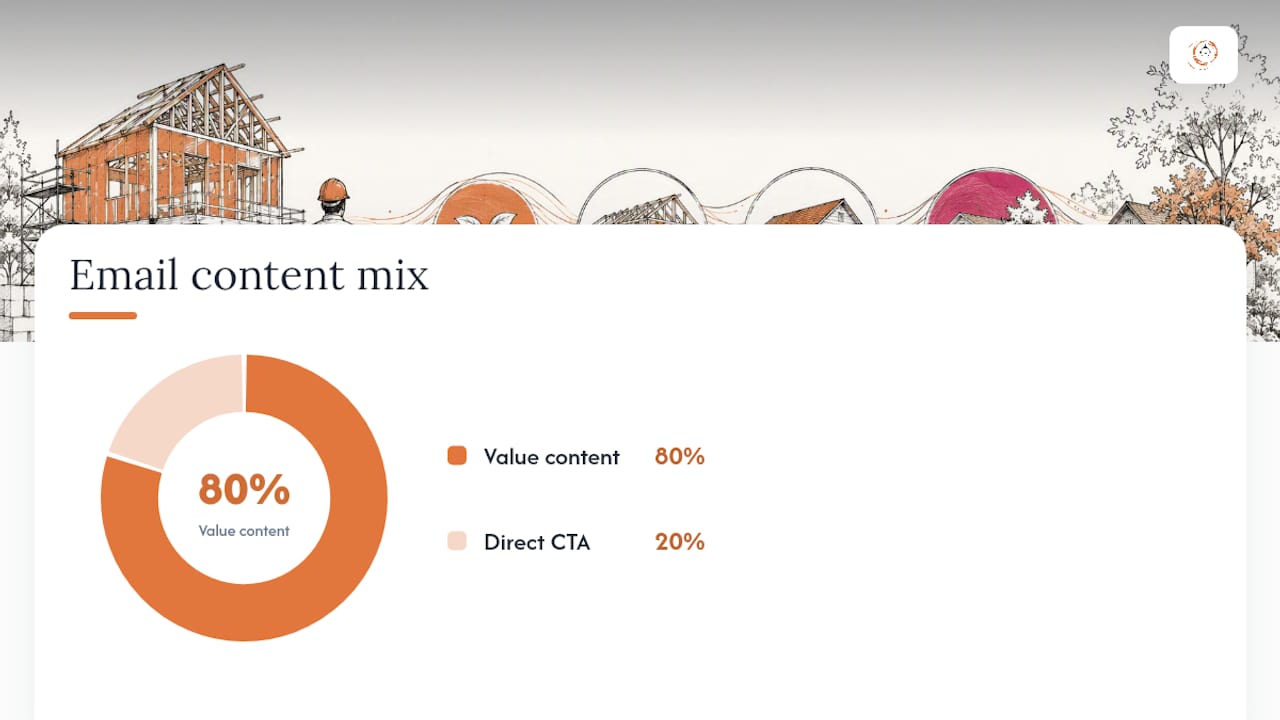
Email remains the most reliable channel for sustaining contact over weeks or months, and targeted emails tied to a lead’s specific project consistently outperform generic broadcast blasts. The mix that works best runs roughly 80% genuine value, project galleries, financing options, maintenance tips, and 20% direct call-to-action. Flood a lead’s inbox with nothing but “call us now” messages and they unsubscribe fast.
Segmentation makes that value relevant instead of generic:
- Split sequences by project type, since a roofing lead and a kitchen remodel lead need entirely different content.
- Adjust cadence by urgency, storm damage gets daily contact; a “maybe next year” renovation gets monthly.
- Tailor tone by lead source, a referral already trusts you more than a cold ad click and needs less convincing.
Speed-to-lead automation should be non-negotiable. Set your CRM to fire an acknowledgement text or email within minutes of a new inquiry, even if a human follow-up call comes an hour later. Tools built specifically for instant lead response automation can handle this trigger without adding headcount.
Sequence design in order:
- Immediate acknowledgement confirming receipt and setting expectations for next contact.
- A short nurture series (three to five touches) mixing project photos, a relevant case study, and a clear next step.
- A longer monthly sequence for cold leads built around seasonal content and portfolio updates.
- A reactivation trigger any time a cold lead engages again, clicks a link, opens three emails in a row, replies to anything.
Case studies and project galleries do more work in these sequences than any discount offer. A prospect comparing three bids wants proof you’ve done this exact job well before, not a coupon.
Measure and Optimize: KPIs Contractors Should Track
Tracking too many numbers is as bad as tracking none. Five metrics tell you almost everything you need to know about whether nurturing is working.
| KPI | What it measures | Practical target |
|---|---|---|
| Lead response time | Speed of first contact | Under 5 minutes |
| Lead-to-estimate conversion | Leads that reach a bid | Track monthly trend |
| Estimate-to-win ratio | Bids that become contracts | Track monthly trend |
| Pipeline coverage | Open leads vs. sales goal | 3x to 5x revenue target |
| Customer lifetime value | Referrals and repeat jobs | Track annually |
Set targets based on your own baseline, not an industry benchmark pulled from a different trade. Run small A/B tests, try a same-day estimate delivery against a three-day delivery for a month, and see which one moves the win ratio. Review response time and conversion weekly on a simple dashboard, check pipeline coverage monthly, and run a full data audit quarterly to catch drift before it compounds.
Quick Templates and Example Nurture Sequences
You don’t need custom copywriting for every lead. A few solid templates cover most situations.
- Immediate acknowledgement (text, sent within 5 minutes): “Thanks for reaching out about your [project type]! This is [name] from [company]. I’ll call you within the hour to go over the details.”
- Hot lead nurture, email 1 of 3: Confirm project scope and attach two to three relevant project photos.
- Hot lead nurture, email 2 of 3: Share a short case study of a similar completed job with before-and-after images.
- Hot lead nurture, email 3 of 3: Offer a firm next step, schedule a walkthrough or send the estimate.
- Cold lead monthly template: Rotate seasonal tips, one recent project spotlight, and a soft reminder that you’re available when they’re ready.
- Phone script for estimate follow-up: “Hi [name], following up on the estimate we sent for [project]. Did you have any questions on scope or pricing before we lock in a start date?”
Common Traps and Quick Cultural Fixes
Contractors tend to overbuild these systems and then let them collapse under complexity. The biggest failure pattern isn’t a bad CRM choice, it’s dumping every automation and field into the tool on week one and expecting the team to keep up. Simpler wins. Start with five fields and one sequence, prove it works, then add.
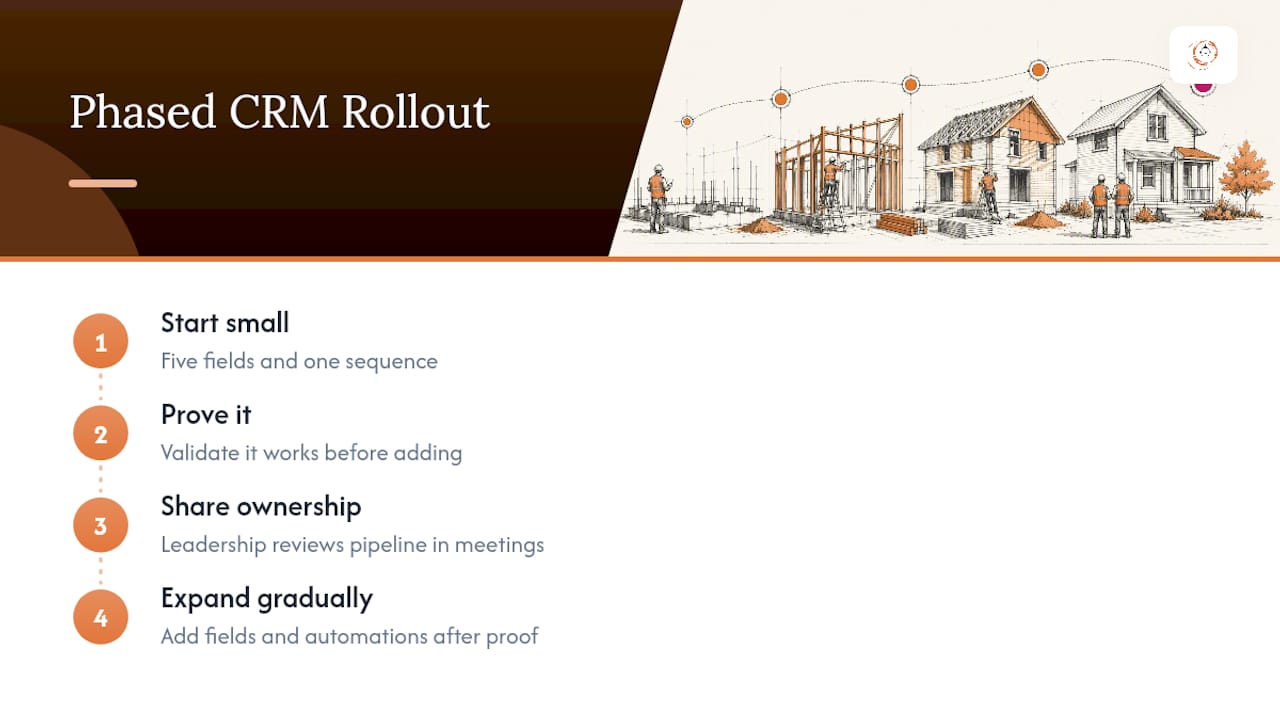
The second trap is letting one person become the entire system. When the office manager who “owns the CRM” goes on vacation, leads sit untouched for two weeks. Governance has to be visible and shared, with leadership actually pulling up the pipeline in Monday meetings instead of asking someone else for a summary.
If you fix only two things this quarter, fix response time and put a templated follow-up call on every estimate you send out. Both are cheap, fast, and immediately measurable.
— Rowena Tulacz
How R Construction Solutions LLC Helps You Build This System
Reading this playbook is one thing. Getting a phased rollout done while you’re also running active jobs is another. Some consulting firms work directly with growth-stage contracting firms to implement the CRM and nurturing systems this article describes, without the guesswork of picking software and hoping your team adopts it.

The firm’s Construction Consulting Services cover CRM and marketing automation setup, role-based training for your estimators and sales staff, and the phased rollout structure that separates a working system from an abandoned software subscription. For general contractors specifically, the services built around estimating support and workflow optimization pair naturally with nurturing work, since a slow estimate turnaround undoes even the best-designed email sequence. Services are often delivered by teams with extensive construction business advisory experience rather than generic software vendors reading from scripts. If your follow-up process is costing you jobs you already paid to generate, consider engaging a consulting firm for a discovery call and a phased rollout plan built around your actual pipeline.
Sources
- CRM playbook for any-size contractor — AGC
- Implementing a construction company CRM: step-by-step guide — iRecruit
FAQ
How Much Do Contractors Typically Pay for Leads?
Costs vary widely by trade, region, and channel, with paid platforms like Google Ads often running from $20 to over $150 per lead depending on competition and project type. R Construction Solutions LLC’s CRM & Marketing services don’t publish flat lead-generation pricing; current service pricing is available directly through the firm.
How Does Lead Nurturing Actually Work?
Lead nurturing works by keeping consistent, relevant contact with a prospect through a planned sequence of emails, texts, and calls until they’re ready to sign. Nurtured leads make purchases 47% larger than non-nurtured leads, because the ongoing contact builds enough trust for the prospect to accept a fuller project scope.
How Much Should a Contractor Spend on Lead Generation?
There’s no universal figure, since it depends on average job value and profit margin per trade. A more reliable approach is tracking cost per booked job rather than cost per raw lead, since pipeline optimization alone has driven 30% to 50% revenue gains for contractors without increasing ad spend at all.
How Can I Find More Leads as a Contractor?
Referrals, Google Business Profile optimization, and past-client outreach typically outperform cold advertising in cost per booked job, especially once a nurture system is in place to keep those contacts warm. Fixing your follow-up and nurturing process first often surfaces more booked jobs from your existing lead flow before you need to spend a dollar more on new lead sources.
Recommended
- Email Marketing Strategy - Email Marketing Insights
- How to Build a Repeat Client Base as a General Contractor
- Contractor Business Consulting Mistakes to Avoid in 2026
- How Process Improvement Drives Success in Construction: Practical Steps for Contractors
Running the job and the business at the same time? One short email a week — change orders, billing, job costing, scheduling. Free, no pitch. Subscribe.
Free and unconditional. No call required, no obligation, unsubscribe anytime.