
General Liability Insurance for Commercial Contractors: 2026 Guide | R. Construction Solutions
General liability insurance is the foundational commercial coverage that protects contractors from third-party claims of bodily injury and property damage arising from their work. For commercial contractors, project managers, and business owners, understanding the role of general liability commercial contractors carry is not optional. It determines whether you win bids, access jobsites, and survive a costly claim. This coverage is required by state licensing boards, property managers, lenders, and nearly every commercial contract in 2026. Getting it right means knowing exactly what it covers, what it excludes, and how to structure it for the projects you pursue.
What does general liability insurance cover for commercial contractors?
General liability insurance covers three core areas: third-party bodily injury, property damage to third parties, and personal or advertising injury. If a visitor trips over materials on your jobsite and breaks an arm, your GL policy responds. If your crew damages a client’s existing structure during renovation, GL covers the repair costs. GL insurance covers third-party losses but excludes first-party losses like your own tools, employee injuries, and professional errors.

Those exclusions matter more than most contractors realize. Your own equipment, vehicles, and tools require separate policies. Employee injuries fall under workers’ compensation, not GL. Faulty workmanship claims and project delays are also excluded from standard GL coverage. Contractors mistakenly assume GL covers faulty work or project delays. It does not. Those risks require separate policies or specific endorsements.
What GL does cover:
- Bodily injury to third parties on or near your jobsite
- Property damage caused to a client’s or neighbor’s property
- Completed operations coverage for claims arising after project completion
- Personal and advertising injury, including libel or slander claims
- Legal defense costs under the duty to defend clause
What GL excludes:
- Your own tools, equipment, and materials (requires inland marine or equipment floater)
- Employee injuries (requires workers’ compensation)
- Professional errors and design mistakes (requires professional liability or E&O)
- Faulty workmanship or defective work product
- Auto accidents involving your company vehicles (requires commercial auto)
Pro Tip: Review your GL policy’s exclusions page before signing any commercial contract. Missing an exclusion can leave you personally liable for a six-figure claim your policy will not touch.
How do coverage limits and endorsements shape your GL protection?
Coverage limits define the maximum your insurer pays per claim and per policy year. Standard commercial contracts in 2026 typically require $1M per occurrence and $2M aggregate as a minimum. Larger projects, including those with developers, lenders, or public agencies, often demand $2M per occurrence and $5M aggregate or higher, frequently backed by an umbrella policy.
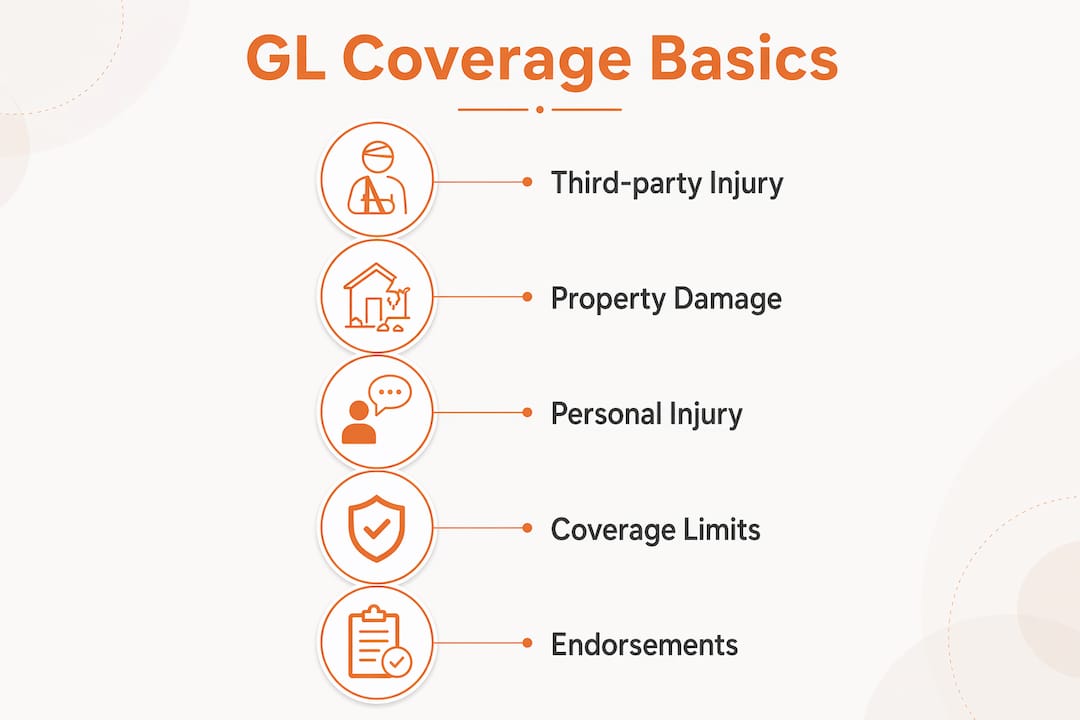
The difference between per occurrence and aggregate limits is critical. Per occurrence is the cap on any single claim. Aggregate is the total your policy pays across all claims in a policy year. A contractor with a $1M/$2M policy who faces two $1M claims in one year exhausts their aggregate after the second claim. That gap can be financially devastating.
Endorsements are additions to your base policy that modify or expand coverage. Three endorsements matter most in commercial contracting:
- Additional Insured (CG 20 10 and CG 20 37): These ISO forms add the project owner or general contractor to your policy. CG 20 10 covers ongoing operations. CG 20 37 covers completed operations. Both are typically required together on commercial projects.
- Primary and Noncontributory: This endorsement ensures your policy pays first without seeking contribution from the hiring party’s insurance. Commercial clients enforce this requirement rigorously.
- Waiver of Subrogation: This prevents your insurer from suing the additional insured to recover claim costs after paying out.
Additional insured endorsement failures are the most common reason certificates of insurance get rejected, blocking jobsite access for new contractors. That rejection can cost you days of mobilization time and damage your relationship with the general contractor or owner.
Pro Tip: Always request a sample certificate of insurance from your broker before bidding a commercial project. Confirm all required endorsements appear correctly before you submit your bid.
Contractors also use project-specific endorsements to meet elevated contractual limits without carrying year-round high-limit policies. This approach keeps annual premiums manageable while satisfying project requirements on a job-by-job basis.
Why is GL insurance critical for contract compliance and business viability?
Commercial contracts treat GL insurance as a non-negotiable entry requirement. Without the right coverage and endorsements in place, you cannot mobilize on a jobsite, regardless of how competitive your bid was. Missing a required endorsement or carrying insufficient limits disqualifies you from the project entirely.
The financial stakes without adequate coverage are severe. A single third-party bodily injury claim on a commercial project can reach hundreds of thousands of dollars in medical costs, legal fees, and settlements. Without GL, those costs come directly from your business assets and personal finances.
The duty to defend clause in GL insurance means your insurer pays legal defense costs separately from your policy limits. Defense costs do not reduce your available coverage for the claim itself. For contractors facing complex litigation, this benefit alone can be worth more than the settlement amount.
The practical implications for bidding are direct. Contractors who carry the right limits, with the right endorsements, from carriers with strong AM Best ratings, win more bids. Relying on outdated insurance leads to lost bids and compliance failures as clients demand higher limits and top-rated carriers. Updating your insurance stack is not just a compliance task. It is a competitive advantage.
Key contract compliance requirements to verify before bidding:
- GL limits meet or exceed the contract’s minimum requirements
- Additional insured endorsements (CG 20 10 and CG 20 37) are in place
- Primary and Noncontributory language is confirmed on the certificate
- Waiver of Subrogation is included where required
- Your carrier holds an AM Best rating of A or better
How does GL insurance fit into the full commercial contractor insurance stack?
General liability is the foundation, but it is not the complete structure. Commercial contractors need a full insurance stack to cover all material risks on a project. General contractors bear broader liability than trade contractors because their exposure includes both their own work and the work of every subcontractor on the project.
Here is how the standard commercial contractor insurance stack breaks down:
| Coverage Type | What It Covers | Who Needs It |
|---|---|---|
| General Liability | Third-party injury and property damage | All contractors |
| Workers’ Compensation | Employee injuries on the job | All contractors with employees |
| Commercial Auto | Company vehicles and drivers | Any contractor with a fleet |
| Umbrella / Excess Liability | Coverage above GL and auto limits | GCs and large trade contractors |
| Inland Marine / Equipment | Tools, equipment, and materials in transit | All contractors |
| Contractor’s Bonds | Performance and payment guarantees | GCs and licensed trades |
GL premiums for small contractors range from $480 to $3,000 annually. Larger multi-trade contractors pay $50,000 to $250,000 or more for their total insurance stack. That range reflects the difference in project scale, payroll, and risk exposure.
Managing subcontractor insurance is a critical responsibility for general contractors. Verifying additional insured status across all subs is vital for GCs to protect themselves from claims arising from subcontractor work. A sub who lets their policy lapse mid-project creates direct exposure for the GC.
Pro Tip: Collect certificates of insurance from every subcontractor before they set foot on your jobsite. Set a calendar reminder 30 days before each sub’s policy expiration date so you can request renewals before coverage lapses.
For large commercial projects where developers or lenders require coverage above your standard GL limits, an umbrella policy is the most cost-effective path. Umbrella coverage sits above your GL and commercial auto policies, extending limits without requiring separate high-limit policies for each line. You can also explore how construction bid compliance connects to your insurance requirements when preparing proposals for major projects.
Key Takeaways
General liability insurance is the non-negotiable foundation of commercial contractor insurance, covering third-party injury and property damage while requiring specific endorsements and adequate limits to satisfy commercial contract requirements.
| Point | Details |
|---|---|
| GL covers third-party losses only | Bodily injury, property damage, and advertising injury are covered. Your tools, employees, and faulty work are not. |
| Endorsements determine jobsite access | CG 20 10, CG 20 37, Primary and Noncontributory, and Waiver of Subrogation are required on most commercial projects. |
| Limits must match the contract | Standard minimums are $1M/$2M, but large projects require $2M/$5M or higher, often backed by an umbrella policy. |
| Duty to defend protects your cash flow | Legal defense costs are paid outside your policy limits, preserving coverage for actual claim settlements. |
| GL is the foundation, not the full stack | Workers’ compensation, commercial auto, umbrella, and equipment coverage complete the protection contractors need. |
What I’ve learned about GL coverage gaps that cost contractors the most
After working with commercial contractors across dozens of project types, the pattern I see most often is not a contractor who skipped insurance entirely. It is a contractor who had insurance but had the wrong endorsements. They carried a solid GL policy, paid their premiums on time, and still got their certificate rejected on day one of a project because their broker did not add the CG 20 37 completed operations endorsement.
That mistake is more common than the industry admits. Contractors underestimate the critical nature of endorsements like Primary and Noncontributory, and commercial clients enforce these requirements without exception. The project owner’s risk manager does not care that your broker forgot. They care that your certificate does not match the contract.
The other gap I see regularly is contractors who correctly structured their insurance for a $2M project and then bid a $10M project without updating their limits. The coverage that worked last year does not automatically scale with your business. As your project size grows, your GL limits, umbrella coverage, and endorsement requirements all need to grow with it.
My advice: treat your insurance review as an annual business planning task, not a renewal formality. Sit down with a broker who specializes in construction, not a generalist. Bring your three most recent contracts and ask whether your current stack would have satisfied every requirement. The answer will tell you exactly where your gaps are. For contractors consulting with general contractor specialists, this kind of structured review is where real risk management begins.
— Rowena
How Rconstructionsolutions helps contractors get their insurance right
Rconstructionsolutions works directly with commercial contractors who need more than a policy. They need a coverage structure that wins bids, satisfies contract requirements, and holds up when a claim happens.
With over 30 years of hands-on construction experience, Rconstructionsolutions helps contractors audit their current insurance stack, identify missing endorsements, and build a coverage plan that matches the scale of their commercial projects. Whether you are a trade contractor moving into larger GC work or a mid-sized firm scaling from $5M to $50M in revenue, the right insurance structure is part of the operational foundation. Connect with the team through construction consulting services to get a clear picture of where your coverage stands and what needs to change before your next bid.
FAQ
What is general liability insurance for contractors?
General liability insurance for contractors covers third-party bodily injury, property damage, and personal or advertising injury claims arising from construction operations. It does not cover the contractor’s own property, employee injuries, or professional errors.
What endorsements do commercial contractors need on their GL policy?
Most commercial contracts require Additional Insured endorsements (CG 20 10 and CG 20 37), Primary and Noncontributory language, and a Waiver of Subrogation. Missing any of these is the leading cause of certificate of insurance rejections.
How much GL coverage do commercial contractors need?
Standard commercial contracts require $1M per occurrence and $2M aggregate at minimum. Larger projects typically require $2M per occurrence and $5M aggregate or higher, often supported by an umbrella policy.
Does GL insurance cover faulty workmanship?
No. Standard GL policies exclude faulty workmanship and project delays. These risks require separate endorsements or standalone policies such as a contractor’s professional liability or a wrap-up program.
Why do general contractors need more GL coverage than subcontractors?
General contractors carry liability for their own work and for the work of every subcontractor on the project. That broader exposure requires more comprehensive GL coverage, higher limits, and active management of subcontractor certificates of insurance.

