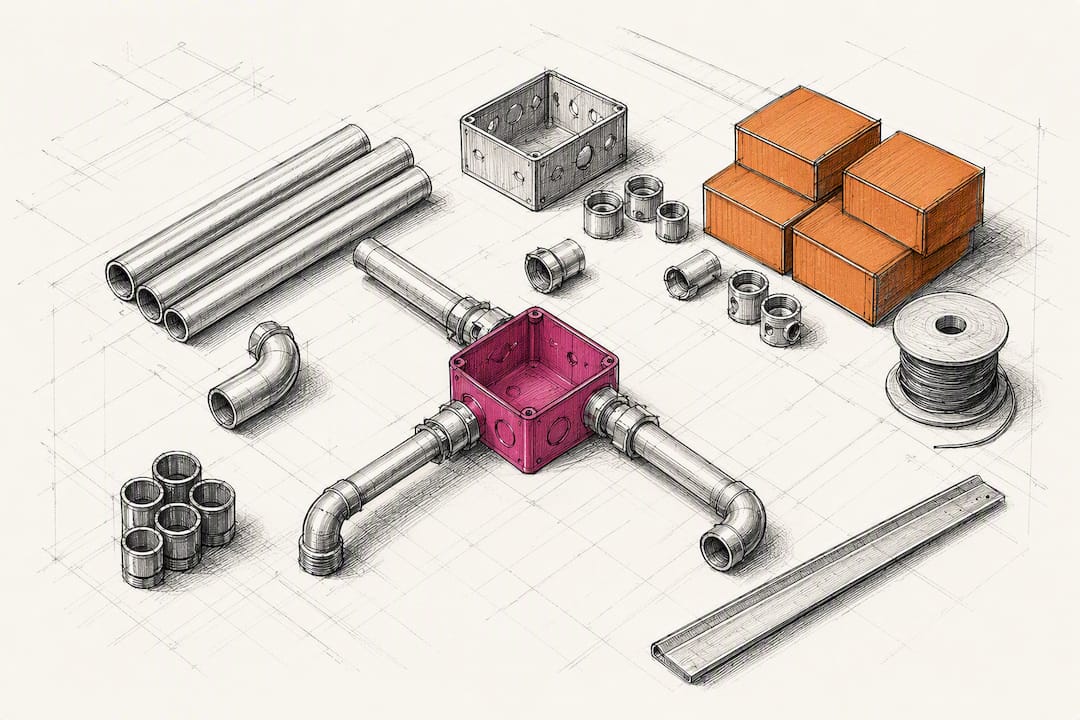
Electrical Estimating Methods That Avoid 20–40% Productivity Swings
For fast conceptual budgets, per-point unit cost estimating gets you a number in hours. For bid-level pricing, the labor-unit method built on NECA units, paired with material takeoff, is the industry standard. For design-build or prefabricated scopes, pre-build and assembly estimating price the job closer to how it will actually get built. Guesstimates belong only in early ROMs, never in a signed bid. Digital and AI-assisted takeoff tools speed up counting, but they don’t replace an estimator’s judgment on scope splits and spec interpretation.
TL;DR:
- Using the labor-unit method with NECA references and documented adjustment factors provides the most accurate bid-level estimates and reliable risk management.
- Digital and AI-assisted takeoff tools speed counting but require human judgment to interpret scope splits and verify scope changes in poor-quality drawings or addenda.
- Maintaining an updated library of assemblies and regular review of unit prices significantly improves estimate consistency and reduces underbidding risks.
- Guesstimates and per-point methods are only suitable for early feasibility and lack the precision needed for final bids, especially when scope and site conditions vary.
- Proper documentation of assumptions, scope, and scope adjustments is critical for defending estimates and avoiding margin loss during dispute resolution.
Table of Contents
- What Are the Main Electrical Estimating Methods?
- How Do You Actually Perform Each Estimating Method?
- Comparing Electrical Estimating Methods by Accuracy, Speed, and Fit
- How to Build an Electrical Estimate From Takeoff to Bid Submission
- Where Estimating Software and AI Takeoff Actually Help
- What R Construction Solutions LLC Recommends for Growing Contractors
- Choosing the Right Method: A Quick Decision Checklist
- An Editorial Take on What Actually Separates Accurate Bids From Lucky Ones
- Sources
- FAQ
What Are the Main Electrical Estimating Methods?
Every electrical estimate you build comes down to one of a handful of core approaches, and knowing which is which matters more than most contractors realize when a bid goes sideways. Here’s the operational breakdown.
- Per-point / unit cost method. You count devices (outlets, switches, fixtures, panels) and multiply each by a flat unit price that already bundles labor and material. A 200-outlet office fit-out might use a rough planning number per device. It’s fast, but it flattens real variation in ceiling height, conduit run length, and access.
- Labor-unit method. You quantify materials, then apply standardized labor hours per unit, most commonly sourced from the NECA Manual of Labor Units (MLU)), the baseline reference nearly every commercial electrical estimator works from. Multiply hours by your loaded crew rate, add material cost, and you get a defensible bid number based on current local wage and burden data.
- Assembly / component estimating. Instead of pricing wire, conduit, boxes, and labor separately, you build a priced “assembly” for a repeatable unit that bundles materials and labor into one line item.
- Pre-build / design-and-construct estimating. Used when prefabrication or a design-assist delivery model changes the labor curve. You price against vendor quotes, shop assembly time, and field installation separately rather than a standard field-labor unit.
- Guesstimate / ROM (rough order of magnitude). A square-footage or cost-per-unit multiplier used for early feasibility conversations, acceptable only when everyone understands it’s a placeholder, not a bid.
- Takeoff modes. Manual (paper or PDF markup by hand), on-screen digital takeoff (software-assisted counting and measuring), and AI-assisted extraction (automated symbol recognition with human verification).
Each method solves a different problem. The mistake most estimators make isn’t picking the wrong one. It’s using the same method for every project stage regardless of what the client actually needs.
How Do You Actually Perform Each Estimating Method?
Knowing the definitions is one thing. Running the workflow under deadline pressure is another. Here’s how each method plays out in practice.
-
Per-point workflow. Count every symbol by type directly from the drawings, then assign a unit price built from historical averages, published references like Craftsman/RSMeans cost data, or your own job-cost history. The unit price should already reflect labor, material, and a rough allowance for incidental fittings. This method moves fast, but it’s only as accurate as your historical baseline. Stale unit prices from three years ago will quietly under-bid you today.
-
Labor-unit workflow. Pull labor hours from the NECA MLU for each material quantity, then apply an adjustment factor based on jobsite conditions, ranging from normal work (0.90 to 1.15) up to very difficult conditions like occupied hospitals or tight retrofit ceilings (1.20 to 1.50), according to NECA’s own guidance. Multiply adjusted hours by your fully loaded labor rate (wages, burden, insurance) to get labor cost, then add material.
-
Assembly workflow. Define your assemblies once (a typical branch circuit, a panel feed, a fixture whip), price the labor and material as a bundle, and reuse that assembly across every project where it repeats. This is where a maintained unit-price library pays for itself on every future bid.
-
Pre-build and vendor-quote workflow. Get firm vendor quotes for prefabricated assemblies, add explicit escalation language for lead-time risk, and separate shop labor from field installation labor since they run at different rates and productivity curves.
-
Guesstimate workflow. Document your assumptions in writing, square footage, cost-per-square-foot multiplier, and scope exclusions, so nobody mistakes a ROM for a firm number six months later when the client is holding you to it.
Pro Tip: Keep a one-page assumptions sheet attached to every estimate, regardless of method. When a change order dispute happens eight months into construction, that sheet is what protects your margin.
The most common mistake across all five methods is skipping documentation of adjustment factors and unit-price sources. If you can’t show your math, you can’t defend your number.
Comparing Electrical Estimating Methods by Accuracy, Speed, and Fit
No single method wins across every dimension. The right choice depends on project stage, scope certainty, and how much time you actually have.
- Accuracy and granularity: Labor-unit and assembly methods deliver the tightest accuracy because they price at the component level. Per-point and guesstimate methods trade granularity for speed, which is fine early but risky at bid stage.
- Speed and setup time: Guesstimates take minutes. Per-point takeoffs take hours. Labor-unit and assembly estimates take longer upfront but pay off on repeat projects once your unit library is built.
- Best-fit project stage: Use guesstimates for feasibility studies and early ROMs, per-point for schematic design (SD) budgets, labor-unit and assembly for design development (DD) through bid-level pricing, and pre-build/vendor-quote for change orders and prefabricated scopes.
- Required inputs: Per-point needs only a device count and a unit-price sheet. Labor-unit needs full material takeoff plus a current NECA labor unit reference. Assembly estimating needs a maintained assembly library. Pre-build needs vendor pricing and lead-time data.
- Cost to implement: Per-point and guesstimate methods require almost no software investment. Labor-unit and assembly methods benefit heavily from an estimating platform and a subscription to a current pricing reference, an upfront cost that pays back on volume.
- Risk profile: Guesstimates and loosely-adjusted per-point numbers carry the highest change-order exposure because they don’t capture site-specific labor conditions. Labor-unit estimating with documented adjustment factors gives you the strongest paper trail if a dispute arises.
The pattern holds across trades, but electrical work is uniquely sensitive to labor variation. A ceiling height change or an occupied-space restriction can swing productivity by 20% to 40%, which is exactly why unit-price libraries need regular maintenance rather than a one-time setup.
How to Build an Electrical Estimate From Takeoff to Bid Submission
A reliable estimate follows the same sequence every time, regardless of project size.
- Confirm scope and code edition first. Review drawings and specs for exclusions, then verify which NEC edition applies. The code updates every three years, and local authorities having jurisdiction may require a specific edition or add supplemental requirements, so this isn’t a step to skip.
- Run takeoff in a fixed order: lighting, then power, then low-voltage systems, then service and distribution. Color-code each category as you go so a second reviewer can verify counts without re-doing the whole takeoff.
- Apply NECA labor units to your material quantities, then layer in adjustment factors for site conditions, normal work runs 0.90 to 1.15, difficult or occupied-space work runs higher, up to 1.50 for very difficult healthcare or retrofit conditions. Convert adjusted hours into a loaded labor rate that includes wages, burden, and insurance; the Bureau of Labor Statistics publishes wage benchmarks useful for sanity-checking your base rate.
- Price materials from a current source and add an escalation allowance for volatile items like conductor and gear.
- Apply markup as a multiplication, not addition. A common structure multiplies direct cost by an overhead and profit factors typically range in moderate percentages and should be multiplied rather than added for accuracy., rather than simply stacking percentages, which under-recovers cost on larger jobs, per standard bid math practice.
- Run a peer-review pass on high-dollar assemblies and critical feeders before final sign-off, not on every single line item.
Where Estimating Software and AI Takeoff Actually Help
Digital takeoff tools count symbols and measure conduit runs directly from PDF plans, saving hours compared to manual highlighter-and-scale-ruler methods. AI-assisted extraction goes further, auto-recognizing standard symbols and populating quantities automatically.
- On-screen takeoff replaces manual measuring but still requires a human to confirm scale and catch drawing revisions.
- AI-assisted extraction can cut counting time substantially, but it struggles with poor-quality scans, nonstandard symbol legends, and addenda that change scope mid-bid.
- NECA labor units and pricing services increasingly plug directly into estimating software, turning a raw quantity takeoff into a priced estimate without manual re-entry.
- The real payoff isn’t just speed. It’s the estimator time freed up for judgment calls, spec interpretation, scope clarification, and risk assessment, that no algorithm handles reliably yet.
Pro Tip: When piloting new takeoff software, run it in parallel with your manual process on two or three bids before trusting it solo. That comparison tells you exactly where the tool’s blind spots are.
What R Construction Solutions LLC Recommends for Growing Contractors
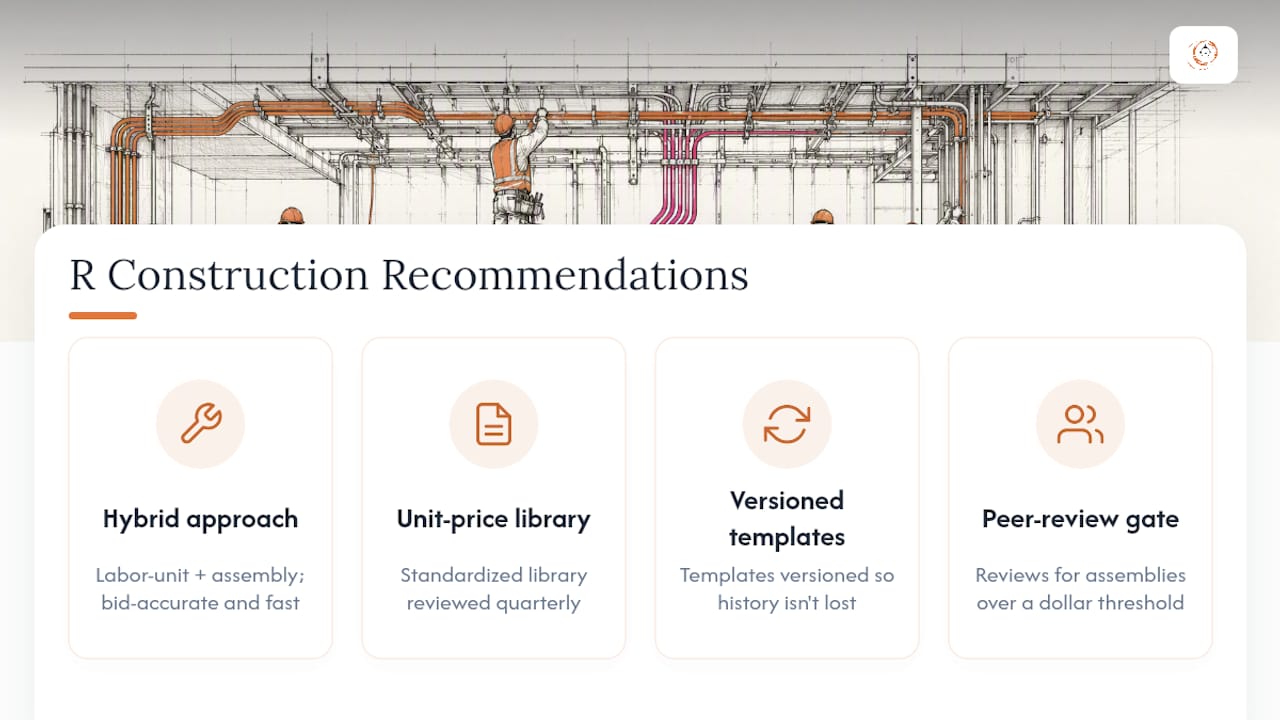
R Construction Solutions LLC generally recommends a labor-unit and assembly hybrid for electrical subcontractors scaling past their first few million in annual revenue. It’s accurate enough for bid-level pricing and fast enough to stay competitive on volume.
The process controls that move the needle fastest: a standardized unit-price library reviewed quarterly, versioned estimate templates so revisions don’t overwrite history, and a peer-review gate on assemblies over a defined dollar threshold. Most advisory engagements start with the same quick wins: standardize your highest-dollar assemblies first, automate repetitive counting tasks, and formalize escalation language in every vendor quote. Explore how R Construction Solutions LLC supports electrical contractors with estimating structure that scales.
Choosing the Right Method: A Quick Decision Checklist
Match the method to the stage: guesstimates for feasibility, per-point for early budgets, labor-unit and assembly for bid-level accuracy, pre-build for prefabricated or design-build scopes. Minimum inputs range from a device count and unit price up to full material takeoff plus a current NECA reference. Three next steps move you forward fastest.
- Standardize your unit-price library and review it at least quarterly.
- Pilot digital or AI-assisted takeoff on two or three bids before switching fully.
- Institute a peer-review gate on high-dollar assemblies before final submission.
| Method | Best used for | Minimum required input |
|---|---|---|
| Guesstimate/ROM | Feasibility, early budget | Square footage, cost multiplier |
| Per-point/unit cost | Schematic design budgets | Device count, unit price sheet |
| Labor-unit (NECA MLU) | Bid-level pricing | Full takeoff, current labor unit reference |
| Assembly | Bid-level, repeatable scopes | Maintained assembly library |
| Pre-build/vendor-quote | Design-build, prefab | Vendor quotes, lead-time data |
If your estimating process still lives entirely in one person’s head or a single outdated spreadsheet, that’s the first thing to fix before you touch software. R Construction Solutions LLC’s construction consulting services help contractors build the estimating structure and bid-preparation process that reduces risk on larger jobs and improves close rates. A verified takeoff review from a partner resource like Schippers Bouwconsult can also serve as a useful outside checkpoint before a bid goes out the door.
An Editorial Take on What Actually Separates Accurate Bids From Lucky Ones
The conventional advice on electrical estimating spends too much time arguing over which method is “best” and not enough time on the discipline behind whichever method you pick. A labor-unit estimate built on stale NECA adjustment factors from a job three years ago isn’t more accurate than a careful per-point budget with current unit prices. The method matters less than the maintenance behind it.
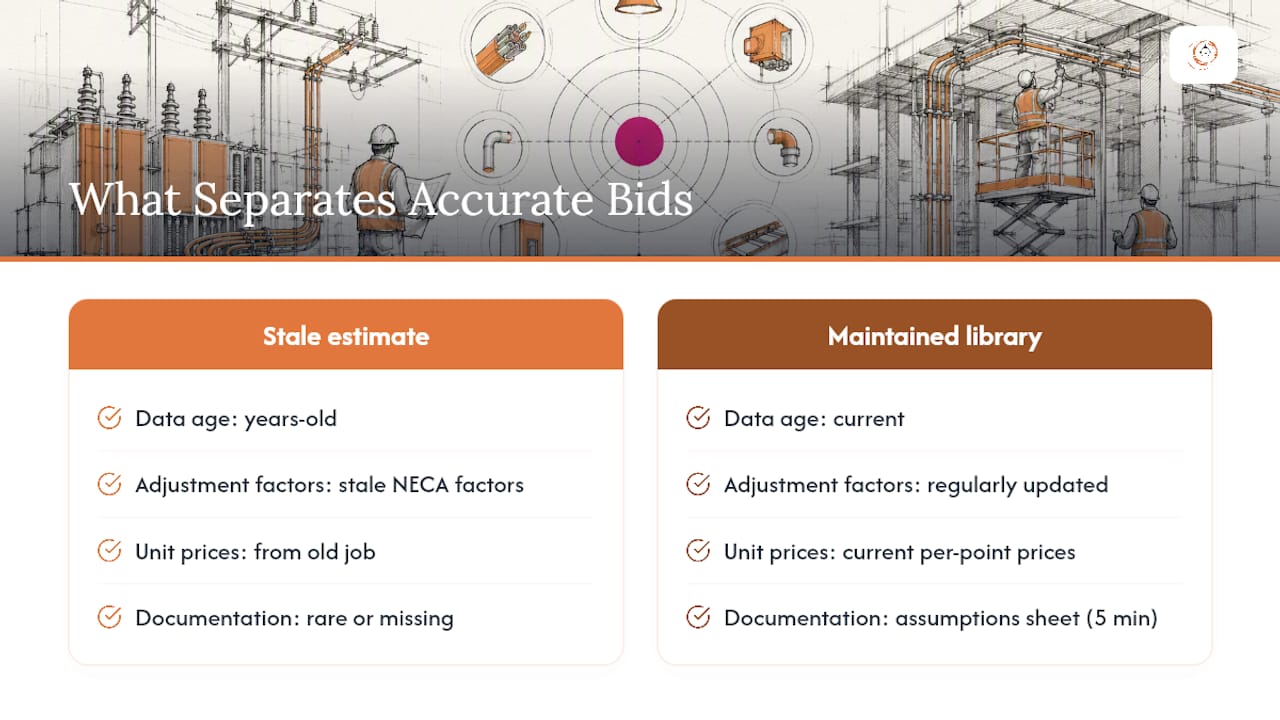
What gets underestimated is documentation. Contractors lose margin on change orders not because their original number was wrong, but because they can’t prove what assumptions that number was built on. A one-page assumptions sheet costs five minutes and saves thousands in disputed change-order negotiations.
If there’s one place to prioritize effort, it’s building and maintaining a real unit-price and assembly library rather than chasing the newest takeoff software. Software speeds up counting. It does not fix a library nobody has updated since before the last NEC revision.
— Rowena Tulacz
Sources
- Electrical Cost Estimating: NECA Labor Units, Unit Pricing, and Bid Math | PILARS
- Estimating Electrical Construction (Craftsman Book Company preview)
- Electrical Estimating Guide: Commercial & Industrial 2026 | Drawer AI
FAQ
What are the four types of estimating?
The four commonly recognized types are conceptual/ROM estimates, square-footage or unit-cost estimates, assembly (or systems) estimates, and detailed unit-price estimates built from full material takeoff and labor units.
What is the best way to estimate electrical work?
For bid-level accuracy, use the labor-unit method built on NECA labor units combined with a maintained assembly library, then apply site-specific adjustment factors and current material pricing before final markup.
What are the top electrical estimating software tools?
Electrical estimating software generally falls into on-screen digital takeoff platforms and newer AI-assisted extraction tools; both integrate NECA labor units and pricing data, but neither replaces human verification of scope and specs.
What is the best free app for electrical estimates?
Free electrical estimating apps typically offer basic device counting and unit-cost multiplication for rough budgets, but they lack the current NECA labor unit data and assembly libraries needed for accurate bid-level pricing.
Recommended
- Electrical Project Cost Components Every Estimator Must Know
- Electrical Takeoff Checklist for Commercial Projects
- How to Improve Your Construction Estimating Process
Running the job and the business at the same time? One short email a week — change orders, billing, job costing, scheduling. Free, no pitch. Subscribe.
Free and unconditional. No call required, no obligation, unsubscribe anytime.