Contractors: Construction Pipeline, Stages, Caps, Forecasts
Construction pipeline management is the discipline of defining stage-based opportunity flow, enforcing bid/no-bid discipline, and running weekly pipeline reviews so leadership can forecast revenue with confidence. Start this week by writing down your pipeline stages and building a 30-minute bid/no-bid checklist for every incoming opportunity. Firms that do this consistently see cleaner forecasts, fewer wasted estimating hours, and higher win rates within a quarter.
TL;DR:
- Consistently applying a clear stage structure with mandatory data fields improves forecast accuracy and highlights deal stalls or delays.
- A 30-minute bid/no-bid checklist helps prioritize opportunities based on funding, client relationship, capacity, and competitiveness, reducing wasted estimating hours.
- Integrating CRM with estimating and project management tools ensures seamless data flow and accurate probability-weighted forecasting for better decision-making.
- Tracking key KPIs such as pipeline value by stage, conversion rates, and time-in-stage reveals bottlenecks and informs targeted process improvements.
- Regular weekly reviews with cross-departmental attendance and explicit ownership prevent deals from stalling and enhance pipeline discipline.
Table of Contents
- What Are the Stages of a Construction Sales Pipeline?
- How Do You Build a Bid/No-Bid Checklist That Sticks?
- Which Tools Belong in Your Construction Tech Stack?
- What KPIs Actually Predict Construction Revenue?
- How Should Weekly Pipeline Reviews and Follow-Ups Work?
- What Pipeline Mistakes Cost Contractors the Most Deals?
- What Does a 90-Day Pipeline Rollout Actually Look Like?
- How Do You Segment Your Pipeline for Better Conversion?
- How Do You Turn One-Off Bids Into Repeat Clients?
- How Do You Get Sales and Estimating Aligned?
- How Do You Find Where Your Pipeline Is Actually Leaking?
- Why Pipeline Discipline Is an Operating System, Not Admin Work
- Get Expert Help Implementing Your Pipeline System
- Sources
- FAQ
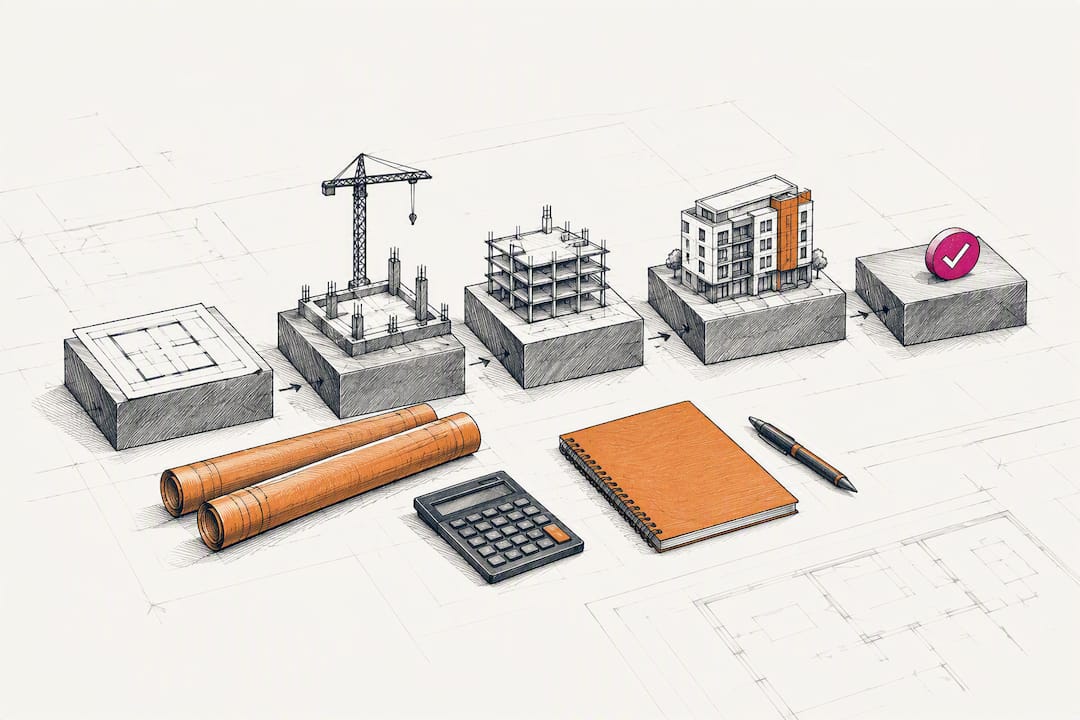
What Are the Stages of a Construction Sales Pipeline?
Most contractors track deals in a spreadsheet with vague labels like “interested” or “waiting to hear back.” That’s not a pipeline. A real construction pipeline needs stages that map to how projects actually get won, and it needs mandatory data fields at each one so nothing falls through the cracks.
A workable stage structure looks like this.
- Pre-bid relationship/discovery — first contact, RFI, or a referral conversation before any invitation to bid exists
- Bid/no-bid decision — the point where you formally decide whether to commit estimating hours
- Estimating — the takeoff, pricing, and scope confirmation phase
- Proposal submitted — the bid or proposal is in the owner’s or GC’s hands
- Negotiation — value engineering, scope clarification, or price discussion before award
- Award or loss — the deal closes, either in your favor or not
Each stage needs specific fields captured, not just a dollar figure. Track contract value, the decision-maker’s name and title, your relationship tier with that client (cold, warm, or established), funding status, target schedule, and any risk flags like unclear scope or unusual bonding requirements. Documenting how your last 50 projects actually moved through these stages will reveal your real stage criteria faster than any generic template.
Time-in-stage matters as much as stage itself. A deal sitting in “negotiation” for eight weeks with no movement is not negotiating. It’s stalled, and it’s probably dead. Set a rough benchmark for each stage, keeping deal durations within reasonable timeframes to maintain momentum, and flag anything that exceeds those typical limits. Every stage should carry a required next action with an owner and a date attached. If a deal has no next action, it has no business staying in the pipeline.
How Do You Build a Bid/No-Bid Checklist That Sticks?
Estimating hours are a finite resource, and most contractors burn far too many of them on bids they never had a real shot at winning. A disciplined bid/no-bid process is the single highest-leverage fix available to a growth-stage firm, because it redirects your best estimators toward the opportunities most likely to convert.
Build a checklist that takes no more than 30 minutes to run for any new opportunity:
- Funding confirmed — is the project actually funded, or still speculative?
- Owner or GC relationship — have you worked with this client before, or is this cold?
- Backlog fit — does this project fit your current schedule and crew capacity?
- Bonding and capacity — can you bond and staff this without straining other jobs?
- Number of bidders — is this a two-bidder job or a fifteen-bidder shootout?
- Owner reputation — does this client pay on time and change scope reasonably?
Score each item on a simple 0 to 2 scale and set a pass threshold, commonly a level well above half the total score. Anything below that gets a hard no unless a partner or estimator overrides it in writing, with a reason logged. Record every decision directly in the CRM against that opportunity record, not in a side email thread, so the data survives past the person who made the call.
Pro Tip: Track your bid/no-bid scores against actual win/loss outcomes every quarter. If your “high score” bids aren’t winning at a meaningfully higher rate than your low scores, your scoring weights are wrong, not your discipline.
Which Tools Belong in Your Construction Tech Stack?
The right tech stack isn’t about buying more software. It’s about making sure your CRM, estimating system, project management platform, and document library talk to each other so nobody re-enters the same data three times.
The core integration to get right is CRM connected to your estimating software, connected to your project management system, connected to a shared photo and document library. When an opportunity moves from proposal to award, the job data, drawings, and client contacts should flow into your PM system automatically instead of getting manually recreated. Estimating software that isn’t wired into your CRM just becomes another disconnected spreadsheet with a nicer interface.
At minimum, your CRM needs these fields enforced as required, not optional:
- Opportunity stage and stage-entry date
- Estimated contract value and probability weighting
- Assigned estimator and BD owner
- Next action and next action due date
- Relationship tier and referral source
Automation earns its keep in a few specific spots: automated follow-up sequences after a proposal goes out, scheduled re-engagement pings on paused deals so a promising lead doesn’t quietly die, and reminders that fire when a next-action date passes with no update. On long sales cycles especially, automated touchpoints prevent deals from losing momentum between the initial handshake and the final award, since construction deals routinely run months longer than a typical B2B sale. None of this works, though, if the probability weighting on each deal is a guess. That data feeds directly into forecasting, which is where pipeline management either proves its worth or gets ignored at the next leadership meeting.
What KPIs Actually Predict Construction Revenue?
Five numbers tell you almost everything about pipeline health: pipeline value by stage, stage-to-stage conversion rate, bid-to-win ratio, average time-in-stage, and estimating capacity against current bid volume. Track those weekly and you’ll spot trouble long before it shows up on a cash flow statement.
- Pipeline value by stage — total dollar value sitting in each stage, so you can see where deals are bunching up
- Conversion rate per stage — what percentage of deals move from bid/no-bid to estimating, and from proposal to award
- Bid-to-win ratio — total bids submitted versus contracts won, tracked by project type
- Time-in-stage — average days spent in each stage against your benchmarks
- Estimating capacity vs. bid volume — hours available against hours committed, so you know when you’re overcommitting your team
Forecasting works best with a three-tier model rather than a single number. Committed revenue covers signed contracts and near-certain awards. This kind of probability-weighted, three-tier approach fits project-based construction revenue far better than a straight-line SaaS forecasting model, since a $2 million job doesn’t close in neat monthly increments the way a subscription contract does.
Calibrate your probability weightings by project type and relationship tier rather than using one blanket number across the board. A negotiated repeat client in late-stage talks deserves a much higher weighting than a cold public bid with fifteen competitors, even if both sit in the same pipeline stage. Bring the three-tier breakdown, the bid-to-win ratio by project type, and a list of stalled deals to every weekly pipeline review. That’s the dashboard leadership actually needs to make staffing and cash decisions.
How Should Weekly Pipeline Reviews and Follow-Ups Work?
Data without a cadence just sits there. The weekly pipeline review is where the numbers turn into decisions, and it needs a fixed agenda so it doesn’t turn into a status-update ramble.
- Set follow-up cadences tied to events, not calendar dates. After a proposal goes out, follow up at day 3, day 7, and day 14. If a deal pauses, schedule a re-engagement touch at 30 and 60 days rather than letting it vanish from view.
- Run the weekly review with the right people in the room. BD leads, the estimating manager, and a project delivery representative should all attend, not just sales.
- Review every deal with no next action. A stalled deal usually traces back to a first meeting that ended without a clear next step or a named decision-maker, so fix that gap the moment you spot it.
- Assign explicit ownership at every handoff. When a deal moves from BD to estimating to delivery, one person owns it at each stage, with a documented handoff date.
- Capture lost deals with a reason code. “Price,” “timeline,” and “relationship” are different problems with different fixes, and the pattern only shows up if you track it.
Measuring proposal win rate against your follow-up cadence over a 30-day window usually surfaces which touchpoint is actually driving conversions and which ones are just noise.
What Pipeline Mistakes Cost Contractors the Most Deals?
Five failure modes show up again and again in growth-stage firms: sloppy data hygiene, no real bid/no-bid enforcement, estimators drowning in too many concurrent bids, missing next-action dates, and tools that don’t talk to each other.
• Assign one owner per opportunity record so accountability doesn’t get lost between BD and estimating
- Make the next-action field mandatory in the CRM. No date, no deal.
- Cap concurrent bids per estimator based on realistic hours, not optimism
- Centralize your project portfolio in one system instead of three disconnected folders
Test fixes in short cycles: a 30-day trial enforcing the next-action field, a 60-day trial capping bid volume per estimator, a 90-day trial running the full bid/no-bid scoring grid. Measure bid-to-win ratio before and after each change.
Pro Tip: Pick one fix per month. Firms that try to overhaul everything at once usually abandon the whole system within six weeks because no single change gets enough attention to prove itself.
What Does a 90-Day Pipeline Rollout Actually Look Like?
Experienced construction operations and business development advisors often see that many $1M to $10M firms have a pipeline that lives entirely in one person’s head. That’s fine until that person is on vacation or leaves. A structured 90-day rollout fixes it without overwhelming a small team.
Month 1 focuses on triage: set up minimal CRM fields, define your stages in writing, and audit your last 50 opportunities to see how deals have actually moved historically.
Month 2 enforces the bid/no-bid checklist on every new opportunity, launches weekly pipeline reviews, and cuts estimating hours going toward low-scoring bids.
Month 3 integrates estimating data into the CRM, runs your first probability-weighted forecast, and documents win/loss reasons across the quarter to spot patterns.
Consulting firms have guided contracting firms through exactly this kind of rollout, often drawing on operational backgrounds rather than trade experience, which helps keep the focus on process and forecasting discipline instead of field methods. You can read more about the firm’s background and client work here.
How Do You Segment Your Pipeline for Better Conversion?
Not every opportunity deserves the same follow-up treatment. A $50,000 tenant improvement job and a $4 million ground-up build have completely different sales cycles, decision-makers, and risk profiles, so treating them identically in your pipeline wastes effort on both ends.
Segment by three variables: project type, project size, and client relationship tier. Commercial tenant improvements, ground-up construction, and public infrastructure work each move through your pipeline at different speeds and need different proof points in a proposal. Size matters separately, since a small job might close in two weeks off a single phone call while a large one needs multiple stakeholder meetings and a formal presentation.
Relationship tier changes the cadence more than anything else. A repeat client who’s awarded you three jobs in two years needs a lighter touch. Quick check-ins, minimal formal proposals, faster verbal agreements. A cold prospect responding to a public RFP needs the full treatment: multiple touchpoints, a polished proposal, and references specific to that project type.
Build separate follow-up sequences for each segment rather than running one generic cadence across your entire pipeline. A cold public-sector lead might need five touches over three weeks. A warm repeat client might need one call and a fast confirmation email. Segmenting this way stops your team from either under-serving your best relationships or over-investing in long-shot cold bids that were never going to convert.
How Do You Turn One-Off Bids Into Repeat Clients?
Winning a bid is the easy part compared to keeping that client coming back without a competitive rebid every single time. Repeat business from established clients typically closes faster and carries lower acquisition cost than any new lead you’ll chase, which makes post-award relationship management one of the highest-return activities in your entire pipeline.
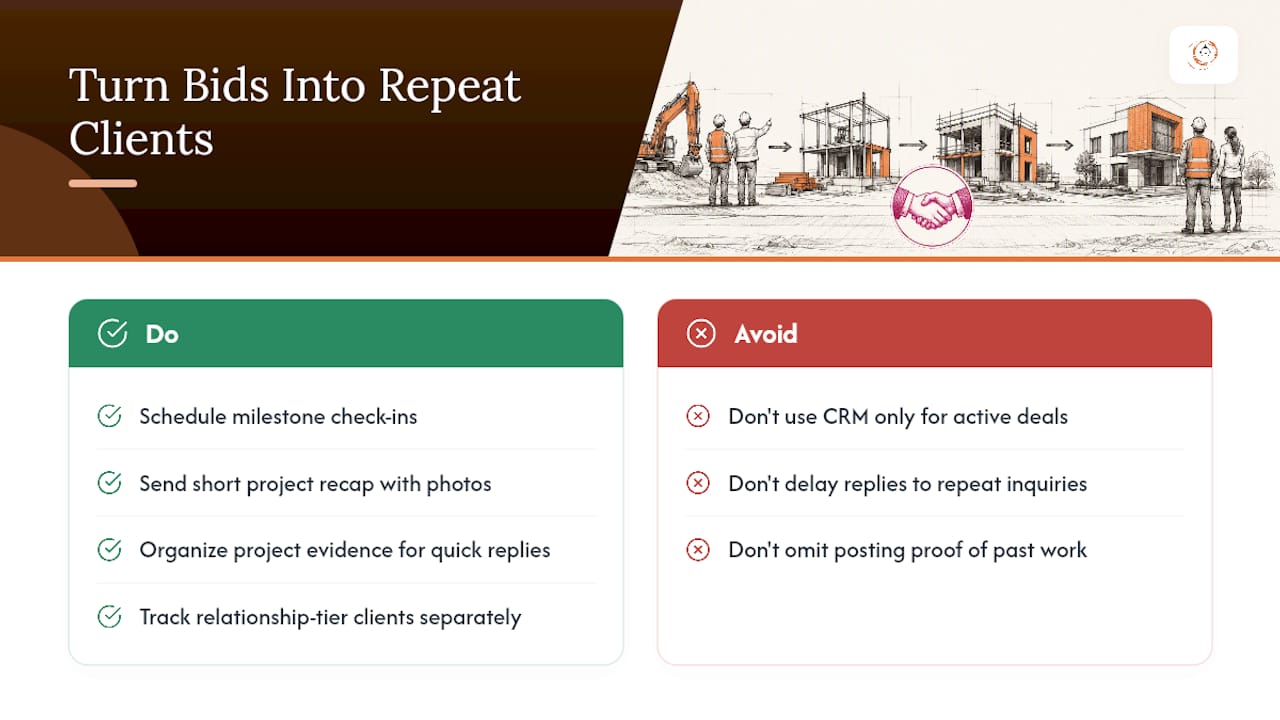
The mechanics are simple but rarely done consistently. Schedule a check-in at project milestones, not just at closeout. Send a short project recap with photos when the job wraps, and ask directly whether they have upcoming work you should know about. Keeping project evidence like photos, references, and delivery details organized and easy to pull means you can respond to a repeat client’s next inquiry in hours instead of days, and speed matters enormously to owners who already trust you.
Track relationship-tier clients as a distinct pipeline segment even when they have no active opportunity open. A client who hasn’t given you work in eight months isn’t gone, they’re paused, and a scheduled quarterly touch keeps you top of mind for their next project before it ever reaches a competitive bid list. Firms that treat their CRM as a active-deals-only tool miss this entirely, because the system stops tracking a client the moment the last invoice clears. Building a public track record also reinforces this trust loop; contractors who maintain visible proof of past work online make it easier for repeat clients and referrals to vouch for them before a conversation even starts.
How Do You Get Sales and Estimating Aligned?
Pipeline discipline falls apart fast when BD and estimating operate off different definitions of what “qualified” means. If your salespeople are handing estimating every lead that shows a pulse while estimators quietly triage based on their own gut feel, you don’t have a pipeline. You have two separate opinions about the same deals.
Fix this with a shared scoring rubric that both teams sign off on, not one BD invents and hands down. Walk through the bid/no-bid checklist together as a group exercise using five or six real past deals, some won and some lost, and have both teams score them independently before comparing notes. The gaps that show up in that exercise reveal exactly where your definitions of “qualified” diverge.
Run a short monthly alignment session, 30 minutes, where BD and estimating review the last month’s scored deals against actual outcomes. This isn’t a blame session. It’s a calibration exercise that keeps the scoring grid honest as market conditions shift. New hires need this training built into onboarding from day one, not picked up informally by shadowing someone for a week. Give every new estimator and BD hire the actual checklist, the stage definitions, and two or three real case examples before they touch a live opportunity. Consistency across staff is what makes pipeline data trustworthy enough to forecast from, and that trust erodes fast the moment one estimator is quietly ignoring the scoring grid because “they know better.”
How Do You Find Where Your Pipeline Is Actually Leaking?
Most contractors can feel that something’s off in their pipeline before they can name it. Deals feel slower. Estimators seem stretched. Win rates seem lower than last year. Feelings aren’t a diagnosis, though, and guessing at the fix wastes the exact resources you’re trying to protect.
Start by pulling stage-by-stage conversion rates for the last two full quarters and lining them up side by side. A sharp drop between two specific stages, say bid/no-bid to estimating, points directly at a bottleneck rather than a vague morale problem. Deduplicating opportunity data and scoring projects consistently at the top of the funnel often exposes leaks that were previously hidden by duplicate or stale records inflating your pipeline numbers.
Cross-reference time-in-stage against deal outcome. If deals that sit in negotiation longer than three weeks almost never close, that’s not a coincidence, it’s a signal to set a hard cutoff and force a decision rather than letting a dead deal quietly occupy an estimator’s attention. Look at bid-to-win ratio broken out by estimator, not just company-wide. A wide gap between your best and worst performing estimator on similar project types usually points to a training or process gap, not a talent gap, and that distinction changes what fix you apply. Run this diagnostic quarterly rather than once a year. Pipelines drift, and a leak caught in month three is far cheaper to fix than one discovered in month eleven.
Why Pipeline Discipline Is an Operating System, Not Admin Work
The biggest blind spot I see in growth-stage firms isn’t a lack of ambition. It’s treating pipeline management as paperwork that happens after the real work of relationship-building and estimating. It’s the opposite. A clean stage structure and a bid/no-bid checklist are what let your best people spend their limited hours on the deals most likely to pay off. Small fixes here compound fast: a stricter estimating cap this quarter, a tighter follow-up cadence next quarter, and within a year your margin looks noticeably different. Treat every process change as an experiment you measure, not a mandate you announce once and forget.
— Rowena Tulacz
Get Expert Help Implementing Your Pipeline System
Reading a playbook and running it under deadline pressure are two different things. Some consulting firms work directly with contracting firms on CRM implementation, bid process redesign, estimating support, and ongoing weekly pipeline coaching, so the system above becomes a habit instead of a document nobody opens after week two.

Engagements typically start with an audit of your current pipeline and estimating workflow, then move into building the actual stage structure, scoring grid, and CRM fields your team will use every week. The goal is straightforward: clearer revenue forecasting, fewer estimating hours burned on bids you were never going to win, and a higher close rate on the bids you actually pursue. If your pipeline currently lives in someone’s inbox or a spreadsheet nobody trusts, schedule a consultation with our construction consulting services and get a second set of eyes on where your process is actually leaking revenue.
Sources
- How to Build a Construction Sales Process That Closes More Work — Abstrakt
- RevOps for construction: Proven 5-Stage Framework — Inveo
- Construction sales pipeline: Close more deals in 2026 — Projul
- The two core challenges in project sales and how revenue engineering solves them — Building Radar
FAQ
What Is Construction Pipeline Management?
Construction pipeline management is the process of tracking every opportunity through defined stages, from first contact to signed contract, using consistent data and a bid/no-bid checklist to decide where to spend estimating time. It combines CRM tracking, stage discipline, and weekly review meetings so leadership can forecast revenue with real numbers instead of gut feel.
Who Is the Biggest Pipeline Contractor?
“Biggest pipeline contractor” usually refers to firms managing the largest volume of active construction opportunities by dollar value, which varies by region and market segment rather than one fixed answer. For most $1M to $10M contractors, the more useful benchmark isn’t a national ranking but how your own bid-to-win ratio and pipeline value compare quarter over quarter.
How Much Does a CRM Cost to Build?
CRM costs vary widely depending on whether you’re customizing an off-the-shelf platform or building custom integrations with estimating and project management software. R Construction Solutions LLC’s CRM and marketing automation implementation services are priced per engagement, so current pricing is available directly through the site rather than as a flat published rate.
What Is the Best CRM for Construction?
The best CRM for construction is the one that integrates cleanly with your estimating software, project management platform, and document library, not just the one with the most features. Enforcing consistent required fields (stage, value, next action, relationship tier) matters more for pipeline accuracy than which specific platform you choose.
How Often Should We Run a Pipeline Review?
Weekly pipeline reviews work best for most growth-stage contractors, since construction sales cycles move slowly enough that daily check-ins add little value but monthly reviews let deals stall without anyone noticing. The review should include BD, estimating, and a delivery representative, and every deal should leave the meeting with a documented next action and owner.
Recommended
- Commercial Construction Project Categories: Owner & Contractor Guide
- Sustainable Contractor Growth Strategies: Real Examples
- General Contractor Estimating Best Practices 2026
- Construction Estimator Hiring Checklist for Contractors
Running the job and the business at the same time? One short email a week — change orders, billing, job costing, scheduling. Free, no pitch. Subscribe.
Free and unconditional. No call required, no obligation, unsubscribe anytime.