
What Is Construction Operational Consulting?
Construction operational consulting is the practice of aligning strategy, processes, and systems across finance, human resources, technology, and risk management to drive reliable and profitable project execution. Where generic business consulting stops at high-level recommendations, construction operational consulting translates leadership intent into working processes on the ground. For contractors scaling from $5 million to $50 million, or managing complex commercial builds, this discipline is the difference between controlled growth and compounding chaos. Rconstructionsolutions brings over 30 years of hands-on construction experience to this work, helping firms build operating models that hold up under real project pressure.
What is construction operational consulting and what does it involve?
Construction operational consulting is a cross-functional discipline that converts business strategy into practical systems for project delivery. The industry term most closely aligned with this practice is operations strategy and enablement, which covers governance, process design, capability building, and sustained performance management across the full project lifecycle. What makes it distinct from standard construction management consulting is scope. It does not just address scheduling or estimating in isolation. It addresses how every function in your business connects to project outcomes.
The four pillars of this discipline are finance, human resources, technology, and risk management. Each pillar shapes how work gets planned, executed, and measured. When these functions operate in silos, small issues snowball into cost overruns, missed milestones, and workforce problems that compound across projects. Operational consulting identifies where those silos exist and builds the coordination mechanisms to close them.

Execution failures are cross-functional by nature. A consultant who only fixes your scheduling software without addressing how field data flows into accounting will not solve your delivery problems. The work requires looking at the whole system, not just the most visible symptom.
What are the core frameworks used in construction operational consulting?
The most widely adopted framework in construction operational consulting is the Last Planner System (LPS), a lean construction method developed to replace top-down scheduling with collaborative, commitment-based planning. LPS places planning authority in the hands of foremen and trade supervisors, the people closest to the actual work. This shift surfaces constraints weeks before they become delays.
The Last Planner System uses three interconnected tools:
- Lookahead planning: A rolling 4 to 6 week window where teams identify upcoming work and flag constraints, such as material lead times, subcontractor availability, or permit approvals, before they block progress.
- Weekly work plans: Specific commitments made by foremen and trades for the coming week, based only on work that is genuinely ready to execute.
- Percent Plan Complete (PPC): A weekly metric that tracks how many planned tasks were actually completed. Traditional scheduling methods produce reliability rates of roughly 50 to 60 percent. LPS-driven teams consistently reach 75 to 85 percent, which means more predictable delivery and fewer costly surprises.
PPC is not just a number. It is a diagnostic tool. When PPC drops, the root cause analysis that follows reveals whether the problem is a procurement failure, a crew capacity issue, or a design gap. That specificity is what makes it far more useful than a red line on a Gantt chart.
Pro Tip: If you are new to lean construction, start with pull planning on a single project phase before rolling out LPS firm-wide. Pull planning schedules work backward from a milestone date, collaboratively, so every trade understands what must happen before their work can begin. It builds the habit of constraint thinking without requiring a full system overhaul.
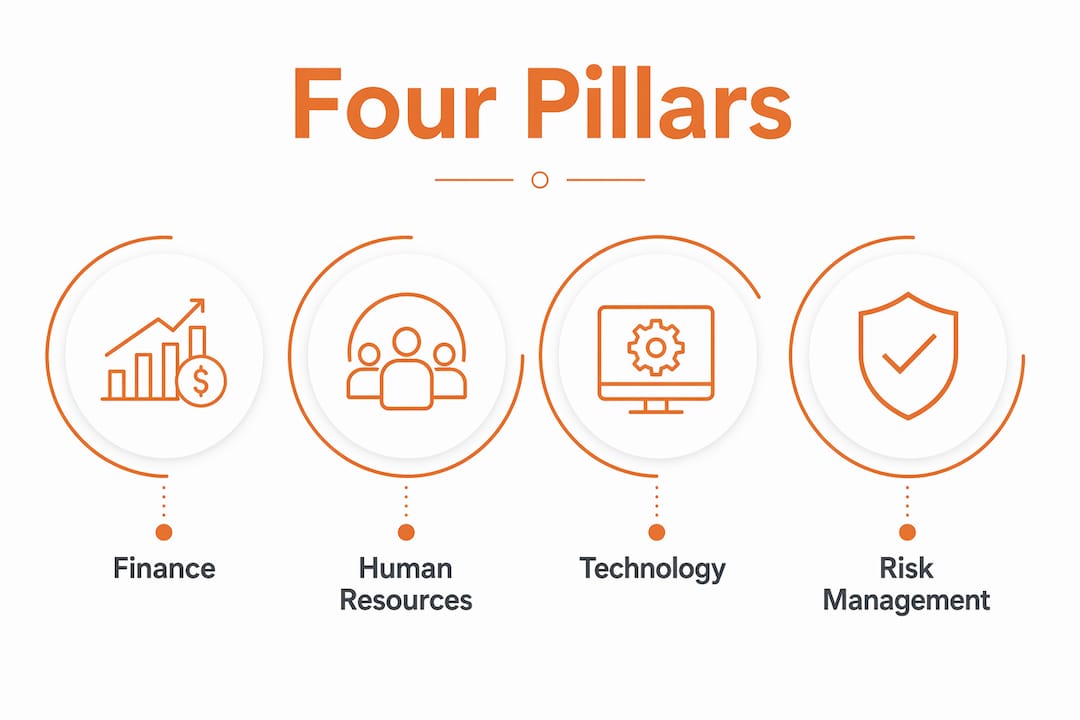
How do the four pillars shape construction operations consulting?
Construction operational consulting does not succeed by fixing one function. It succeeds by connecting all four pillars into a working system. Here is how each pillar contributes and where the critical gaps typically appear.
| Pillar | Core Focus | Common Gap |
|---|---|---|
| Finance | Job costing, cash flow, overhead recovery, profitability analysis | WIP schedules that misrepresent project health |
| Human Resources | Workforce alignment, safety, training, performance management | No clear accountability structure for field supervisors |
| Technology | Estimating, project management, accounting, and field system integration | Data that lives in disconnected tools and never reaches decision-makers |
| Risk Management | Contract review, insurance, bonding, jobsite controls | Risk exposure buried in contract language that operations teams never read |
The finance pillar goes deeper than monthly P&L reports. Job costing accuracy, overhead recovery rates, and cash flow timing directly affect whether a project stays profitable as conditions change. Operational consultants work with your accounting team to build reporting that project managers can actually use in the field, not just reports that satisfy year-end audits.
Technology integration is where many mid-sized contractors lose the most ground. Estimating tools, project management platforms, and accounting software often operate independently, creating data gaps that cost time and money. Operational consulting evaluates how these systems connect and where automation can replace manual data entry. Rconstructionsolutions uses AI-driven estimating tools as part of this technology alignment work, giving clients faster and more accurate bid preparation.
Pro Tip: Before investing in new software, map your current data flow from field to office. Identify where information gets re-entered manually or where it simply stops moving. That map will tell you whether you need a new tool or better integration between the tools you already have.
What role do audit-style reviews play in construction operational consulting?
A construction operations audit is a structured review of financial records, contracts, work-in-progress schedules, and management controls to identify inefficiencies, compliance gaps, and cost risks. Audits are not just a year-end accounting exercise. In operational consulting, they function as diagnostic tools that reveal root causes of schedule and cost problems that standard project reviews miss.
Construction audits occur at three stages:
- Pre-construction: Reviews contract terms, bonding requirements, insurance coverage, and project budget assumptions before work begins. This stage catches risk exposures before they become claims.
- During construction: Monitors WIP accuracy, change order documentation, subcontractor compliance, and cash flow against projections. This is where operational consultants identify drift between planned and actual performance.
- Post-construction: Evaluates final costs against estimates, documents lessons learned, and identifies process improvements for future projects.
The value of audit-driven reviews within an operational consulting engagement is that they surface cost and control breakdowns that schedule-only reviews never reach. A project can appear on track by schedule while carrying significant financial risk in its WIP schedule or subcontractor billing. Integrating audit findings into your operational improvement plan connects financial health to execution quality.
Here is what audit findings typically reveal in mid-sized construction firms:
- Overhead costs allocated inconsistently across projects, distorting job profitability
- Change orders processed late or incompletely, eroding margin on otherwise well-run jobs
- Subcontractor invoices approved without matching to contract scope or completion milestones
- Insurance and bonding gaps that expose the firm to claims not covered by existing policies
Each of these findings becomes an input to the operational improvement plan. The goal is not to produce an audit report that sits in a drawer. It is to translate findings into specific process changes, system updates, or accountability structures that prevent the same problems from recurring. For a deeper look at how process improvement connects to audit findings, Rconstructionsolutions has documented this approach across multiple contractor engagements.
How does construction operational consulting benefit your business in practice?
The practical benefits of construction project consulting services show up in three areas: schedule reliability, financial performance, and scalability. Here is how each plays out for contractors who commit to the work.
-
Improved schedule adherence. When LPS and lookahead planning replace top-down scheduling, teams stop waiting for problems to arrive and start removing them in advance. Constraint identification at the 4 to 6 week horizon gives procurement, subcontractors, and field supervisors enough lead time to act. The result is fewer last-minute scrambles and more predictable project delivery.
-
Stronger financial controls. Operational consulting aligns job costing with field reporting so that project managers see accurate cost data in real time, not three weeks after the fact. This allows course corrections before overruns become unrecoverable. Firms that build this discipline into their operations protect margin on every project, not just the ones that go smoothly.
-
Scalability without chaos. Cross-functional coordination mechanisms and clearly defined roles across project phases are what allow a contractor to grow from managing two projects to managing ten without losing control. The operating model that works at $5 million in revenue needs to be deliberately redesigned to work at $20 million. Operational consulting builds that redesign into a structured process rather than leaving it to chance.
-
Reduced risk exposure. Contract review, insurance alignment, and jobsite control protocols built into the operating model reduce the frequency and severity of claims. Risk management is not a separate function. It is embedded into how projects are set up and monitored from day one.
-
Sustained operational readiness. Operations consulting must stay engaged through project phases to keep operating models valid as complexity grows. A one-time consulting engagement that produces a binder of SOPs rarely delivers lasting change. The firms that see the biggest gains treat operational consulting as an ongoing discipline, not a one-time fix.
Pro Tip: Align your leadership team around two or three operational KPIs before engaging a consultant. PPC, overhead recovery rate, and cash flow days outstanding are a strong starting set. Shared metrics create shared accountability, which is the foundation any consulting engagement builds on.
Key takeaways
Construction operational consulting works because it addresses the full system of project delivery, not just isolated functions, using frameworks like LPS, audit integration, and cross-functional pillar alignment to produce measurable and sustained results.
| Point | Details |
|---|---|
| Cross-functional scope | Operational consulting connects finance, HR, technology, and risk management into one working system. |
| Last Planner System | LPS raises schedule reliability from 50 to 60 percent to 75 to 85 percent through commitment-based planning. |
| Audit integration | Construction audits reveal cost and control gaps that schedule-only reviews consistently miss. |
| Scalability focus | Operating models must be redesigned deliberately as project volume and complexity grow. |
| Continuous engagement | One-time consulting rarely holds. Sustained engagement keeps operating assumptions valid under real project pressure. |
Why living operating models beat static plans every time
I have worked with contractors who had excellent SOPs, well-designed org charts, and detailed project templates. And I have watched those same contractors struggle through project after project because the documents sat in a shared drive while the actual decisions got made in hallway conversations and reactive phone calls.
The hardest lesson I have seen construction leaders learn is that governance and accountability under pressure matter far more than the quality of any written plan. When a subcontractor walks off a job or a material delivery fails, the operating model that actually runs your business is the one that lives in your people’s habits and decision-making instincts. Not the one in the binder.
This is why I push every client to treat operational consulting as a culture-building exercise, not a documentation project. The metrics matter. PPC tracking, overhead recovery, and cash flow reporting are not bureaucratic overhead. They are the feedback loops that tell you whether your operating model is actually working or just looking good on paper.
The emerging role of digital tools, including AI-driven estimating and integrated project management platforms, gives contractors real-time visibility that was not available even five years ago. But technology only amplifies the operating model you already have. If your coordination mechanisms are weak, better software will just surface your problems faster. Fix the model first, then use technology to scale what works.
My advice: find a consultant who will sit in your project meetings, review your actual job cost reports, and challenge your field supervisors on their constraint lists. That is where the real work happens. The construction consulting services that produce lasting results are the ones built on that kind of hands-on engagement.
— Rowena
How Rconstructionsolutions supports your operational consulting needs
Rconstructionsolutions delivers construction operational consulting grounded in over 30 years of hands-on industry experience. The team works directly with residential and commercial contractors to build operating models that connect finance, HR, technology, and risk management into a system that holds up under real project conditions.
Whether you need a full operational consulting engagement or targeted support in a specific pillar, Rconstructionsolutions tailors every engagement to your firm’s size, project mix, and growth goals. Contractors scaling toward $50 million in revenue will find practical frameworks, audit-ready financial controls, and lean construction tools in The Sandbox, a resource hub built specifically for contractors who want to implement these systems without starting from scratch. Contact Rconstructionsolutions to discuss where your operations need the most attention.
FAQ
What is construction operational consulting?
Construction operational consulting is the practice of aligning finance, human resources, technology, and risk management into coordinated systems that support reliable and profitable project delivery. It translates business strategy into practical operating models for construction firms.
What does a construction operations audit involve?
A construction operations audit reviews contracts, financial records, WIP schedules, and management controls at pre-construction, during construction, and post-construction stages to identify inefficiencies, compliance gaps, and cost risks that affect schedule and profitability.
How does the Last Planner System improve operational efficiency?
The Last Planner System replaces top-down scheduling with weekly commitments from foremen and trades, supported by lookahead planning and PPC tracking. This approach raises schedule reliability from roughly 50 to 60 percent to 75 to 85 percent.
What are the main benefits of construction consulting for business owners?
The primary benefits include improved schedule adherence, stronger financial controls through real-time job costing, reduced risk exposure from contract and insurance alignment, and a scalable operating model that supports growth without losing operational control.
How is construction operational consulting different from standard project management?
Standard project management focuses on delivering a specific project on time and on budget. Construction operational consulting focuses on building the firm-wide systems, processes, and accountability structures that make reliable delivery repeatable across every project.