Cut RFI Cycle Time 2–3 Days: RFI Management Process for Contractors
An effective RFI management process runs on one central log where every request has a named owner, a hard deadline, and a documented answer before it closes. The single fastest fix most teams can make is pairing that centralized log with ball-in-court ownership and enforced response windows. This article walks through the full lifecycle, roles, templates, common breakdowns, and the cadence that keeps RFIs from quietly eating your schedule.
TL;DR:
- Centralized log and clear ownership reduce RFI cycle times and prevent unanswered requests from accumulating beyond the contract window.
- An effective RFI template must include specific references, a clear question, a proposed solution, and a realistic response deadline to speed up answers.
- Routing RFIs through a single intake point and enforcing response deadlines ensures timely answers and prevents log breakdowns.
- Pilot programs using strict template, routing, and KPI tracking protocols lead to faster, more reliable RFI responses and better schedule control.
Table of Contents
- What Counts as an RFI in the RFI Management Process?
- The Step-by-Step RFI Lifecycle From Draft to Close
- Who Owns Each Step of the RFI Process?
- What Should an RFI Template Actually Include?
- Why Do RFI Workflows Break Down So Often?
- Best Practices That Actually Cut RFI Cycle Time
- What Should You Demand From RFI Management Software?
- Rolling Out RFI Discipline Without Disrupting an Active Job
- RFI Discipline Is a Margin Protection Lever, Not Paperwork
- Get Hands-On Help Implementing Your RFI Workflow
- Sources
- FAQ
What Counts as an RFI in the RFI Management Process?
A Request for Information, or RFI, is a formal question raised when construction documents contain a conflict, an omission, or an ambiguity that field crews cannot resolve on their own. It exists to get a documented answer from the design team or owner before work proceeds, not to serve as a catch-all for every field decision.
That boundary matters more than most contractors treat it. A submittal requests approval of a product, material, or shop drawing already specified. An Architect’s Supplemental Instruction (ASI) is the design team pushing a clarification outward, the reverse direction of an RFI. A change order addresses scope or cost, not clarity. Mixing these into one channel is how logs balloon with noise and real questions get buried.
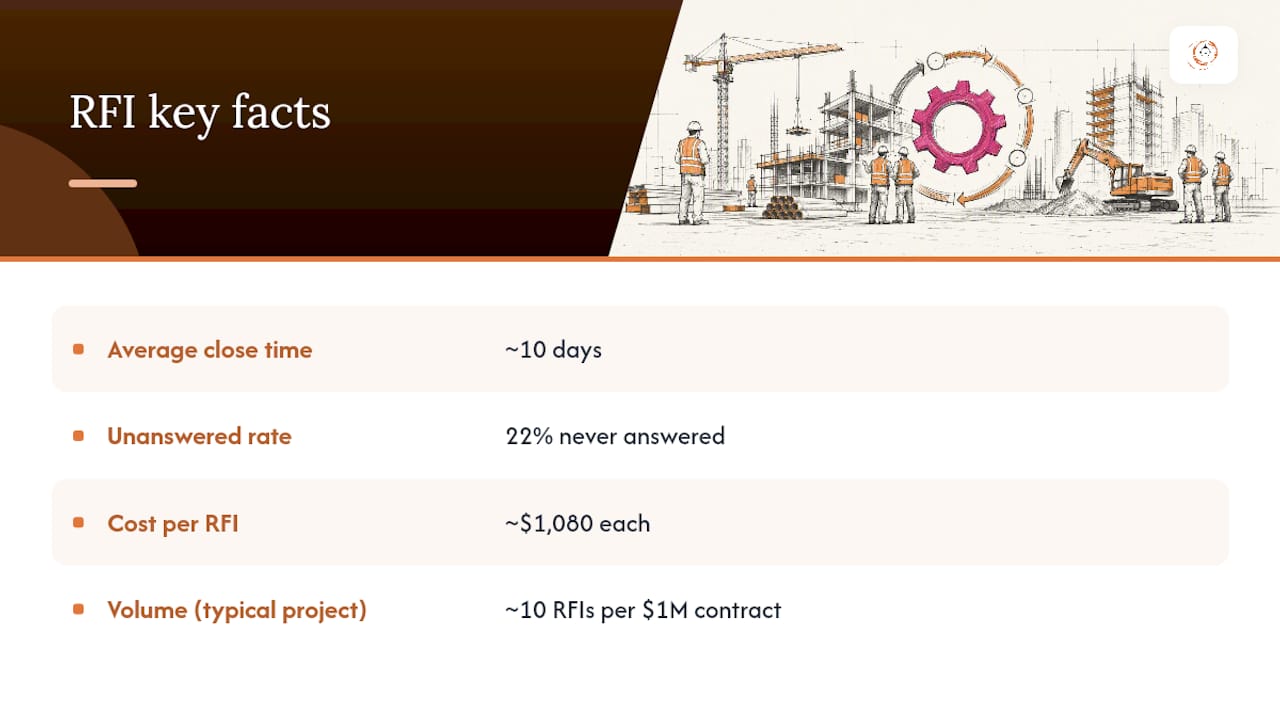
The stakes are real. RFIs take close to 10 days to close on average, and roughly 22% never get a response at all. Each one costs approximately $1,080 once you factor in coordination time and the schedule ripple it creates. On a typical project, that volume adds up fast, since most jobs generate about 10 RFIs per $1 million of contract value.
The Step-by-Step RFI Lifecycle From Draft to Close
A disciplined RFI process management workflow follows six stages, and skipping any one of them is usually where projects lose weeks.
- Identify the issue in the field. The superintendent or foreman screens the question first: is this really unanswerable from existing documents, or has someone just not looked closely enough? Apply the single-subject rule here. One RFI, one issue. Bundling three unrelated questions into one submission guarantees a partial answer or a stalled one.
- Draft the RFI with complete required fields. Every submission needs a clear question, the specific drawing or spec section it references, a suggested resolution, a needed-by date, and any supporting photos or sketches attached.
- Submit through a single intake point. Route every RFI to one address or one platform entry point, never to an individual’s personal inbox. This is the step most logs quietly fail at.
- Route for review. The project engineer or PM logs it, assigns “ball-in-court” ownership to whoever must answer next, and forwards it to the architect, engineer, or owner as required.
- Answer and distribute. The response gets logged with a date, then pushed out to every subcontractor and field lead who needs it, not just the person who asked. Undistributed answers are functionally useless.
- Verify closure. An RFI closes only after the answer has been confirmed as received, understood, and incorporated into the work, with a documented sign-off.
Standardized templates, clear routing, ball-in-court ownership, and enforced deadlines are the operational controls that actually reduce cycle time, not just good intentions written into a project manual.
Who Owns Each Step of the RFI Process?
Ambiguous ownership is the number one reason RFIs age past two weeks. Every project needs a clear role map before the first RFI gets submitted, not after the third one stalls.
- Subcontractors and field crews identify the issue and draft the initial question with supporting detail.
- Project engineers log the RFI, verify it meets template standards, and assign the first ball-in-court owner.
- Project managers monitor aging, escalate stalled items, and confirm the response gets distributed.
- Architects and engineers answer within the contractual window and flag cost or schedule impact when it applies.
- Contracts administrators track formal notice requirements tied to schedule impact claims.
Closure authority should sit with the general contractor’s PM, not the architect and not the subcontractor. The GC is the party accountable for schedule and coordination across every trade, so the GC is the party who confirms an answer actually resolves the field condition. Escalation should trigger automatically: unanswered at 3 business days gets a reminder, unanswered at 7 gets escalated to the PM and design principal, unanswered at 10 gets flagged in the next owner-architect-contractor (OAC) meeting. Structured logs with these origination, routing, and escalation fields are exactly what industry guidance from CMAA and AIA documentation recommends for both day-to-day management and later dispute documentation.
What Should an RFI Template Actually Include?
A complete RFI template forces the submitter to do the thinking before it lands in someone’s queue, which is exactly why it gets answered faster.
- RFI number and project reference, following a consistent naming convention so nothing gets duplicated or lost.
- Drawing and spec section reference, pinned to the exact sheet number and detail callout, not a general area description.
- Clear, single-subject question, written so a stranger to the project could understand the conflict without a phone call.
- Proposed solution, even a rough one. Submitters who suggest a fix get answered materially faster than those who just flag a problem.
- Needed-by date, tied to the actual field schedule impact, not a generic default.
- Supporting attachments: photos, sketches, or marked-up drawings.
Pro Tip: Before submitting, search the log for similar questions on the same drawing sheet. Duplicate RFIs are one of the most common ways logs balloon past the point of being useful.
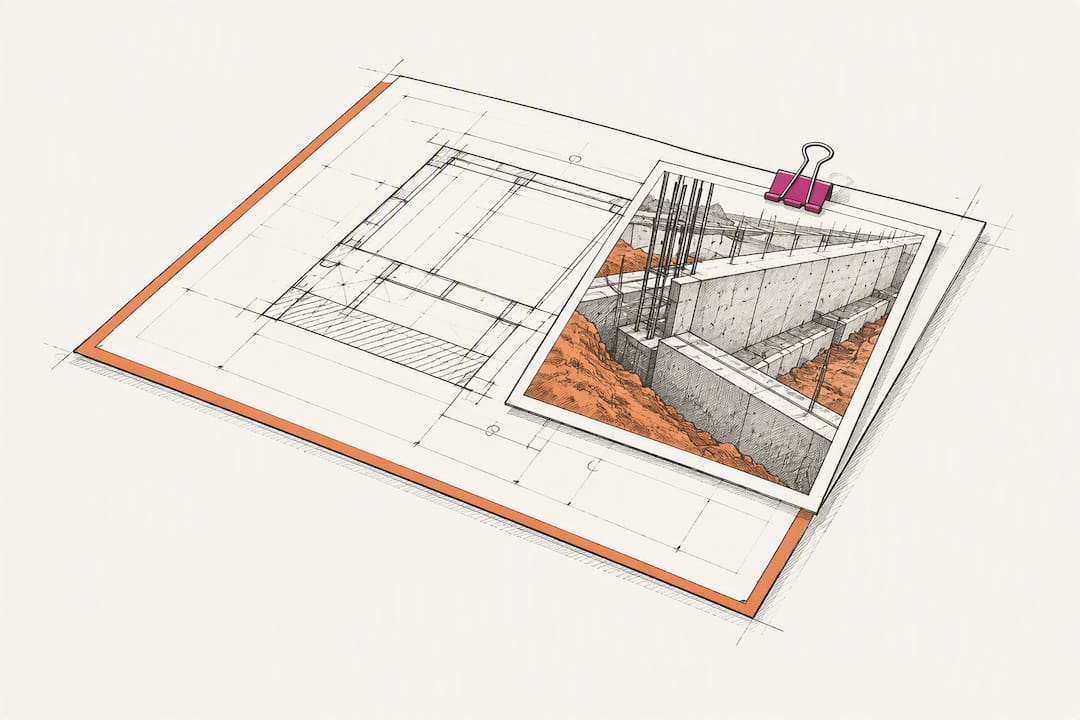
Pinning the RFI to the drawing set with photos attached cuts ambiguity and can roughly halve response time compared with a text-only description.
Why Do RFI Workflows Break Down So Often?
Most failure modes trace back to the same handful of causes, and each one has a specific, fixable operational answer.
- Routing errors. RFIs sent to individual inboxes instead of one intake address get lost when someone is on vacation or changes roles. Fix it with a single centralized submission point, no exceptions.
- Vague questions with no proposed solution. These generate a back-and-forth that adds days. Fix it by enforcing the proposed-solution field as mandatory, not optional.
- Lost context between systems. An RFI answered in email but never logged in the tracking platform means the field never sees the resolution. Fix it by requiring every response to route back through the same system it originated in, with distribution confirmed before closure.
- Aging items nobody tracks. RFIs sit for weeks because no one reviews the log regularly. Fix it with a standing weekly aging report reviewed in the OAC meeting.
Best Practices That Actually Cut RFI Cycle Time
The operational habits that shrink RFI turnaround aren’t complicated. They just require enforcement, not aspiration.
- Run a daily triage meeting. A 10 to 15 minute stand-up where the PM and PE review new and pending RFIs keeps submissions from batching up and falling behind the field schedule.
- Set contractual response windows in writing. Most subcontracts should specify a firm response window (commonly 5 to 10 business days depending on complexity), with escalation language that triggers automatically once that window closes.
- Conduct constructability reviews in preconstruction. Catching conflicts before mobilization prevents a meaningful share of RFIs from ever needing to be written.
- Track and report KPIs weekly. Average days open and percentage overdue, reported at every OAC meeting, changes reviewer behavior measurably because nobody wants their name attached to the oldest item on the list.
Given that the average RFI takes close to 10 days to close and costs roughly $1,080 in coordination and schedule impact, shaving even two or three days off that average across a hundred-RFI project adds up to real money and real float protected on the schedule.
What Should You Demand From RFI Management Software?
You don’t need to compare vendor feature lists line by line. You need to know which capabilities actually reduce friction and refuse to adopt anything that skips them.
- A single centralized log that every party, including subcontractors, can access without a separate login for each firm.
- Pin-to-drawing functionality that ties the RFI directly to the sheet and detail, not a free-text description.
- Ball-in-court tracking that shows, at a glance, exactly who owes the next response.
- Aging alerts that flag items automatically at defined thresholds, so escalation doesn’t depend on someone remembering to check.
- Automatic distribution on close, pushing the answer to every affected trade the moment it’s logged.
- Integration with the drawing set, schedule, and daily field logs, so an RFI answer updates the model or schedule instead of living in isolation.
- Duplicate and similar-request detection, flagging when a new submission overlaps with one already in the queue.
Training subcontractors on the template and platform at project kickoff, rather than after the first bounced RFI, significantly improves first-pass acceptance and cuts the back-and-forth that eats PE time.
Rolling Out RFI Discipline Without Disrupting an Active Job
Some consulting firms have guided growth-stage contractors through this kind of workflow change using a 30/60/90 pilot approach rather than a company-wide mandate on day one. Pick one active project, set baseline KPIs (average days open, percent overdue) in the first 30 days, then enforce the template and routing rules strictly for 60 days before rolling to a second project. Train subs at kickoff, not after their first rejected RFI. Report the improved metrics at every OAC meeting during the pilot. Teams that follow this sequence typically see faster response times and fewer aging items within one project cycle, giving leadership real numbers before asking every crew to change habits.
RFI Discipline Is a Margin Protection Lever, Not Paperwork
Most contractors treat RFI logs as administrative overhead until a dispute forces them to reconstruct a timeline from scattered emails. That’s backwards. A clean log with ball-in-court ownership is cheaper insurance than any change order negotiation, and it costs almost nothing to maintain once the habit sticks.
The real obstacle isn’t the template. It’s getting field crews and subs to submit through one channel consistently, especially on projects where old habits (a text to the super, a hallway conversation with the architect) feel faster in the moment. They aren’t faster. They just hide the cost until it shows up as a schedule slip nobody can explain.
— Rowena Tulacz
Get Hands-On Help Implementing Your RFI Workflow
Reading about a disciplined RFI process and actually enforcing one across active crews, subcontractors, and design teams are two different problems. Certain consulting firms work directly with growth-stage contractors to close that gap, bringing extensive operations and business development experience to the workflow and process improvement side of the business, not the trade work itself.

Our process improvement and workflow optimization engagements typically follow the same pilot approach outlined above: baseline the current RFI aging on one active project, standardize the template and routing rules, then hand off KPI reporting so your PMs can run it independently. We also support the project management system implementation work that makes centralized logs and ball-in-court tracking possible in the first place, whether that means configuring Procore, Buildertrend, or another platform your team already owns. If schedule float and RFI turnaround are quietly costing you margin on every job, start with a conversation about our Construction Consulting Services and we’ll walk through what a pilot looks like for your current project load.
Sources
- Why RFI Management in Construction Breaks Down (And How to Fix It in 2026) - Constructable Blog
- RFI Management (How To Fix Before It Breaks the Schedule) | Datagrid
- Construction RFI Management: Stop the #1 Cause of Project Delays | Softabase
- Impact & Control of RFIs on Construction Projects — CMAA
FAQ
What Is an RFI Process?
An RFI process is the structured workflow a project uses to raise, route, answer, and close formal questions about conflicts or ambiguities in construction documents. It runs through a centralized log with assigned ownership at every step, from field identification through verified closure.
Can an RFI Be Rejected?
Yes. An architect or engineer can return an RFI as invalid if it duplicates an existing entry, is already answered in the contract documents, or lacks the drawing reference and detail needed to respond. That’s exactly why pre-submission checks against the existing log matter.
How Long Should an RFI Take?
Most RFIs take close to 10 days to close on average, though well-written contracts typically set a firm response window between 5 and 10 business days depending on complexity. Anything sitting open longer than that window should trigger automatic escalation.
What Is the RFI Checklist?
A complete RFI checklist covers the RFI number, drawing and spec reference, a single clear question, a proposed solution, a needed-by date, and supporting photos or sketches. Skipping the proposed-solution field is one of the most common reasons an RFI takes longer than it should to answer.
Recommended
- From Chaos to Coordination: Process Improvement for Construction
- How Process Improvement Drives Success in Construction: Practical Steps for Contractors
Running the job and the business at the same time? One short email a week — change orders, billing, job costing, scheduling. Free, no pitch. Subscribe.
Free and unconditional. No call required, no obligation, unsubscribe anytime.

